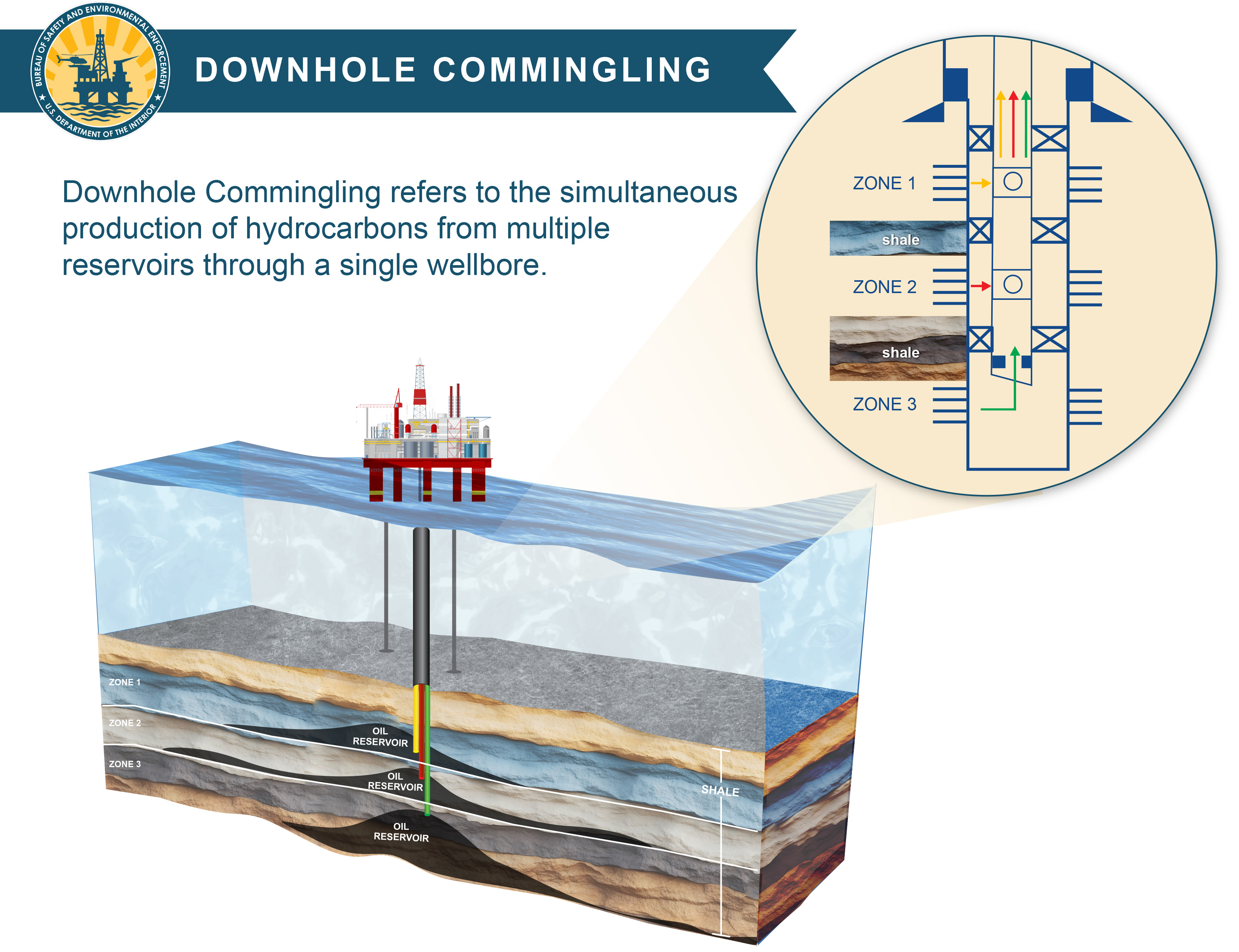
The “One Big Beautiful Bill Act of 2025” (OBBB), Public Law 119-21, which was signed into law on July 4, 2025, includes a significant offshore production directive (section 50102) that has received little public attention:
“The Secretary of the Interior shall approve a request of an operator to commingle oil or gas production from multiple reservoirs within a single wellbore completed on the outer Continental Shelf in the Gulf of America Region unless the Secretary of the Interior determines that conclusive evidence establishes that the commingling—(1) could not be conducted by the operator in a safe manner; or (2) would result in an ultimate recovery from the applicable reservoirs to be reduced in comparison to the expected recovery of those reservoirs if they had not been commingled.”
This is, to the best of my knowledge, the first time in the history of the OCS oil and gas program that Congress has directed the safety regulator to approve well completion practices that could increase safety, environmental, and resource conservation risks.
Rather than calling for the operator to demonstrate that a downhole commingling plan is safe and optimizes resource recovery, the plan must be approved unless BSEE proves conclusively that the operation could not be conducted safely or that resource recovery would be reduced. This is the antithesis of the operator responsibility doctrine, a fundamental principle of the OCS regulatory program, and safety management principles that call for the operator to demonstrate that safety, environmental, and resource conservation risks have been effectively addressed.
Only 40 days after the OBBB was signed, BSEE published a direct final rule implementing the downhole commingling directive. This is warp speed for promulgating a Federal regulation! In keeping with the rush to finalize the rule, the preamble asserts that “notice and comment are unnecessary because this rule is noncontroversial; of a minor, technical nature; and is unlikely to receive any significant adverse comments.”
I intend to submit comments prior to the Sept. 12 deadline. These comments will assert that the rule does not qualify for an exemption from the Administrative Procedures Act’s public review and comment requirement. I will also recommend that BSEE consider hosting a public forum during the comment period to present their research on downhole commingling and discuss the risk mitigations.
Below are some of the issues/questions that should be considered during the public comment period:
- BSEE’s own fact sheet acknowledges the well-known pressure differential, crossflow, and fluid compatibility risks associated with downhole commingling. The public should have the opportunity to provide input on the extent to which “intelligent completions” and other production technology are effective in mitigating these risks.
- The industry-funded Univ. of Texas (UT) study, which led to a relaxation of downhole commingling restrictions, was specific to the “unique Paleogene Gulf of Mexico fields.” Does BSEE have evidence that supports the applicability of the study to other fields?
- The authors of the UT study acknowledged that their findings were based on a “simple but reasonable geological base case model.” They also acknowledged the need for “a more comprehensive study using advanced geological models to explore additional geological features.” What are BSEE’s plans for additional research?
- Should an independent assessment of Gulf of America downhole commingling safety and resource recovery risks be conducted before finalizing a rule that essentially mandates approval of all applications?
- BSEE’s April 2025 policy change raised the allowable pressure differential for commingling production in Paleogene (Wilcox) reservoirs from 200 psi to 1500 psi. Unlike the policy update, the new rule includes no boundaries whatsoever.
- What criteria will BSEE use in determining that there is “conclusive evidence” that a commingling request would be unsafe or would reduce ultimate resource recovery? Will BSEE disapprove any requests outside the parameters in the current policy guidance or subsequent updates?
There are many more issues that remain to be discussed, which is why the downhole commingling rule should be published in draft form, with a comment period of at least 90 days.
 Bud's Offshore Energy (BOE)