April 6, 2010 by offshoreenergy
The hearings resume tomorrow. Catching up on what I missed:
- I’d like to have a dollar for each time one of the witnesses said “in hindsight.” I guess saying “in hindsight” is a way of acknowledging that you were wrong without admitting you made a mistake. After all, how could anyone have known that a float leak wouldn’t cure itself, that an underbalanced well would start to flow, that oil and gas might pass through the channels in the shoe, that well barrier requirements have a real purpose (beside challenging your cost-cutting creativity), and that gas bubbles might be actually be a reason for concern? When you do a proper risk assessment, you consider all of the future possibilities and how decisions made in the present could affect the outcomes. You are thus taking advantage of hindsight BEFORE an accident occurs.
- The “Not My Job” attitude seemed to be prevalent at Montara. Did the famous Arizona highway worker use the “in hindsight” defense? (In hindsight, I should have removed the dead armadillo before striping the highway.)
- I guess I’m slow, because it took me until Day 12 (more than 1000 pages of transcripts) to realize that the mudline suspensions were not really mudline suspensions, but that the wells were hung from the jacket (just above the splash zone?). The tops of the wells during the suspension of operations were thus in a highly corrosive environment, so the damage to the unprotected 13 3/8″ casing threads is not surprising.
- I’m still scratching my head about that “shudder” that was felt on the platform the night before the blowout (see Tom Maunder’s comments below). Was there a seismic event? I checked the USGS records and didn’t see anything for that area and time. Apparently PTTEP checked with the Australian government. Is the seismic grid sufficient to detect small quakes in that portion of the Timor Sea?
- So now we know that the integrity of 3 of the 5 Montara wells was compromised. Gas bubbles were observed in the annulus of the G-1 and there were significant cementing issues with the H-2.
- None of the PCC’s were pressure tested in situ. I’m still waiting for a tutorial on how that is done. Would the 9 5/8″ PCC have been pressure tested against the casing? If so, perhaps that test would have identified the channels in the casing shoe?
Posted in accidents, well control incidents | Tagged accidents, Australia, blowouts, drilling, Montara, offshore oil, safety, well control | Leave a Comment »
April 5, 2010 by offshoreenergy
Mr Mueller likens the role of cementers in well construction to that of cornerbacks in football: “When we fall down and someone passes for a touchdown, everyone sees it. … When there’s a failure (in cementing), it’s typically quite noticeable and costly, even catastrophic. … You have to always ask yourself, ‘What haven’t I thought about? What can go wrong? If it does go wrong, how can we fix it?’ ”
In the wake of Montara, I recommend that you read an excellent article in the latest edition of Drilling Contractor magazine about Dan Mueller, a cementing specialist for ConocoPhillips. Having read hundreds of pages about the cementing issues that appear to be the root-cause of the Montara blowout, it was refreshing to see Mr. Mueller’s comments and learn more about his company’s commitment to safe and effective cementing operations. While incidents like Montara rightfully attract much of our attention, most companies understand the importance of cementing and provide the resources necessary to ensure success. As the article reminds us:
The high stakes at play – plus the increasingly hostile conditions under which wells are drilled today – means that preplanning on a well-by-well basis is crucial. Thermal modeling, wellbore stress modeling, hydraulics modeling, computational dynamics modeling – everything that can be done has to be done to make sure nothing gets overlooked. In today’s complex wells, Mr Mueller explained, anything that’s an “unknown” has the potential to damage the cement’s effectiveness.
Posted in accidents, drilling, Offshore Energy - General | Tagged cementing, ConocoPhillips, Dan Mueller, drilling, Drilling Contractor, offshore oil, safety, well control | Leave a Comment »
April 3, 2010 by offshoreenergy

Like offshore oil and gas development, wind turbine projects have safety, structural, and operational issues that require careful consideration by operators, contractors, suppliers, and regulators. The National Academies Marine Board recently held a workshop to address these issues. Of particular interest was a presentation by Dr. Malcolm Sharples that addresses some of the challenges faced by offshore wind energy developers.
Posted in Offshore Wind, Wind Energy | Tagged Malcolm Sharples, Marine Board, Offshore Wind, safety, Wind Energy | Leave a Comment »
April 2, 2010 by offshoreenergy
There is a small cadre of experienced oil and gas professionals who have been following the Montara transcripts religiously, and I have received a number of email messages about the testimony. Pasted below is a message from Tom Maunder, a well engineer working in Alaska. Tom has extensive industry and regulatory experience, and actually lived on the Alexander Kielland while working offshore Norway.
I have highlighted a couple of Tom’s observations in bold. Like the Montara Commission, I had largely dismissed the possibility that a seismic event was a contributing factor to the blowout. Also, I don’t think the Commission has sufficiently considered the effect of the horizontal well section on the delayed gas migration and flow following the removal of the corrosion cap.
Based on the statements regarding GOC and OWC, it appears that the reservoir is saturated and stratified with a gas cap over oil over water as would be expected. What went unstated is that at reservoir conditions, the oil contains some amount of solution gas. Based on the testimony, it seems clear that any cement inside the bottom of the casing was contaminated with sea water and likely oil based on where the shoe was set. Some amount of seal probably was established by holding pressure to allow the cement to set. Although the plugs were bumped, the float failure and subsequent “check” allowed cement and oil to be let into the casing and that also resulted in lifting at least the top plug some distance up into the casing. It is possible that this lifting reversed the fins essentially making the top plug worthless as a separating device for the cement and sea water displacement fluid. This would seem to be supported since the testimony indicates that it was not possible to rebump the plug. There is much discussion regarding the pore pressure and displacement weights or EMW. I believe the seawater did not have sufficient weight to counter the formation pressure. If ther was any overbalance it was very slight. In either Seadrill’s or PTTEP’s submissions and in recent testimony the possibility of some seismic event is considered and then dismissed. Based on reported experiences in Cook Inlet Alaska, I believe the “event” was real and it was likely whatever cement seal that had been formed at the bottom of the casing finally failing. There have been a couple of deep production casing failures on wells drilled from Cook Inlet platforms. In each case, the people on the platform reported feeling a “jolt”. It is not unlike shooting drill pipe conveyed perforating guns. There is also testimony regarding the “time delay” between removing the 9-5/8” PCC to the initial burp and then the final unloading. I don’t think any one is considering the horizontal portion of the well. Movement along that section would be significantly different and likely much slower than movement in the more vertical portion of the wellbore. With little vertical depth change the evolution of solution gas as the pressure drops would be slower in the horizontal section. I remember that well control school problems were changed to incorporate separate calculations for the horizontal versus vertical sections since the pressure change per time or volume in the horizontal section would be much, much smaller than in the vertical.
Posted in accidents, well control incidents | Tagged accidents, Australia, blowouts, drilling, Montara, offshore oil, safety, well control | Leave a Comment »
March 31, 2010 by offshoreenergy

Offshore Energy Awakening?
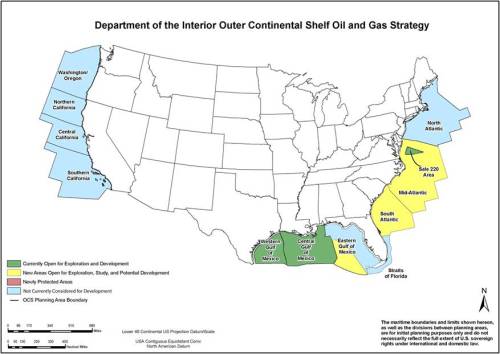
When you wake up after a long nap (in this case 25 years), you don’t just leap out of bed. You first squint at the light, yawn, flex an arm, stretch your legs, and prepare to rise and actually do something. The President’s decision to open a small slice of the Atlantic to exploration and consider new areas in the Atlantic and Eastern Gulf of Mexico in the new 5- Year Program may seem modest, but it demonstrates that the nation is waking up to the importance of our offshore energy resources. After 25 years of neglect, almost everyone agrees that US energy policy has been an economic and national security disaster. More and more Americans are also recognizing that denying access to offshore resources is not in the best interest of the environment – regionally, nationally, and globally.
Some political leaders remain in dreamland as evidenced by the large blue areas in the map below. When you have cried “wolf” about offshore drilling for your entire political career, you either believe what you have been preaching or are concerned about the political implications of changing your position. However, demonizing offshore energy development is no longer a smart political strategy, and the views of these anti-energy stalwarts may finally be challenged, even in their own states and districts.
We operations, safety, pollution prevention, and regulatory professionals have to hold up our end. Safety disasters or pollution spectaculars are not acceptable. We need to examine our programs, operations, and incidents openly and honestly, and anticipate what might go wrong. When an accident occurs, we need to learn what happened and why, and make sure it doesn’t happen again – anywhere in the world.
Posted in drilling, energy, gas, Offshore Energy - General, oil | Tagged drilling, energy, offshore oil, oil and gas leasing | Leave a Comment »
March 31, 2010 by offshoreenergy
BOE has returned in time for an interesting day of testimony by Mr. Duncan, PTTEP’s well construction manager. Tom Howe, Commission attorney, was in fine form (as usual) and took Mr. Duncan to task for the root-cause cementing and barrier decisions, and PTTEP’s seeming reluctance to accept responsibility. When told that MMS requires 2 tested barriers, Duncan tried to equate the brief period when BOPE is removed (after cementing) to install a new wellhead section with leaving a well suspended for months without a legitimate barrier. He continues to claim claim that PTTEP had a tested and verified barrier in the annulus despite the cement miscalculation and the absence of any log or test to verify the top of the cement.
Random thoughts while reading the testimony:
- Are mud line suspensions acceptable, if (as was the case at Montara) there is no means of monitoring casing pressures during the suspensions?
- Kudos to Advanced Well Technologies, a completion contractor that told PTTEP (prior to the blowout) they were taking undue risks to save money, and stopped working for the company. Why hire experts, if you don’t intend to listen to them? PTTEP seemed intent on cutting costs without assessing the risks.
- Where is the independent review that was prepared for PTTEP’s parent company and why hasn’t it been provided to the Commission?
Of particular interest to BOE are the philosophical questions raised by the quotes below:
Q. Howe: What about sending a request to the regulator in the middle of an afternoon on a Friday, asking for approval to substitute PCCs for a cement plug to enable you to get cracking doing that the very next day and the day after, that is, over the succeeding weekend – do you think that that signifies at all the fact that things were being done on the run, you were getting around to doing things belatedly and barely staying on top of things?
A. Duncan: That particular event, to an extent, yes.
If you are going to administer a command-and-control regulatory regime, you better be prepared to respond to frequent requests for program deviations, and you better be able to say no. If you are a regulator, you are not part of the operating team and you shouldn’t think of yourself as such. Absent compelling justification, changes in fundamental safety measures should not be authorized. More philosophically, if you have to approve everything a company does, should that company be allowed to serve as an operator? Also, how much accountability does the regulator assume by approving these deviations?
BOE will summarize Days 8-12 during the Commission’s Easter break.
Posted in accidents, well control incidents | Tagged accidents, Australia, blowouts, drilling, Montara, offshore oil, safety, well control | Leave a Comment »
March 27, 2010 by offshoreenergy

Section from a brace that failed on the Alexander Kielland, Stavanger Oil Museum
Thirty years ago today, 123 workers died when the Alexander Kielland capsized in the Norwegian sector of the North Sea. The Kielland was a converted semisubmersible drilling rig that was functioning as a floating quarters facility in the Ekofisk field. The capsizing was triggered by a failure in one of the structural braces during a storm. 212 workers were aboard. More information on this tragedy can be found at the Stavanger Oil Museum site.
We join our friends and colleagues in Norway and throughout the world in remembering this tragedy. The best way to honor the dead is to make sure similar accidents don’t occur in the future, and that is our commitment.
Posted in Uncategorized | 2 Comments »
March 24, 2010 by offshoreenergy
Because of prior commitments and allegations of unfair labor practices by our overworked staff :), we regret that we must temporarily suspend coverage of the Montara hearings. We will resume coverage on 31 March, just in time for the Easter break that the Commission announced today. On well, at least we’ll have time to catch up on what we missed.
Thank you for the supportive email messages and calls.
Posted in Uncategorized | Leave a Comment »
March 23, 2010 by offshoreenergy
Q. (Mr. Howe): It’s really just the last entry that I want to ask you about, which seems to indicate that you made a comment to the effect that there were regular changes to the program during the first phase of drilling, most of which were just to save two to three minutes and cut corners. Do you see that?
A. (Mr. Horne, Atlas driller) Yes
Q. Do you recall providing that information to anyone?
A. Yes.
Q. Does that information that is attributed to you accurately record your views?
A. Yes.
Those comments by one of the rig’s drillers are consistent with the sense one gets in reading the submissions and testimony. Efficiency superseded caution:
- Don’t deviate from the “batch” approach to drilling and completing the wells even if events dictate that a change might be prudent.
- Don’t stop to pressure test the casing shoe even after there was evidence of channeling.
- Don’t weight-up the treated water prior to the suspending the well even if there were indications that its specific gravity was lower than needed to provide an overbalance.
- Use “barriers” that can be quickly installed and removed even if testing and safe installation/removal have not been fully considered.
- Only provide training that is required by the regulator – well control school.
Transcript
Posted in accidents, well control incidents | Tagged accidents, Australia, blowouts, drilling, Montara, offshore oil, safety, well control | Leave a Comment »
March 22, 2010 by offshoreenergy
Quote of the Day :):
MR WHYBROW: I hear what my friend says, and I do note that it seems that I’m the only person who is required not to try to put words into the witness’s mouth.
No major developments in today’s transcript. Comments and observations:
- The discussion of the 9 5/8″ casing cementing issues is a bit imbalanced in that most of the attention is on the reinjection of fluids after the influx that followed the casing pressure test. Very little attention has been paid to any evidence (positive or negative) of float valve closure after the cement had been pumped. Also, there has been almost no discussion about the timing of the casing pressure test. This test may have created or expanded the channels in the shoe. After the influx, it was probably a mistake to inject any fluids until the cement hardened. At that point, it would have made sense to pressure up and test the shoe.
- The hearings have drawn attention to the absence of well integrity, planning, and cementing elements in well control training programs. This should be a topic for discussion by WellCap and IWCF administrators, operators, and regulators.
- While fault-finding and fact-finding are certainly related, today’s sessions seemed skewed toward the former. We’ve read enough to know there were serious flaws in the management systems, and are not so concerned about individual guilt.
- The testimony indicated that oil-field units were converted to metric units after the drilling reports were written, and that these revisions were solely for the purpose of satisfying the “authorities.” US offshore regulators started down this path many years ago and reversed course after considering the safety implications. Perhaps there is a need for further international discussion about this topic.
- It was interesting to learn that a rig supervisor kept excerpts from drilling reports on a personal thumb drive. I wonder how the lawyers and IT security folks like that.
- It seems odd that Mr. Treasure, PTT’s senior drilling representative (albeit a contractor) on the rig when some critical decisions were made, did not get to review or provide any input to the PTT submission.
Posted in accidents, well control incidents | Tagged accidents, Australia, blowouts, drilling, Montara, offshore, offshore oil, safety, well control | Leave a Comment »
« Newer Posts - Older Posts »