Feeds:
Posts
Comments

Archive for the ‘Offshore Energy – General’ Category

President-elect Dilma joked recently that the oil discoveries were just the latest proof that God is Brazilian. And economists from Goldman Sachs no less are predicting that Brazil — along with Russia, China and India — will dominate the world economy in the 21st century.

If you didn’t see the 60 Minutes story on Brazil, you can view it here. With regard to the significance of Brazil’s recent deepwater discoveries, OGX owner Eike Batista offered the following:

Oh, it, it means we should be producing in excess of six million barrels a day. So it’ll put us in among the third, fourth largest producer in the world. Massive exporting.

According to this blog entry, Batista forecasts this 6 million bopd production rate (more than double the current output) by 2020!

Like other offshore producers, Brazil has experienced its tragedies, most notably the sinking of the P-36 production platform that resulted in 11 fatalities. Petrobras and Brazil have recovered nicely from that disaster, but outstanding safety performance is critical if they are to sustain their offshore success.
Read Full Post »

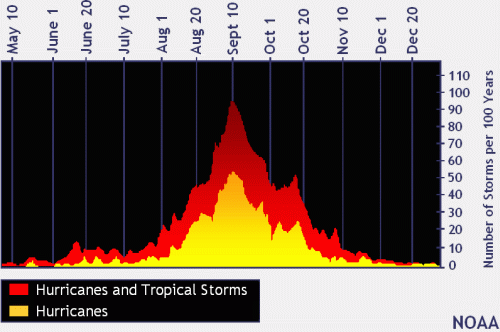
Based on the chart above, I think we can now safely declare that the 2010 hurricane season is over. While the threat of tropical storms posed some problems for the Macondo response, the Gulf of Mexico was spared any significant damage or suspensions of production.

During the post-Macondo discussion about safety and regulatory issues, not much has been said about the major disruptions caused by Hurricanes Ivan, Katrina, Rita, Gustav, and Ike, and the attention and resources that have been dedicated to hurricane issues for the past five years. Major advances have been made in mooring capabilities and assessments, design standards, securing topsides equipment, and other aspects of hurricane preparedness.

How much did hurricane issues affect the assessment and management of other operating risks? This question may merit further attention.

Mars TLP took a direct hit from Hurricane Katina with sustained winds >150 mph

Read Full Post »

Shell has agreed to transport its used drilling fluids from Beaufort Sea exploration drilling out of the Arctic if the company finally gets government permission to drill a well next summer. Alaska Journal of Commerce

I assume this includes all drilling fluids and drilled solids (cuttings) except for the spud mud and cuttings generated prior to installing the riser?  If so, I believe this will be a first for an exploratory well drilled from a floating rig in US offshore waters.

Read Full Post »

It looks like Montara has not affected frontier exploratory drilling offshore Australia.  Per Upstream:

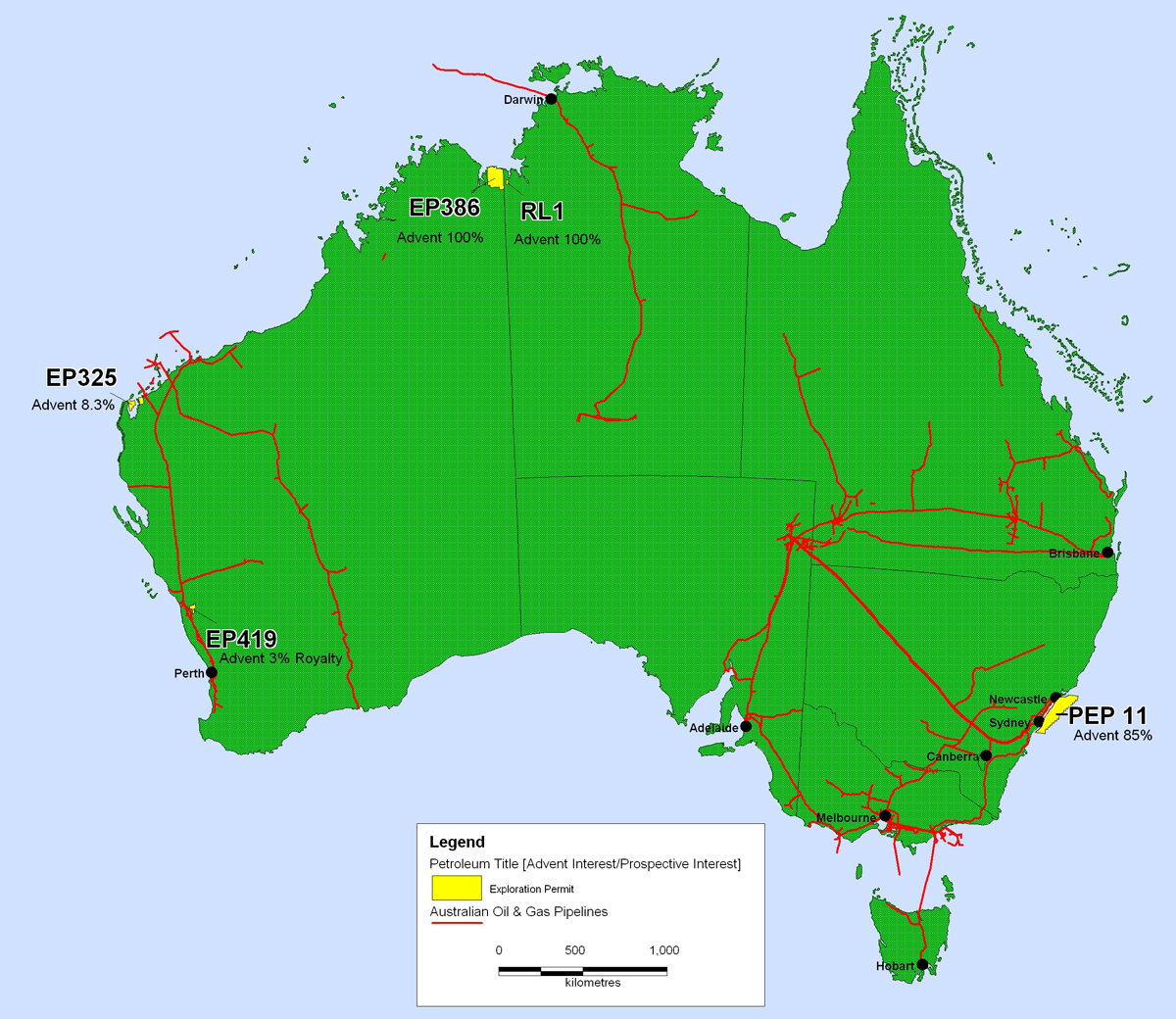
New Seaclem-1 will be the first well to be drilled off the New South Wales coast and will target an estimated 6 trillion cubic feet of gas in the Great White & Marlin prospects.

Well site is in PEP-11 (Advent Energy map)

Read Full Post »

The Economist reports on the Laggan-Tormore gas project :

The £2.5 billion project, approved earlier this year, should deliver its first gas in 2014—a full 28 years after the Laggan field was discovered, a delay that exemplifies the region’s challenges. The field was too small and remote to justify the construction of a pipeline until the nearby Tormore field was discovered in 2007.


Read Full Post »

Yesterday, I was fortunate to receive a copy of Bjørn Vidar Lerøen’s excellent book “Drops of Black Gold” which chronicles the history of Statoil and Norwegian offshore oil and gas development.  Of particular interest was a letter on page 17 of the book (not available online) that I had heard about but hadn’t seen. The letter, dated October 29, 1962, is from Phillips Petroleum to the chairman of a Norwegian government committee considering offshore oil and gas exploration.

Phillips’ request is quoted below.  You have to give  Phillips high marks for taking an aggressive negotiating position (or was it pure chutzpah?).  No small lease blocks for them.  Phillips asked for the whole Norwegian shelf including any future additions! And what would they offer in return – a seismic survey program costing an estimated $1 million.

We have reason for believing that the geologic basin in which large reserves of natural gas have been discovered in Holland may be extended northward into the Norwegian portion of the North Sea. Therefore, Phillips Petroleum Company is interested in obtaining from the Norwegian government an oil and gas concession covering the lands lying beneath the territorial waters of Norway plus that portion of the continental shelf lying beneath the North Sea which may now or in the future belong to or be under the control of Norway.

Read Full Post »

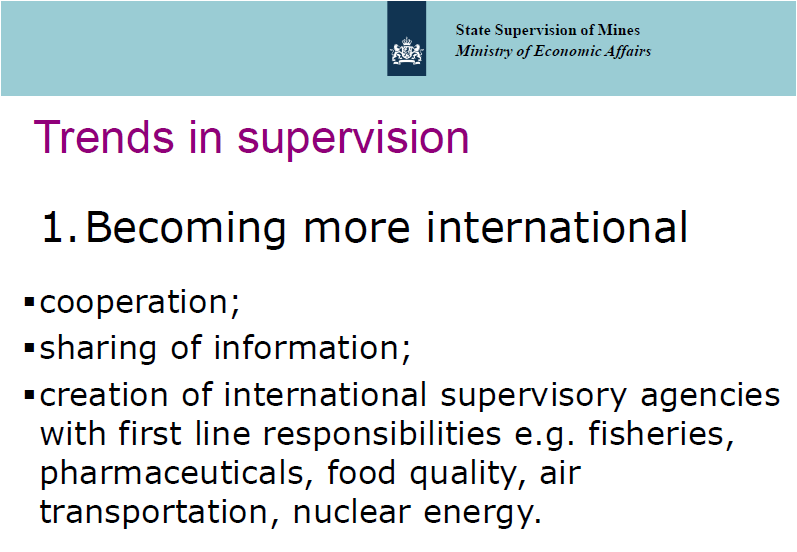
The above slide is from the excellent presentation that Jan de Jong (Inspector General, State Supervision of Mines, the Netherlands) never got to deliver in Vancouver. As session chair, Jan graciously yielded his time to his panelists.

Jan’s presentation notes the growing importance of international cooperation. This trend has the potential to improve regulatory capabilities, expand data availability and access, reduce regulatory costs through the sharing of resources, reduce costs for industry through greater international consistency and regulatory certainty, and improve international relations.  The Netherlands, Russia, Norway, Cuba, the US, and everyone else should be on the same team when it comes to offshore safety and pollution prevention.  Some near-term suggestions follow:

  • Except where regional conditions dictate otherwise, the same standards should be applied worldwide.  Government and industry should be collectively questioning, testing, and improving these standards. Remember that the goal is continuous improvement, not mere compliance.
  • An international information system should provide for the collection and verification of incident and performance data.
  • Using international data and expertise, a cooperative risk assessment program should be initiated.
  • An organized international audit capability should be established to evaluate operators and regulators.
  • To improve access to expertise and reduce costs, a network of specialists should assist regulators worldwide.
  • Industry training requirements should be uniform and consistently applied, and regulator training programs should be consolidated regionally or internationally.
  • The international research network should be expanded.
  • To ensure that accidents are investigated independently and to minimize the potential for political influences on the investigation process, an international accident investigation capability should be established.
  • The safety culture message should be promoted worldwide.  Successes and failures should be cooperatively examined.

Read Full Post »

The White House said Tuesday the government will lift a moratorium on deep water oil drilling in the Gulf of Mexico “very soon” – likely this week. Washington Post

Read Full Post »

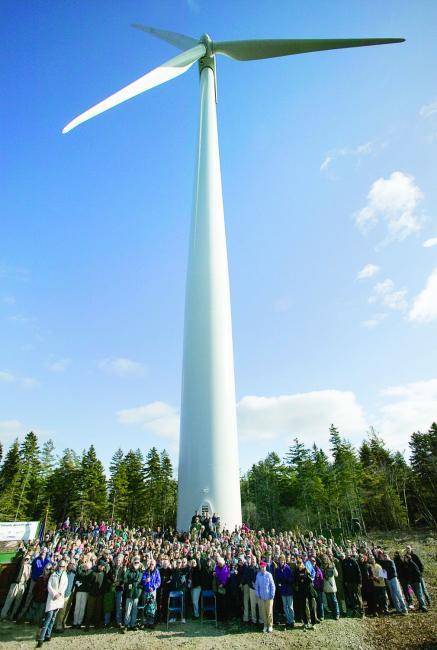
This New York Times article and video discuss the dispute on the island of Vinalhaven, Maine, about the noise associated with the island’s three wind turbines.

Comments:

-Locating wind projects offshore minimizes noise and visual issues, but increases costs and operational complexity.  There are always trade-offs.

-When all environmental impacts are considered, offshore natural gas is tough to beat: minimal visual impacts, none of the freshwater issues that are complicating shale gas development, few land use issues, little or no spill risk (depending how dry the gas is).  The trade-off is CO2 emissions. While combustion of natural gas emits 30% and 45% less CO2 than oil and coal respectively, the CO2 emissions are still significant.

Read Full Post »

In recognition of the earlier fall harvests to our north, Canada celebrates Thanksgiving a month ahead of the US. As a result, Canada’s Thanksgiving coincides with our Columbus Day.  So Happy Holiday to folks on both sides of the border, even if you have to work! 🙂

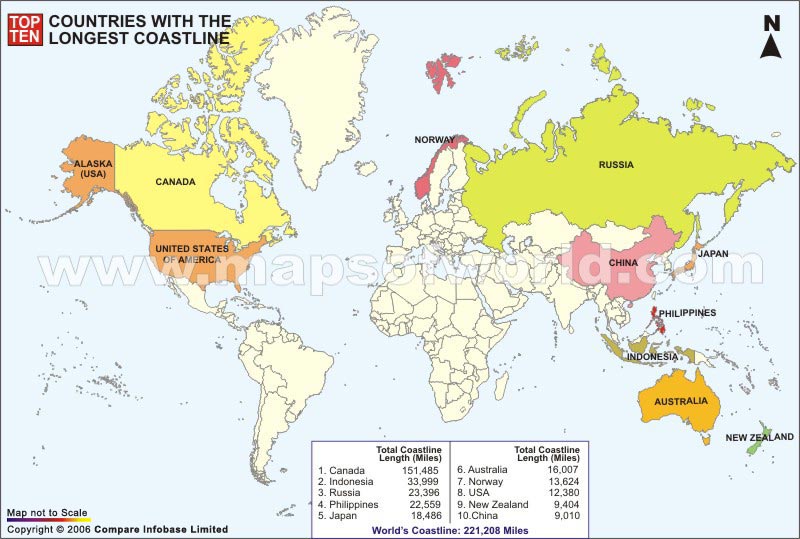
Canada, which is on our minds this week as we get ready for the big conference in Vancouver,  is especially significant to our offshore scholars because of its long coastline, by far the longest of any nation (see below and this slightly different Wiki ranking).   80% of the world’s nations have coastlines bordering an open sea, and about 1/3 of all nations have an existing or planned offshore oil and gas program.

link

Read Full Post »

« Newer Posts - Older Posts »