Look at the US Dept. of Energy homepage and I think you’ll get a better sense of the imbalanced energy policies, in the US and elsewhere, that are contributing to the emerging energy crisis.
There isn’t a single mention of oil or natural gas on the Dept. of Energy homepage. DOE’s priorities are “Combating the Climate Crisis” (embellished with a satellite image of Hurricane Andrew), “Creating Clean Energy Union Jobs” (other energy jobs aren’t important?), and “Promoting Energy Justice.” With regard to the latter, how is driving up energy prices “energy justice?” How is importing more of the oil that we consume “energy justice.” Affordable energy has increased economic opportunities for all and enabled us to better protect our environment. In that regard, this Petr Beckmann slide holds true:
As the global economy recovers and global leaders prepare to gather for a landmark conference on climate change, the sudden energy crunch hitting the world is threatening already stressed supply chains, stirring geopolitical tensions and raising questions about whether the world is ready for the green energy revolution when it’s having trouble powering itself right now.
In the United States, which as an energy producer has been spared the worst consequences of the crisis even as gasoline prices have hit their highest mark since 2014, Energy Secretary Jennifer Granholm suggested Wednesday that the Biden administration might sell off part of the country’s Strategic Oil Reserve or ban exports of crude oil.
Energy analysts warned that such moves could be self-defeating, and on Thursday the department backpedaled.
Energy analysts argue that Europe moved too quickly away from fossil-fueled power, before ensuring that sufficient renewable sources could take up the slack in an emergency. Caught halfway in a transition that should take decades, they say, Europe is now scrambling to find coal and gas to burn in its remaining traditional plants.
In Guangdong, China’s most populous province, authorities have banned the use of elevators in office buildings for the third floor and below, encouraged residents to use natural light as much as possible, and asked for air conditioners to be adjusted to higher temperatures. Beijing and Shanghai canceled annual light shows during the Golden Week holiday that spanned the first week of October.
The White House urged OPEC to boost oil production Wednesday, saying recent planned increases are insufficient as countries around the world seek to emerge from the Covid-19 pandemic.
In light of energy security and price considerations, rebounding oil demand, uncertainty about the long-term viability of non-conventional onshore production, and the elimination of most other offshore options, sustaining deepwater GoM production should be a high-priority U.S. policy objective. The deepwater GoM also offers significant environmental advantages in that approximately 1.6 million BOPD are produced from only 58 widely dispersed surface facilities that are well maintained, closely monitored and inspected, and distant from shore. Another advantage of US deepwater production is the low carbon intensity relative to other sources of petroleum (more on this in a later post).
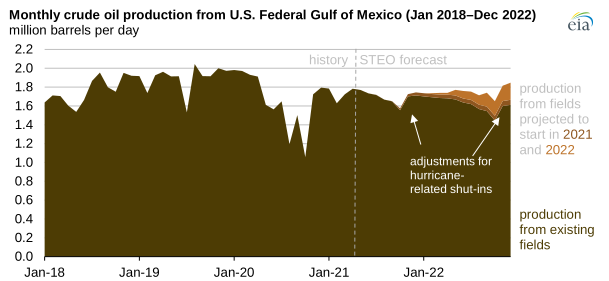
EIA (Chart 1) projects relatively stable GoM production over the next 2 years. Platt’s (Chart 2) is forecasting a slight decline in 2021 production primarily because of COVID-related delays in the initiation of production at Shell’s VIto and PowerNap and BP’s Mad Dog 2 and Thunder Horse South 2 facilities. Based on the latest available EIA data, current stabilized GoM oil production appears to be in the 1.7-1.8 million BOPD range.
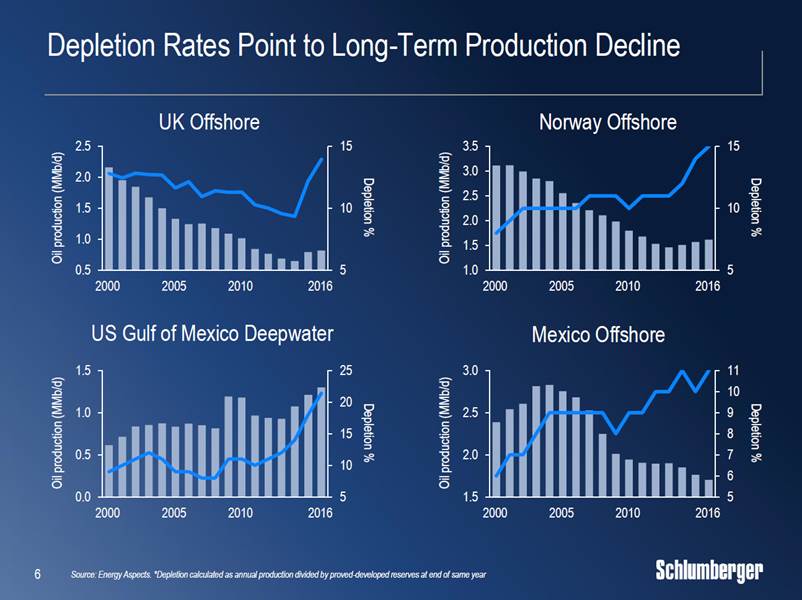
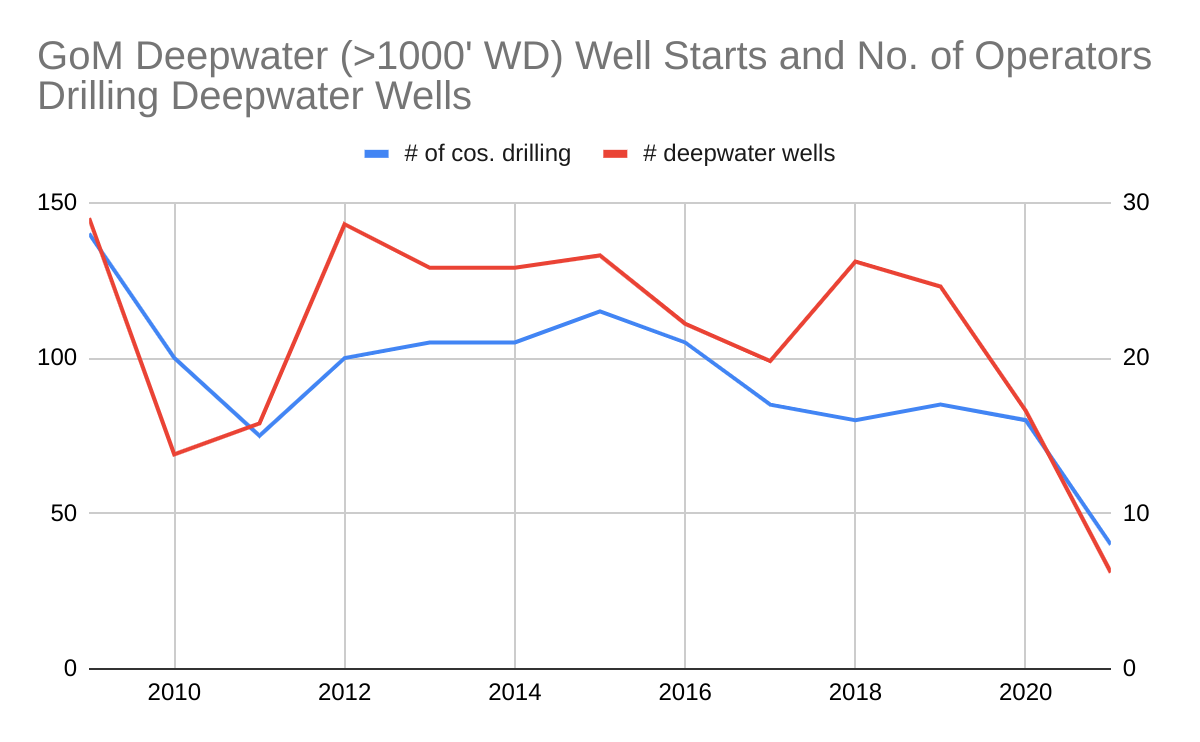
Going forward, the concern is the high rate of reserve depletion and the absence of drilling activity needed to replace reserves. Schlumberger data through 2016 (Chart 3) show depletion rates rising to above 20%, the highest (by far) of the offshore regions analyzed. I was unable to find more recent data, but unless this trend line has made a sharp turn, production declines are likely in the next 3-5 years. Further, drilling trends do not suggest the likelihood of significant reserve growth. Data from BSEE’s Borehole File (Chart 4) indicate deepwater well start activity that is comparable to the moratorium years of 2010 and 2011. Even more concerning is the absence of exploratory drilling (chart 5) and the very few operating companies that are drilling deepwater wells. Only five operators have spudded deepwater exploratory wells in 2021 YTD. One US supermajor hasn’t started a well since 2019, and another US major has essentially exited the Gulf.
Deepwater production trends are not easily reversed, so dialogue is urgently needed to assess the implications of declines in drilling, reserves, and industry interest. As the resource manager on behalf of the public, BOEM is the logical choice for initiating these discussions. BOEM’s Norwegian equivalent, the Norwegian Petroleum Directorate (NPD) demonstrates the importance of pro-active land management. The NPD has done an outstanding job of sustaining exploration activity and production consistent with Norwegian safety and environmental values, which are among the highest in the world. On their website, NPD provides ongoing updates on exploration, production, and reserve depletion parameters. Their competency and commitment to sustaining production on the Norwegian shelf is underscored in this news release, an excerpt from which is pasted below:
Exploration is of great importance for the long-term value creation on the shelf. The supply of oil and gas resources from new discoveries, as we have seen so far this year, is necessary so that activity in the petroleum industry does not fall sharply after 2030. Without new discoveries, production can fall by more than 70 percent in 2040 compared to 2020, says Torgeir Stordal, director of Technology and coexistence in the Norwegian Petroleum Directorate.
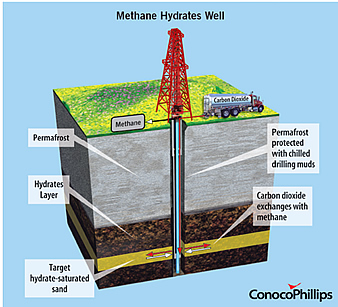
Conoco Phillips will try injecting carbon dioxide into the hydrate. Laboratory tests show that injecting carbon dioxide displaces methane, which comes out of the hydrate as a gas. The idea is that the carbon dioxide molecules take the place of the methane molecules in the hydrate, keeping it stable.
This could be neat, if it works. Carbon dioxide would be permanently sequestered, or stored, underground, while the methane is extracted and the hydrate is left intact.
One question the Conoco Phillips production test will attempt to answer is whether this reaction in the hydrate can occur fast enough for methane production to reach practical volumes.
The comment below is an understatement, but the enormous energy potential justifies the research.
This isn’t a slam dunk, though. The technical challenges are considerable.
First, thanks to the unexpected shale gas boom in the U.S., liquefied natural gas cargoes once planned for the U.S. have gone looking for new buyers. Result: European customers have been able to shake off Russian long-term contracts linked to the price of oil.
Russia insists the gas glut is temporary. It has tried to fight back by pushing gas sales to China. But now those talks are stalled over price thanks to Beijing’s discovery that—guess what?—China back home may have the biggest shale potential of all.
And the hits will keep on coming, upending a high-price dynamic and European dependency that have suited Russia very well (and, admittedly, also suited some of its customers, especially German utilities).
Will the great potential of shale gas be fulfilled? In the US? In Europe? Elsewhere?
But what the Lord giveth, European politics may fritter away. French campaigner Jose Bove, having failed to kick McDonald’s out of Paris, is now jawboning Poland against developing its reserves, handing a Polish-subtitled copy of “Gasland,” the U.S.-made antifracking documentary, recently to Poland’s president.
France in May passed a ban on fracking. Poland is the anti-France, set to take the European Union’s rotating presidency next month and determined to move ahead on fracking. A mystery wrapped in an enigma is Germany, with its precipitous decision to retire its nuclear plants, and its big, Russia-friendly investment in Nord Stream, a gas pipeline whose board is headed by former German Chancellor Gerhard Schroeder.
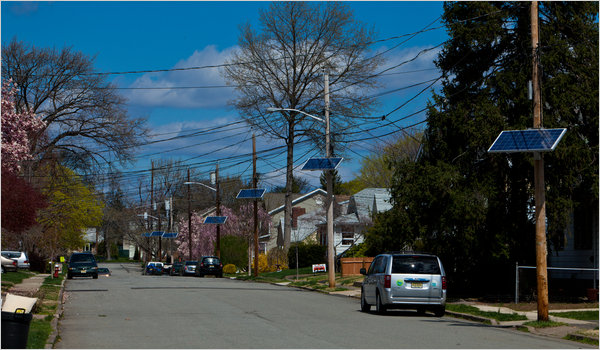
Like a massive Christo project but without the advance publicity, installations have been popping up across New Jersey for about a year now, courtesy of New Jersey’s largest utility, the Public Service Electric and Gas Company. Unlike other solar projects tucked away on roofs or in industrial areas, the utility is mounting 200,000 individual panels in neighborhoods throughout its service area, covering nearly three-quarters of the state. NY Times
So what’s next, mini-turbines on every utility pole, or worse yet, geeks like this guy hooked up to the electric grid? 🙂
Shale gas is important to the economic future of states like Pennsylvania. However, there are legitimate public concerns about environmental issues including the potential for contaminating freshwater supplies. Significant impacts are preventable with prudent operating practices and effective regulatory programs. So what directive does the responsible State agency issue to its inspectors?
Field inspectors and regional directors for the state Department of Environmental Protection have been told they must obtain approval from DEP Secretary Michael Krancer before issuing permits or enforcing regulations pertaining to Marcellus Shale drilling.. PostGazette.com
How would you like to be an inspector for an organization like that?
Unless this decision is promptly reversed, expect the following:
The public will assume that politicians are micromanaging critical field inspection programs, and confidence in the regulatory program will be eroded.
Inspectors will be unable to respond quickly when violations are observed. Morale will suffer. Skilled personnel will leave or lose motivation.
Regulatory efficiency will decrease while costs increase.
The operating companies will deal directly with the Secretary’s office, leaving field personnel out of the loop.
The industry’s image will suffer. Effective regulation identifies those who are willing to cut corners and protects the leading companies.
Previewing his speech at a New York City fundraiser last night, Obama said he wants to break “the pattern of being shocked at high prices and then, as prices go down, being lulled into a trance.”
“Let’s actually have a plan,” he said. “Let’s, yes, increase domestic oil production, but let’s also invest in solar and wind and geothermal and bio-fuels and let’s make our buildings more efficient and our cars more efficient.” USA Today
The Subcommittee on Energy and Power announces a multi-day hearing on “The American Energy Initiative.” The first day of the hearing will be on Thursday, March 17, 2011, at 9:00 a.m. in 2123 Rayburn House Office Building. It will focus on oil supplies, gasoline prices, and jobs in the Gulf of Mexico.




 Shale gas is important to the economic future of states like Pennsylvania. However, there are legitimate public concerns about environmental issues including the potential for contaminating freshwater supplies. Significant impacts are preventable with prudent operating practices and effective regulatory programs. So what directive does the responsible State agency issue to its inspectors?
 Bud's Offshore Energy (BOE)