Feeds:
Posts
Comments

Archive for the ‘drilling’ Category

Scarabeo 9

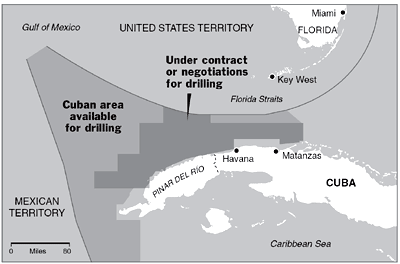
According to the Miami Herald an Italian rig, the Scarabeo 9, will drill the long-awaited exploratory well offshore Cuba.  The article indicates that the new-build rig is expected to arrive in Cuba late this year.

Per Oil and Gas Interntional:

The Scarabeo 9 embodies the latest technology for deepwater drilling operations and is capable of drilling in waters 3,600 meters in depth. Expectations are it will mobilize to Cuban waters during the second or third quarter of 2011 and commence drilling during the third or fourth quarter. (note: the Miami Herald article projects an earlier arrival). Repsol holds the six blocks in the Cuban sector of the Gulf of Mexico in a production-sharing agreement with Union Cubapetroleo (Cupet), the Cuban national oil company. The concession encompasses Blocks N25, N26, N27, N28, N29, and N36, a combined area of some 10,200 sq km along the island’s northwest coast. Repsol is the operator of the six blocks with 40% interest in partnership with Statoil, holding 30% and Oil and Natural Gas Corporation (ONGC) with the remaining 30%.


Read Full Post »

Besides cutting through thicker steel, the new blade design – which features a wicked-looking spear in the center – requires less ram force to do the job, allowing use of lighter support equipment, such as smaller accumulator bottles that use compressed gas to slam the valves shut.

link

Read Full Post »

Given the complicated situations that can occur, I think that the key is in understanding what can happen on a particular well, given the well geometry and rig specifics, such that communications with the crew are simple and focused.  The key is playing the “what if” games before a real incident occurs. ~ Colin Leach

In light of BOE’s interest in drilling safety, we thought we would ask a few questions to Colin Leach, a well control expert and a partner in Argonauta Energy Services.   Colin has over 26 years of upstream experience with an emphasis on deepwater drilling, and is internationally recognized for the depth and breadth of his understanding of drilling systems.  Read Colin’s insightful comments here.

Read Full Post »

Mr Mueller likens the role of cementers in well construction to that of cornerbacks in football: “When we fall down and someone passes for a touchdown, everyone sees it. … When there’s a failure (in cementing), it’s typically quite noticeable and costly, even catastrophic. … You have to always ask yourself, ‘What haven’t I thought about? What can go wrong? If it does go wrong, how can we fix it?’ ”

In the wake of Montara, I recommend that you read an excellent article in the latest edition of Drilling Contractor magazine about Dan Mueller, a cementing specialist for ConocoPhillips.  Having read hundreds of pages about the cementing issues that appear to be the root-cause of the Montara blowout, it was refreshing to see Mr. Mueller’s comments and learn more about his company’s commitment to safe and effective cementing operations.  While incidents like Montara rightfully attract much of our attention, most companies understand the importance of cementing and provide the resources necessary to ensure success.  As the article reminds us:

The high stakes at play – plus the increasingly hostile conditions under which wells are drilled today – means that preplanning on a well-by-well basis is crucial. Thermal modeling, wellbore stress modeling, hydraulics modeling, computational dynamics modeling – everything that can be done has to be done to make sure nothing gets overlooked. In today’s complex wells, Mr Mueller explained, anything that’s an “unknown” has the potential to damage the cement’s effectiveness.

Read Full Post »

Offshore Energy Awakening?

When you wake up after a long nap (in this case 25 years), you don’t just leap out of bed.  You first squint at the light, yawn, flex an arm, stretch your legs, and prepare to rise and actually do something.  The President’s decision to open a small slice of the Atlantic to  exploration and consider new areas in the Atlantic and Eastern Gulf of Mexico in the new 5- Year Program may seem modest, but it demonstrates that the nation is waking up to the importance of our offshore energy resources.  After 25 years of neglect, almost everyone agrees that US energy policy has been an economic and national security disaster.  More and more Americans are also recognizing that denying access to offshore resources is not in the best interest of the environment – regionally, nationally, and globally.

Some political leaders remain in dreamland as evidenced by the large blue areas in the map below.  When you have cried “wolf” about offshore drilling for your entire political career, you either believe what you have been preaching or are concerned about the political implications of changing your position.  However, demonizing offshore energy development is no longer a smart political strategy, and the views of these anti-energy stalwarts may finally be challenged, even in their own states and districts.

We operations, safety, pollution prevention, and regulatory professionals have to hold up our end.  Safety disasters or pollution spectaculars are not acceptable.  We need to examine our programs, operations, and incidents openly and honestly, and anticipate what might go wrong.  When an accident occurs, we need to learn what happened and why, and make sure it doesn’t happen again – anywhere in the world.

Read Full Post »

The Florida Legislature may soon decide whether to lift the 20 year ban on oil and gas exploration and production in State waters.

As part of  the review process, the State has prepared a list of questions on the management and regulation of offshore oil and gas resources.   Responses to these questions will help define the general terms of the regulatory regime that the State would follow if the ban is lifted.

The State is inviting input on any or all of the questions.  Please email your responses to adam.blalock@myfloridahouse.gov by the close of business on Monday, March 15.  Response should be limited to no more than 500 words per question.

Read Full Post »

Cuba Watch; the Wait Continues

Cuba’s only deepwater well was drilled in July 2004 by Repsol, a Spanish company.  Repsol reported a non-commercial oil discovery 95 miles southwest of Key West.  For the past 5 years, there have been a series of announcements from Havana, but no offshore drilling activity.

Here is what we know about Cuba’s offshore oil and gas potential:

USGS (2005) estimates that Cuba’s northern offshore basin could contain 4.6 billion (mean) barrels of oil, with a 5% probability of discovering 9.4 billion barrels. Mean natural gas resources are estimated to be 9.8 trillion cubic feet.

Cuban government officials believe the USGS estimates are low.  They indicate that Cuba may have more than 20 billion barrels of recoverable oil.

Cuba’s 2008 oil production was estimated at 61,300 barrels per day.

Will the offshore activity and results ever match the inflated rhetoric?  We will be watching.

Read Full Post »

« Newer Posts