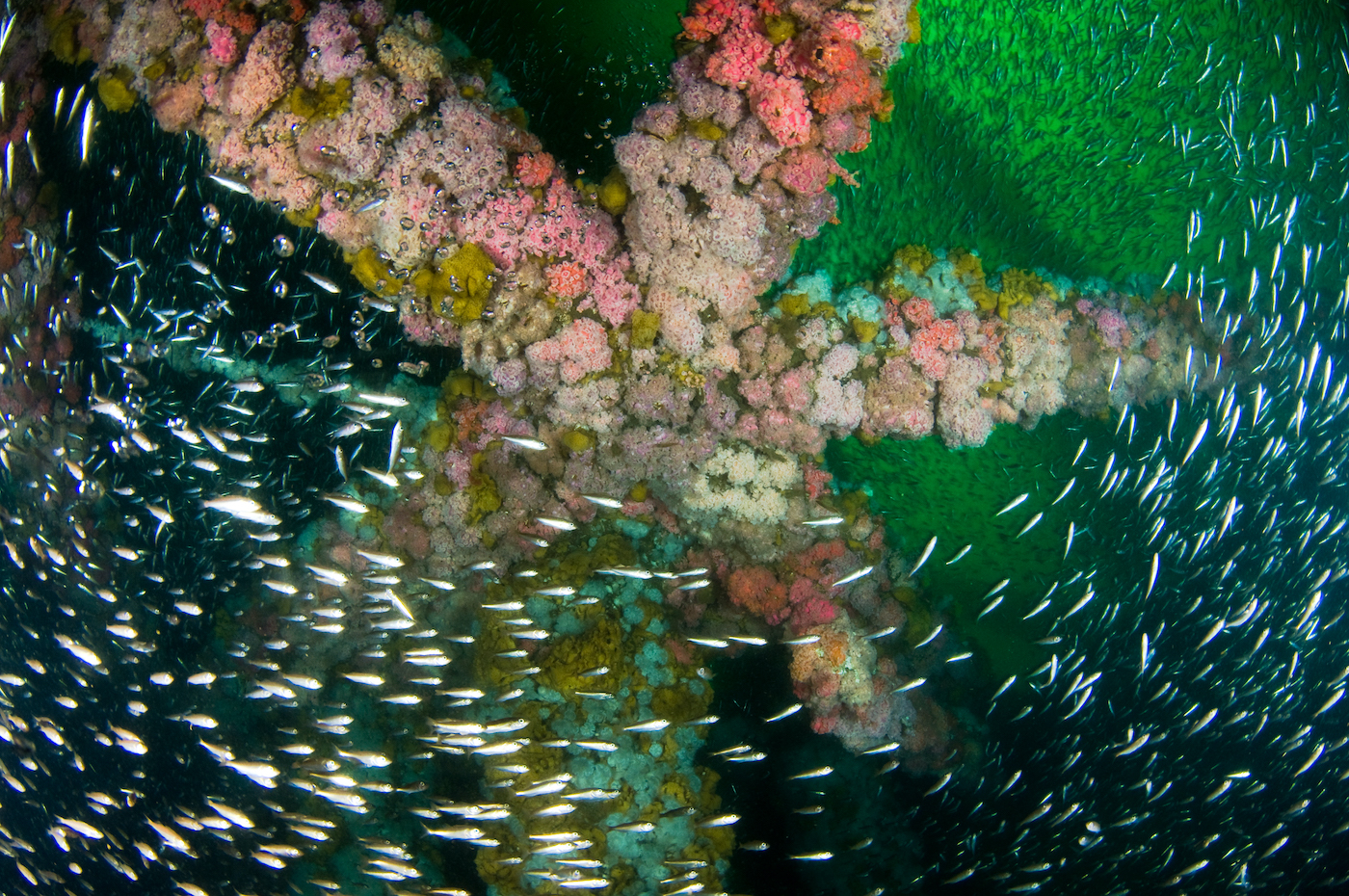
Dr. Jeremy Claisse, Cal Poly Pomona: “The oil and gas platforms off the coast of California are the most productive marine habitats per unit area in the world.”
Dr. Milt Love, UCSB: “Even the least productive platform was more productive than Chesapeake Bay or a coral reef in Moorea.”
John Smith has made the case for reefing California platforms. He is now proposing a change in the regulations that could facilitate such partial removals of offshore structures. His full proposal is attached.
As background John notes:
“In contrast to the Gulf of Mexico (GOM), where more than 600 decommissioned platforms have been converted to artificial reefs, the State of California does not have reefing legislation considered workable by industry, nor does it have an approved or State funded artificial reefing program which is a prerequisite under MMA (formerly BSEE and BOEM) OCS oil and gas regulations (30 CFR § 250.1730) for waiving platform removal requirements which allows conversion of the structure to an artificial reef.“
He further informs that “operators of the platforms have not expressed any serious interest in reefing OCS platform jackets because they consider the California Marine Resources Legacy Act unworkable in its present form due primarily to its liability provisions, inequitable 80% cost-savings sharing requirement, and the requirement for the first reefing applicant to fund the setup costs for the artificial reefing program.“
John’s proposal is intriguing because it allows qualified 3rd parties to accept title and liability for reefed structures. This would create interesting business opportunities. A company, consortium, nonprofit, or entrepreneur could, for a fee, acquire submerged structures and obtain insurance or other financial protection in accordance with their business plan. Reef preservation and enhancement studies, and other marine research could also be conducted at the sites. Marine ecosystems would be protected, and the cost and efficiency of decommissioning operations would be significantly improved.
“So, you disconnect the jacket… you kill all the fish. There’s an awful lot of animals that die,” said Dr. Love. As our world has become dependent on fossil fuels, so too have these millions of animals become dependent on the structures that pump them from beneath the sea floor. “As a biologist, I just give people the facts, but I have my own view as a citizen, which is I think it’s criminal to kill huge numbers of animals,” said Dr. Love.
John’s proposal warrants serious consideration.


Great idea, John. Keep pushing it! Bob Byrd