Feeds:
Posts
Comments

Archive for November, 2024

Offshore oil and gas:

  • The current 5 year OCS oil and gas leasing plan, which provided for the fewest sales in history, will be rewritten.
  • The new program will include at least one Gulf of Mexico lease sale annually.
  • Where there is State support (e.g. Alaska), other offshore areas may be added to the program.
  • Reversal of the Beaufort Sea Presidential withdrawals, either by executive order or, if necessary, by congressional action, is a distinct possibility.
  • A Gulf of Mexico oil and gas sale will be held during the first half of 2025. This can be accomplished under the Biden administration’s 5 year plan.
  • Judge Boardman’s ruling requiring a new biological opinion under the Endangered Species Act (ESA) has created some uncertainty regarding the timing of a GoM sale. Her decision is being litigated and the effective date of her ruling is now 5/21/2024 (see attached). Congressional action could also reverse this decision.
  • Expect other litigation on NEPA and ESA grounds with the intent of stalling oil and gas leasing. Congressional action could reverse or limit such litigation.

Offshore wind:

  • Expect offshore wind leasing to be “paused.”
  • Current leaseholders are contractually entitled to continue developing and operating their leases. Expect construction and operation plans to be more closely scrutinized.
  • Expect BSEE’s report on the Vineyard Wind turbine blade failure to receive added attention and publicity.
  • Expect considerable tension between North Atlantic governors, strong supporters of offshore wind, and the new administration.

Expect less babble about absurd topics like “petro-masculinity.” 😉
Read Full Post »

Mike Werth’s response to Jim Kramer’s question about US production leadership is spot-on (see the clip below).

Kudos to Kramer for visiting Chevron’s Anchor platform in the Gulf of Mexico. More business/energy reporters and government officials with energy responsibilities need to (1) learn more about offshore oil and gas exploration and development and (2) visit offshore facilities.

Read Full Post »

As the table below illustrates, Denmark’s highly publicized oil and gas exploration ban is more pragmatic than has been reported in the media. The expansion of production from existing fields is not restricted.

12/4/2020 policy announcement10/29/2024 discovery announcement
Denmark has brought an immediate end to new oil and gas exploration in the Danish North Sea as part of a plan to phase out fossil fuel extraction by 2050. TotalEnergies announces that the Harald East Middle Jurassic nearby exploration well (HEMJ-1X) has discovered additional gas condensate resources in the Harald field, in the Danish North Sea.“The success of the Harald East Middle Jurassic well, nearby our Harald facilities in Denmark, demonstrates the strength of our Exploration strategy.” 

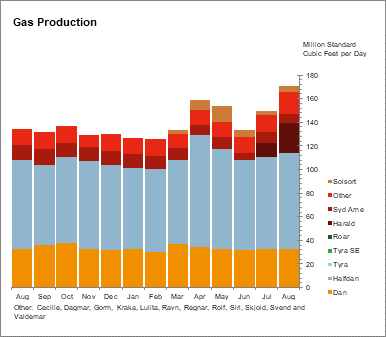
As a result of new exploration, Danish gas production is on the rise (graphic below) after two decades of decline. August 2024 production (165.8 MMCFD) was 21% higher than August 2023 production (136.9 MMCFD)

While Total has proven to be resourceful in sustaining North Sea gas production, Denmark’s refusal to hold new licensing rounds dooms their production over the longer term. This is consistent with Denmark’s intent to cease domestic production by 2050. (Those of you who are young enough can report on whether that deadline is met 😉).

The demand for fossil fuels, which has yet to peak, will still be strong in 2050 and beyond. Phasing out domestic production may be Denmark’s choice, but it’s not a good choice for much of the world.

Denmark is a lovely country, but their rather smug commitment to “lead a global campaign on the role of fossil-fuel producing countries” is not universally welcome. Similarly, companies like Orsted (50.1% Danish govt ownership) are not always the best ambassadors for exporting Danish energy policy.

Other governments, including the US, are quite capable of risking their economic growth and energy security without Denmark’s help.

Related posts:

Read Full Post »

This year’s presidential race features an oddity: a discussion about a ban on fracking. What’s striking is that such a conversation is happening at all. This talk takes participants through the Wayback Machine to the first two decades of this century, when hydraulic fracturing and horizontal drilling—together known as fracking—came to public attention. The U.S. was then the world’s largest importer of oil. Today it is energy-independent with, S&P Global estimates, more than 70% of its oil and more than 80% of its natural gas produced through fracking. The process has become essential to the nation’s energy supply and can’t be eliminated.

Not long ago the prospect of U.S. energy independence seemed fanciful. For more than four decades every president aspired to it, but their goal seemed unattainable. Many observers considered the U.S. destined to grow more dependent on imports. In recent years, however, America has achieved energy independence on a net basis. U.S. output is closing in on 13.5 million barrels of crude oil a day, exceeding that of perennial big producers Saudi Arabia and Russia by several million barrels per day. Add what are called natural-gas liquids, and the U.S. produces around 20 million barrels per day.

WSJ article

More from Dan Yergin

Read Full Post »

The table below illustrates the dramatic decline in bidding for Atlantic wind leases over the past 2 years. (The California sale is also included in the table.)

offshore areasale dateleases soldacres leasedbonus bids
($ millions)
$/acre
NY/NJ2/20226488,0004,3708955
California12/20225373,268757.12028
Central Atl.8/20242277,94892.65333
Gulf of Maine10/20244439,09621.9 50

Accepting that bidding at the 2/2022 sale, which averaged nearly $9000/acre, was irrationally exuberant, bidding at this week’s sale was still incredibly weak. Even the bids at the Central Atlantic sale, just 2 months ago, averaged $333/acre, 6.7 times higher than the Gulf of Maine bids.

Energy giants Equinor, Repsol, and Total were among the eligible Gulf of Maine bidders that opted not to participate.

Do the Gulf of Maine bids pass BOEM’s fair market value tests? Apparently so; the sale notice established $50/acre as the minimum bid, and that is where the bidding started and ended. Invenergy and Avangrid had no competition and presumably got the tracts they wanted at the lowest possible price. We’ll see how this works out for the companies and power consumers.

Read Full Post »

« Newer Posts