“Blackrock, Vanguard, and State Street utilized the Climate Action 100 and the Net Zero Asset Managers Initiative to signal their mutual intent to reduce the output of thermal coal, which predictably increased the cost of electricity for Americans across the United States.
These firms also deceived thousands of investors who elected to invest in non-ESG funds to maximize their profits. Yet these funds pursued ESG strategies notwithstanding the defendants’ representations to the contrary.”
This is yet another example of the importance of proper well plugging, platform removal, and decommissioning financial assurance. It’s noteworthy that Texas is among the states suing to block BOEM’s financial assurance rule for Federal waters.A serious collaborative Federal, State, and industry effort to address decommissioning issues is long, long overdue.
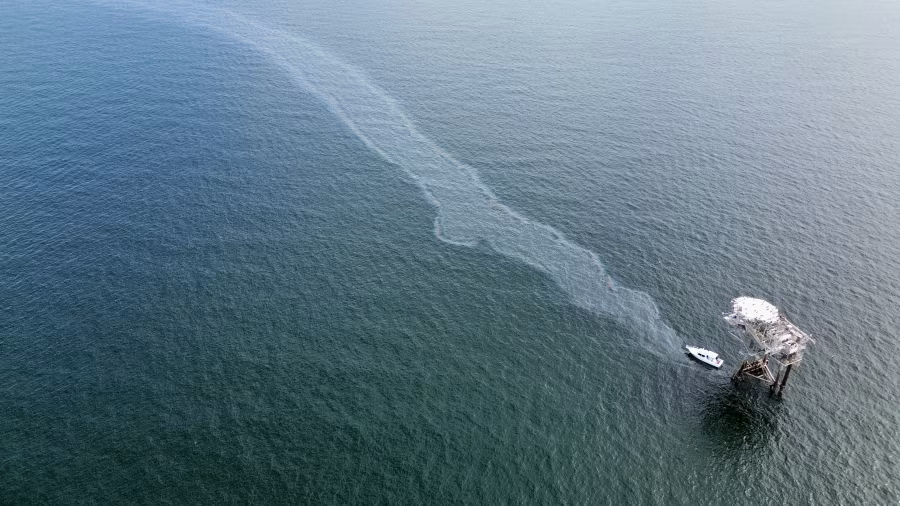
8 miles offshore Galveston County (TX State waters extend 3 marine leagues/9 nautical miles/10.35 statue miles offshore)
flowline riser leaking natural gas and condensate (badly corroded platform)
no recoverable oil
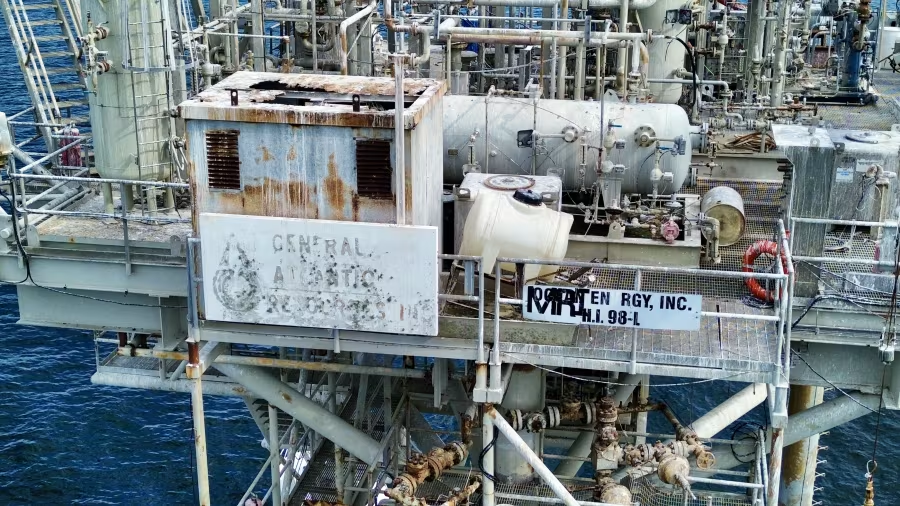
abandoned platform
additional research is needed to fully determine ownership of the leak source (???)
HIGH ISLAND BLOCK 98-L INCIDENT :
The Texas General Land Office (GLO) is sharing the following information:
On Sunday, July 14, 2024, at 8:00 pm, the Oil Spill La Porte Office Response Officer received notification of a natural gas/oil discharge off the coast of Crystal Beach, Galveston County. The spill was reported to be from a platform in High Island Block 98-L, about eight miles offshore in the Gulf of Mexico. Oil Spill personnel traveled via response boat to investigate on Monday morning and determined the discharge to be from a flowline riser leaking natural gas and condensate. Although the leak can be seen from the water, no recoverable oil was visible. The platform is abandoned, as defined by the Texas Railroad Commission, placing it within the Railroad Commission’s statutory authority for administration. The wells are not covered as part of the GLO’s current well plugging MOU with the Railroad Commission. The platform and associated wells are documented in the Oil Spill program’s abandoned well listings.
On Wednesday, July 17, La Porte office staff, with US Coast Guard and Railroad Commission personnel, inspected the platform area again. The leak is still present but has not increased. Railroad Commission staff stated that additional research is needed to fully determine ownership of the leak source.
The Coast Guard reports receiving a call from Channel 2-KPRC (NBC) in Houston regarding the leak and also seeing social media posts by a local area fishing group.
At this time: No injuries reported, No impact to commerce, No impact to wildlife.
… and you deniers are fully responsible. There’s a reason why Texas is the most affected state 😉
But fear not, we will line our shores with wind turbines, restrict offshore oil and gas leasing, and subsidize carbon disposal in the Gulf of Mexico. All of this “help” will have a negligible effect on the climate, which will continue to change as it always has and always will.
Bayou Bend CCS LLC commenced drilling an offshore (Texas State waters) and an onshore stratigraphic well for carbon sequestration in the first quarter 2024.
Is offshore carbon disposal ocean dumping?One of the provisions that was slipped into the “2021 Infrastructure Bill” exempted carbon sequestration from the Marine Protection, Research, and Sanctuaries Act of 1972 (Ocean Dumping Act). This exemption revises the OCS Lands Act and thus does not apply to State offshore lands. The Texas offshore wells must therefore be permitted by EPA as “Class VI wells,” as is the case for onshore disposal wells. However, Texas and Louisiana have asked the EPA for “primacy,” which would allow state agencies to approve and oversee these operations.
Meanwhile, the regulations for carbon disposal on the OCS, which the Infrastructure Bill mandated by November 2022, have yet to be published for comment. The latest Federal regulatory agenda indicates a publication date of 12/00/2023 for these regulations. Presumably the staff work has been completed and the rule is stalled in the review process.
Despite the absence of a regulatory framework, BOEM has accepted sequestration bids at the last three oil and gas lease sales. These bids were evaluated as if the leases were being acquired for oil and gas exploration and production, even though the bidders’ intentions were widely known. Why was BOEM a willing participant in this charade, not just at one sale, but at three sales in succession?
Given that the perceived carbon disposal bonanza is dependent on mandates and subsidies, one has to wonder about the massive revenue projections for this industry and raise concerns about the associated public and private financial risks. What is the long term business plan for this industry? Who will be monitoring the offshore wells (in perpetuity)? How will the public be protected from financial assurance and leakage risks? We will see how the myriad of carbon sequestration issues are addressed in the proposed regulations.
This CBC story, which includes excellent video interviews, was brought to my attention by Newfoundlander Howard Pike, an engineer and offshore safety leader.
We know a lot about Rigs-to-Reefs, and the importance of active and reefed platforms in providing the habitat, shelter, and food that is necessary to increase biodiversity and productivity. However, the carbon reduction potential of artificial reefs has received little attention.
The linked CBC story is particularly interesting in that it includes interviews with artificial reef researchers who are assessing the carbon capture aspects. To date the results are encouraging:
As for the impact on climate change, the researchers say they have found some evidence that an artificial reef could hold more carbon compared to a natural reef.
Per their court filing, Montana, Alabama, Alaska, Arizona, Arkansas, Georgia, Kentucky, Mississippi, Missouri, Nebraska, Oklahoma, Texas, Utah, and West Virginia seek to protect oil and gas production in the Gulf of Mexico and throughout the United States. The States’ brief is rather political, which is not surprising given their support for offshore leasing and the apparent alignment of the Federal defendants and the plaintiffs in support of the decision by Judge Contreras to vacate the sale.
In 2018 CEQ found that, across the federal government, the average EIS completion time and issuance of a Record of Decision was over 4.5 years and the median was 3.6 years.
On average, Interior takes five years and the Department of Transportation 6.5 years to complete an EIS—and that’s not including the usual years of resulting litigation.
CEQ found that “across all Federal agencies, draft EISs averaged 586 pages in total, with a median document length of 403 pages.” As a result, “[t]he entire original purpose of doing NEPA analysis has been lost along the way to creating mountains of data and information in the hopes of successfully defending against inevitable litigation.”
Nice bounce in Texas where 320 rigs are now active, up 12 from last week and up 117 from a year ago. Rig activity in New Mexico, where (unlike Texas) most of the Permian is on Federal land, has been less robust. The number of rigs operating in NM actually dropped by 1 to 98.




 Bud's Offshore Energy (BOE)