Feeds:
Posts
Comments

Posts Tagged ‘Supreme Court’

The response by the Nantucket group’s attorneys is attached. Key excerpt:

NMFS absurdly argues that agency officials, in preparing a biological opinion for a project, must ignore information about impacts on endangered species from other offshore wind turbine projects that are planned and in various stages of development and governmental review. Perhaps even more bizarrely, NMFS contends that, in preparing a biological opinion for a project, it must consider the cumulative impacts of planned state and local projects but ignore the impacts of planned federal projects.

Background:

Read Full Post »

The Dept. of Justice (DOJ) has responded (attached) to the ACK for Whales petition (ACK is the FAA abbreviation for Nantucket) to the Supreme Court to review the First Circuit’s ruling on the Vineyard Wind project. (Also see the amicus brief filed by the Aquinnah Wampanoag Tribe of Gay Head).

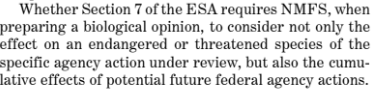
The question before the Supreme Court:

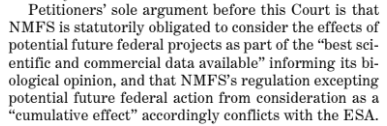
Excerpt from the DOJ filing:

The petitioners’ “sole argument” is rather compelling to this non-attorney. Given that multiple offshore wind projects are planned for Right whale habitat, how do you fulfill your endangered species responsibilities by only considering the first project (I.e. Vineyard Wind 1)?

(In light of Vineyard Wind’s performance to date, one could also argue that the Right whale is jeopardized by the Vineyard Wind project alone.)

Keep in mind that the Federal govt wanted to block all oil and gas leasing in a huge swath of the Gulf of Mexico because of far more speculative concerns about potential impacts to Rice’s whales.

Read Full Post »

The Nantucket non-profit ACK for Whales (ACK is the FAA abbreviation for Nantucket Airport) has petitioned the Supreme Court to review the 1st Circuit’s ruling on the Vineyard Wind project. Per the Supreme Court filing (full document attached):

Despite the agencies’ explicit statutory duty to consider all “best information available,” regarding the impacts its actions might have on an endangered or threatened species and those habitats, the National Marine Fisheries Service (NMFS) and the Bureau of Ocean Energy Management (BOEM), did not consider the cumulative impacts of other planned projects when they authorized and issued permits to construct the Vineyard Wind 1 Project.

Will the Supreme Court accept the case?

  • “Hail Mary:” Per the Nantucket Current, the odds that the Supreme Court justices will accept the case are exceedingly slim. Of the 7,000 cases that the Supreme Court is asked to review each year, only 100 to 150 of them – about 2 percent – are accepted.
  • “Really good chance:Per Val Oliver, ACK for Whales founding director, “In light of the recent Chevron decision, we think we have a really good chance. That was about government overreach and that is what this (Vineyard Wind) has felt like since the beginning: go, go, go, and we’ll figure it out as we go. That’s just not responsible.

Regardless of the outcome of this case, there is a profound inconsistency in the administration of the Endangered Species Act as evidenced by our comparison of the operating restrictions for the Right whale (Atlantic wind) and Rice’s whale (Gulf of Mexico oil and gas). Note that the more onerous Rice’s whale restrictions were removed by court order.

Read Full Post »

In a major decision, the Supreme Court overturned the Chevron doctrine, which for four decades led judges to defer to how federal agencies interpreted a law when its language wasn’t clear. In a later post, we will speculate on how this ruling could affect the offshore regulatory program.

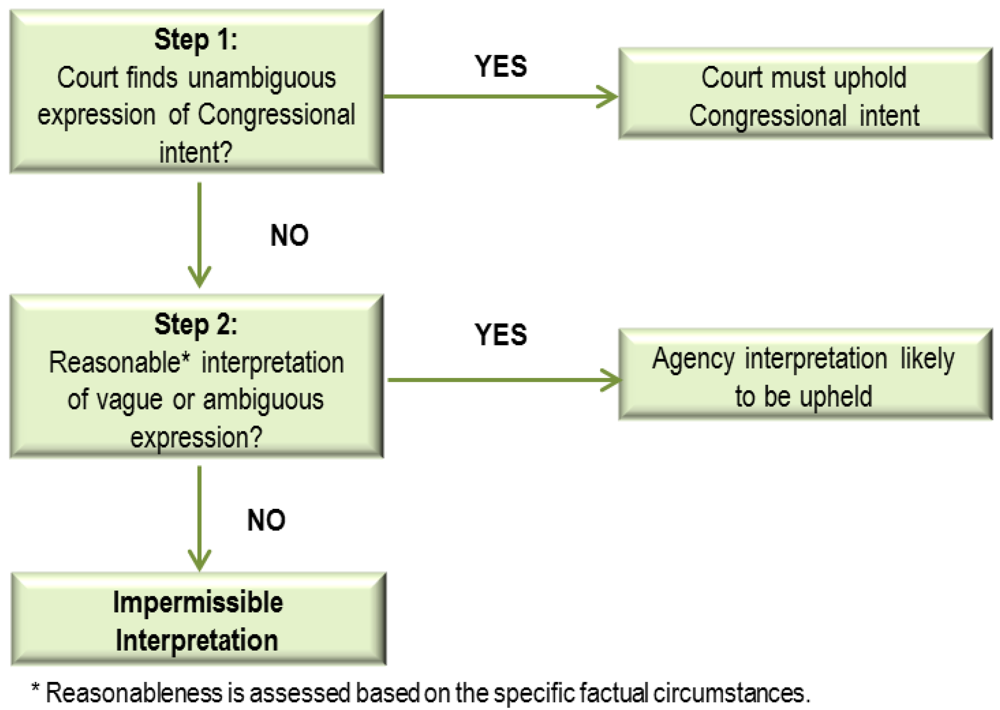
About the Chevron doctrine:

One of the most important principles in administrative law, the “Chevron deference” was coined after a landmark case, Chevron U.S.A., Inc. v. Natural Resources Defense Council, Inc., 468 U.S. 837 (1984). The Chevron deference is referring to the doctrine of judicial deference given to administrative actions. In Chevron, the Supreme Court set forth a legal test as to when the court should defer to the agency’s answer or interpretation, holding that such judicial deference is appropriate where the agency’s answer was not unreasonable, so long as Congress had not spoken directly to the precise issue at question. 

previous post on the Chevron doctrine

Read Full Post »

There are a number of recent articles related to the Guyana Supreme Court ruling on Exxon’s financial assurance obligations. An Oil Now piece (quoted below) is the most informative. It seems that the Supreme Court decision is based on a provision of Exxon’s EPA permit and that EPA is siding with Exxon in this dispute.

The Guyana government and the Environmental Protection Agency (EPA) are set to appeal a recent Guyana Supreme Court ruling that determined that the EPA and ExxonMobil affiliate, Esso Exploration and Production Guyana Limited (EEPGL), breached the terms of the Liza 1 environmental permit. The permit was revised and granted to EEPGL last year for operations in the Stabroek Block, offshore Guyana.

Justice Sandil Kissoon granted several declarations, including that the EPA failed to enforce compliance by EEPGL of its Financial Assurance obligations to provide an unlimited Parent Company Guarantee Agreement and/or Affiliate Company Guarantee Agreement to indemnify and keep indemnified the EPA and the Government of Guyana against all environmental obligations of the Permit Holder (EEPGL) and Co-Venturers (Hess and CNOOC) within the Stabroek Block.

While acknowledging the court’s ruling, the Government of Guyana, as a major stakeholder, maintained in a statement that the Environmental Permit imposes no obligation on the Permit Holder to provide an unlimited Parent Company Guarantee Agreement and/or Affiliate Company Guarantee Agreement. The government believes that Justice Kissoon erred in his findings and that the ruling could have significant economic and other impacts on the public interest and national development.

OIlNow

Unlimited liability is a rather daunting and open-ended obligation that would trouble permittees in any industry.

In the US, the liability for oil spill cleanup costs is unlimited for offshore facilities, but there is a liability cap for the resulting damages. That cap is currently $167.8 million after a recent inflation adjustment. BP, of course, paid far more than that for damages associated with the Macondo blowout. BP’s costs, which amounted to an astounding $61.6 billion, were both voluntary and compulsory as a result of agreements and settlements. Keep in mind that the damage liability limit was only $75 million at the time. One can imagine what would have happened if a company with less financial strength or more inclination to fight had been responsible for the spill.

Read Full Post »
The Supreme Court will hear a case that could significantly scale back federal agencies’ authority, with implications for regulations affecting the US offshore program. The court could overturn a precedent known as the “Chevron doctrine” that instructs judges to defer to federal agencies when interpreting ambiguous federal laws.

Few Supreme Court doctrines have been stretched more by regulators and lower-court judges than Chevron deference, which says judges should defer to regulators’ interpretations when laws are supposedly ambiguous. The High Court agreed Monday to give Chevron a much-needed legal review.

WSJ

About the Chevron doctrine:

One of the most important principles in administrative law, the “Chevron deference” was coined after a landmark case, Chevron U.S.A., Inc. v. Natural Resources Defense Council, Inc., 468 U.S. 837 (1984). The Chevron deference is referring to the doctrine of judicial deference given to administrative actions. In Chevron, the Supreme Court set forth a legal test as to when the court should defer to the agency’s answer or interpretation, holding that such judicial deference is appropriate where the agency’s answer was not unreasonable, so long as Congress had not spoken directly to the precise issue at question. 

Cornell Law
Market Chess

Read Full Post »

This should not surprise experienced OSHA regulators given the absence of clear legislative authority.

Offshore regulators in the US have used “work-arounds” in the form of Notices to Lessees, Conditions of Approval, and other types of guidance documents. However, there was a general understanding that requirements imposed by these methods would not survive legal challenges unless they were clearly authorized by legislation or regulations. Most work-arounds aren’t challenged because the regulatory authority is reasonably clear, their issuance is at least minimally acceptable to the regulated industry, or the perceived cost of challenges exceeds the cost of compliance.

Read Full Post »