Feeds:
Posts
Comments

Posts Tagged ‘oil spills’

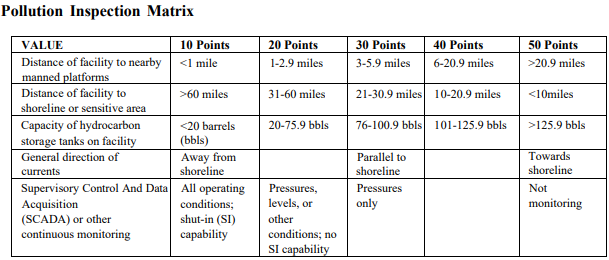
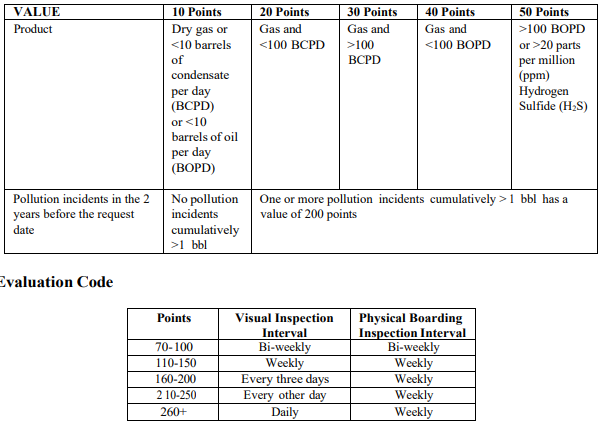
The attached BSEE document provides guidance for determining pollution inspection frequencies for unmanned facilities. Thoughts:

  • Reasonable risk-based approach
  • A minimum of bi-weekly visual and physical inspections for low risk platforms producing dry gas
  • Any platform with significant oil production and storage, and no real time monitoring system, will have to be visually inspected at least every 3 days (daily if other risk factors apply) and boarded weekly
  • Any platform that had spillage totaling > 1 bbl in the past 2 years will have to be visually inspected every other day and boarded weekly.
  • Provides for the application of technology (cameras, drones, innovative monitoring systems) to reduce inspection frequencies.
Read Full Post »

Cheryl Anderson took oil spill data analysis to a level worthy of a world class offshore program. In my opinion, Cheryl was the top analyst in the history of the OCS program, a true Hall of Famer. Regardless of the politics of the day, she always stuck to the facts and resisted “spin,” and that was a trait her colleagues greatly admired.

Cheryl retired at the end of 2010 and her final update, with assistance from 2 other OCS program icons, Melinda Mayes and Bob LaBelle, was published in June 2012. That update is attached.

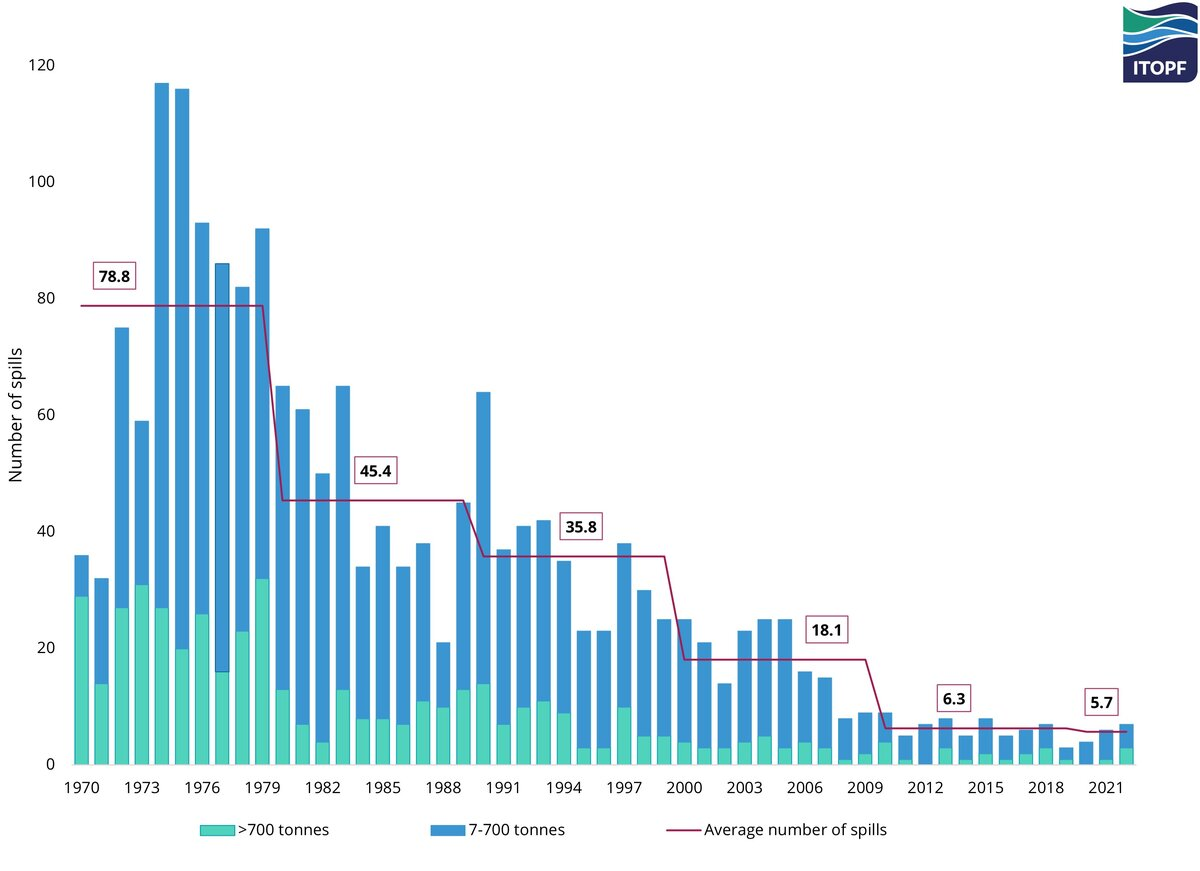
ITOPF also deserves mention for their comprehensive tanker spill data. A recent chart is pasted below. ITOPF’s data are nicely presented on their website. No such data are available for international offshore production.

Read Full Post »

Carbon-Zero US LLC of Dallas (a Cox Oil affiliate) has applied for up to $12 million in U.S. Department of Energy funds to develop a pilot sequestration hub in offshore storage fields about 20 miles from Grand Isle, according to officials from Cox Operating LLC, the Dallas operator that owns some of the storage fields.

Cox Operating LLC will “repurpose facilities and equipment” for the carbon storage project, according to a news release.

The Advocate

Should this company be authorized to repurpose Gulf of Mexico facilities for carbon sequestration?

  • Per BSEE Incident of Non-Compliance (INC) data for 2022, Cox had more component shut-in INCs (132) than any other company. Cox was second to the Fieldwood companies in the number of warning and facility shut-in INCs, and in the total number of INCs. 48% of the Cox INCs required either a component or facility shut-in.
  • Cox had an INC/facility-inspection ratio of 0.77, nearly 50% higher than the GoM average of 0.53.
  • Per the posted BSEE district investigation reports for 2022, Cox was responsible for 9 of the 30 incidents that were significant enough to require investigation. That is more than twice as many as any other company (next highest was 4).
  • The incidents included 3 serious injuries, 2 fires, a large gas leak, and oil spills of 114, 129, and 660 gallons. Per the posted reports, only one other company had an oil spill of >1 bbl. (Note: Only spills of > 1 bbl are routinely investigated by BSEE. One bbl = 42 gallons.)
  • While INCs were issued for only 3 of the 9 Cox incidents, a review of the reports suggests that INCs should have been issued for at least 4 of the other incidents.
  • Cox operates 375 platforms with installation dates as early as 1949. 134 of their platforms are > 50 years old. Only 66 were installed in the last 20 years and only 6 in the last 10 years (most recent December 2014). How will the carbon sequestration plans affect their massive decommissioning obligations?
  • Many of the Cox platforms were assigned by predecessor lessees. Those predecessors can only be held responsible for the decommissioning of facilities they installed, not for more recent wells or platforms and not for facilities that are repurposed for carbon sequestration.

Other more generic issues should be addressed before DOE awards funds for offshore sequestration projects.

Also, as noted in the discussion of Exxon’s 94 Sale 257 oil and gas leases, a competitively issued alternate use RUE is required (30 CFR § 585.1007) before sequestration operations may be conducted on an oil and gas lease.

Read Full Post »

The National Academies have released Oil in the Sea IV, which updates estimates of oil entering North American seas. This is the third update since the publication of Oil in the Sea in 1985.

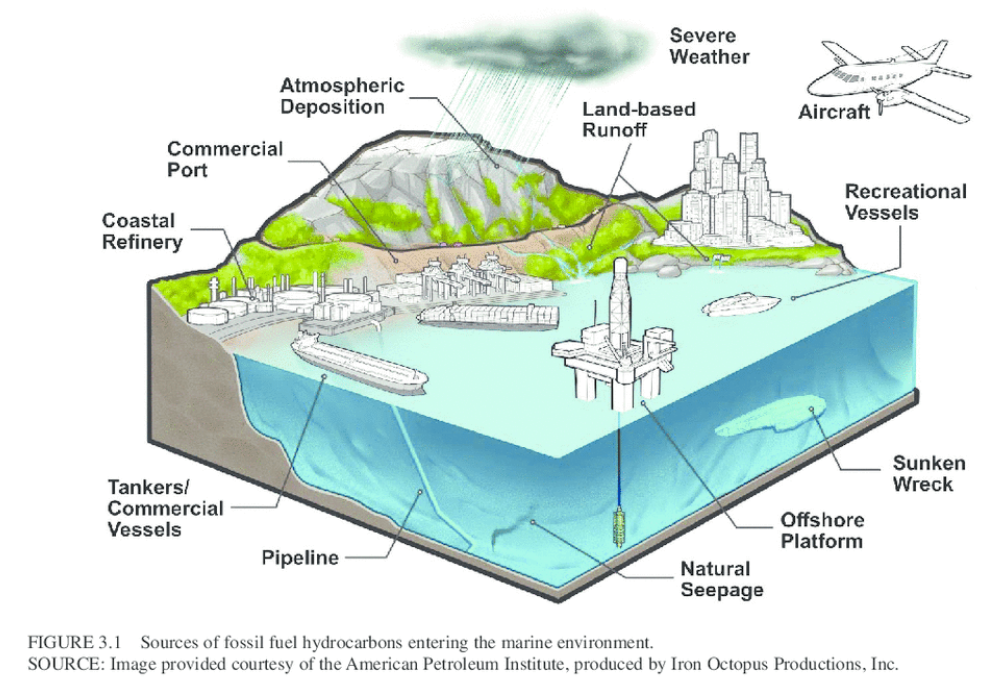
The updated inputs and seeps summary tables are pasted below. Some comments:

  • The Oil in the Sea reports are important in that they provide perspective on natural inputs and those associated with man’s activities. The estimates generate informed discussion about the relative significance of the various inputs.
  • The estimate for land-based sources, which far outweigh all other sources, increased dramatically from the previous report.
  • The oil seepage estimate was reduced by 37.5%, owing to methodology.
  • The difference between the itemized seepage total in Table 3.2 (109,000 mta) and the seepage total in Table 3.1 (100,000 mta) is not explained.
  • The authors assume zero oil seepage in the entire US and Canadian Atlantic, and Arctic offshore. This is highly unlikely given the widespread presence of methane seeps in the Atlantic, the numerous oil seeps identified offshore Labrador, and the MMS/BOEM report on Arctic seepage.
  • The estimate for platform spills (excluding Macondo and the MC-20 seepage) was significantly and inexplicably increased from the previous report, and is well above what BSEE data indicate for that period. No data or justification are provided.
  • The statement (p. 58) that “spills occurred more frequently in offshore waters than nearshore waters” is puzzling and unsubstantiated.

Read Full Post »