Feeds:
Posts
Comments

Posts Tagged ‘oil prices’

The Strategic Petroleum Reserve would have no doubt been tapped again, as the Administration implied in June, if prices had exceeded $80/bbl for a sustained period prior to the upcoming elections. Fortunately, for the consumer and the SPR, that has not been the case.

Prior to the 2022 midterm elections, oil prices reached as high as $122/bbl in June and remained above $90/bbl through July. The SPR was tapped hard with a massive reduction of 123 million bbls in the 5 months prior to the elections.

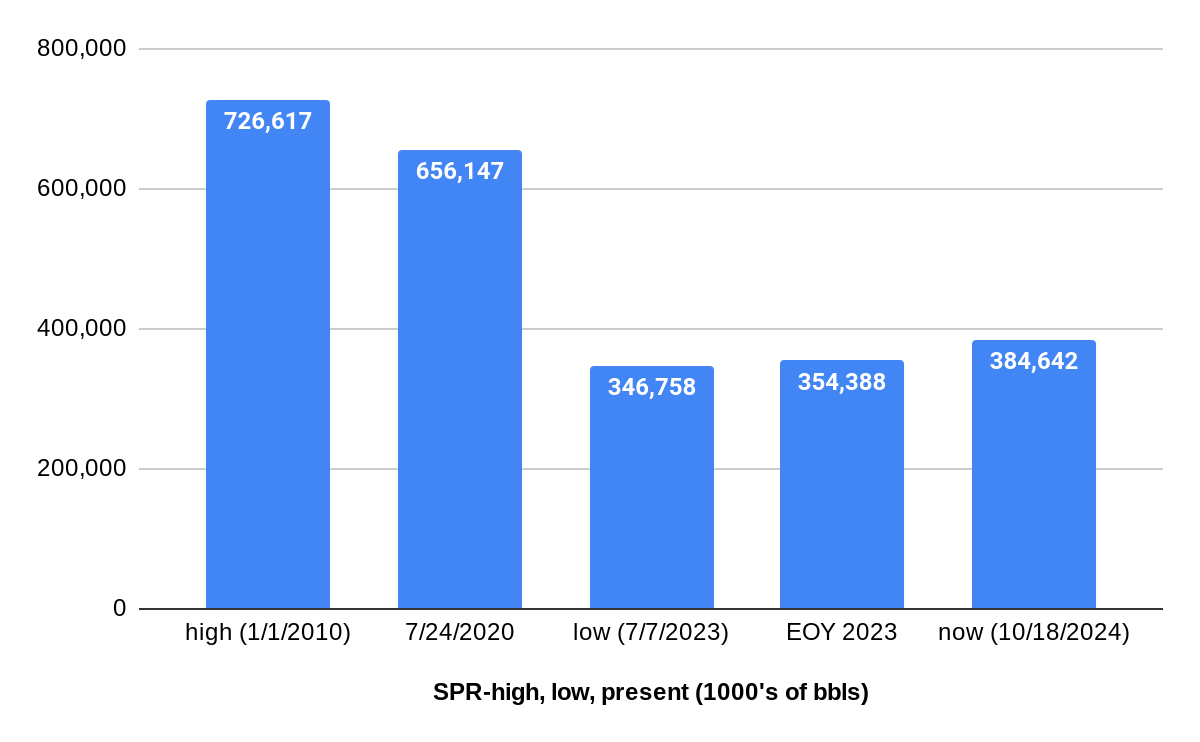
Despite the modest additions to the SPR in 2024, the reserve is only about one-half of capacity and 11% above the all-time low (7/7/2023).

Read Full Post »

Jennifer Granholm

Energy Secretary Jennifer Granholm last month said it would be difficult for the U.S. to take advantage of low oil prices to replenish the Strategic Petroleum Reserve because of maintenance at two of the four sites.

The Financial Times reported, citing people familiar with Saudi Arabia’s thinking, that Riyadh was “irritated” by that comment. In any case, it came on top of stress in the financial sector that had dragged oil prices as low as $64 in March.

Market Watch

As previously posted, the SPR is easier to drain than fill. The reserve is still flat-lined at 371.6 million barrels or about half full.

Read Full Post »

  1. Gulf of Mexico Lease Sale 257 was vacated on 1/27/2022 because DC Federal Court Judge Contreras ruled that BOEM failed to consider the “positive” effect that higher prices (the logical result of lower production) would have on reducing foreign consumption and the associated GHG emissions. Think about that in the context of the timing and magnitude of this ruling. Why did the court fail to consider the other logical consequences of tight oil supplies and higher prices – increased coal consumption and energy poverty? To avoid the latter, India, the world’s second largest coal producer and consumer, is boosting coal production to record highs.
  2. The Administration, which had only proceeded with Sale 257 because a prior court ruling invalidated the President’s leasing pause, chose not to appeal the decision by Judge Contreras. Why appeal a decision that is consistent with your agenda?
  3. The legislatively mandated 5 year leasing program, without which no Federal offshore leases sales may be conducted, expires at the end of June. This is why last week’s cancellation of the 3 remaining sales in the current 5 year program was rather meaningless. Despite bipartisan congressional support for prompt completion of a new 5 year plan, this does not appear to be a high priority for the Department of the Interior. The only hope for a sale this year might be a successful appeal by Lousisiana and API of Judge Contreras’s Sale 257 ruling.

Read Full Post »

Remember that only 5 weeks ago Judge Contreras (DC Federal Court) vacated OCS Lease Sale 257 because  BOEM didn’t analyze the benefits of higher oil and gas prices (as a result of lower US offshore production) in reducing international consumption and GHG emissions. The about that!

Lease Sale 257 wouldn’t have helped get us through this crisis, but would have most definitely reduced our vulnerability to future crises.

473 days since the last US offshore oil and gas lease sale.

Read Full Post »

The very disappointing 68 page ruling on Lease Sale 257 boils down to the following:

  1. BOEM had correctly determined that, from a GHG standpoint, US offshore production was preferable to more carbon intensive foreign production.
  2. The plaintiffs, who are seemingly intent on stopping all oil and gas production regardless of the economic consequences, argued that BOEM failed to consider the “positive” effect that higher prices (the logical result of lower production) would have on reducing demand.
  3. In particular, the plaintiffs asserted that BOEM failed to consider the effect that reduced production (and higher prices) would have on foreign consumption and the associated GHG emissions.
  4. The judge not only decided in favor of the plaintiffs, but ruled that BOEM’s omission was so serious that the lease sale had to be vacated.
  5. The judge reached this decision even though (1) the five year leasing plan expires in June leaving the timing of any future sale very much in doubt and (2) all of the sale 257 bids are now public information compromising the integrity of the leasing process at the next sale (if and when that occurs).

So, if BOEM has to consider the environmental benefits of higher oil and gas prices, shouldn’t they also have to consider the negative economic and environmental effects from the resulting price inflation and energy poverty? Are higher prices, which are most detrimental to the poor and to developing nations, “energy justice?”

If your only objective is the destruction of the US offshore oil and gas program, this was a great decision. For everyone else, this is yet another reason to be concerned about our energy future.

Read Full Post »

But certainly, the supply and — and OPEC and putting additional pressure on OPEC is something that — that, certainly, our national security team will continue to do. 

Jen Psaki, Press Secretary

Equally predictable:

I will also note that, as it relates to gas prices, we remain concerned about trends we have seen where, even as supply has increased at times over the last several months, we’ve still seen heightened prices.

The FTC — we’ve asked the FTC to look into that.  They’ve said they were doing that.

Jen Psaki, Press Secretary

Related post.

Read Full Post »

Egypt Crisis

Map of Suez Canal

Cheryl Anderson is monitoring the energy issues associated with the crisis in Egypt.  According to Cheryl, news reports are careful to note that the Suez Canal has not been specifically threatened by the unrest at this time. However, that possibility will have a significant effect on energy markets.

According to EIA, closure of the Suez Canal and SUMED Pipeline would add 6,000 miles of transit around the continent of Africa.

The Suez Canal is located in Egypt, and connects the Red Sea and Gulf of Suez with the Mediterranean Sea, covering 120 miles. Petroleum (both crude oil and refined products) accounted for 16 percent of Suez cargos, measured by cargo tonnage, in 2009. An estimated 1.0 million bbl/d of crude oil and refined petroleum products flowed northbound through the Suez Canal to the Mediterranean Sea in 2009, while 0.8 million bbl/d travelled southbound into the Red Sea. This represents a decline from 2008, when 1.6 million bbl/d of oil transited northbound to Europe and other developed economies.

The 200-mile long SUMED Pipeline, or Suez-Mediterranean Pipeline provides an alternative to the Suez Canal for those cargos too large to transit the Canal. The pipeline moves crude oil northbound from the Red Sea to the Mediterranean Sea, and is owned by Arab Petroleum Pipeline Co., a joint venture between the Egyptian General Petroleum Corporation (EGPC), Saudi Aramco, Abu Dhabi’s ADNOC, and Kuwaiti companies. Transit through the pipeline declined from approximately 2.3 million bbl/d of crude oil in 2007 to 1.1 million bbl/d in 2009.

Fears that the busy Suez Canal waterway would be shut down amid social strife in Egypt ramped up stocks of tanker owners and pushed up oil prices near $100 a barrel on Friday.


Read Full Post »