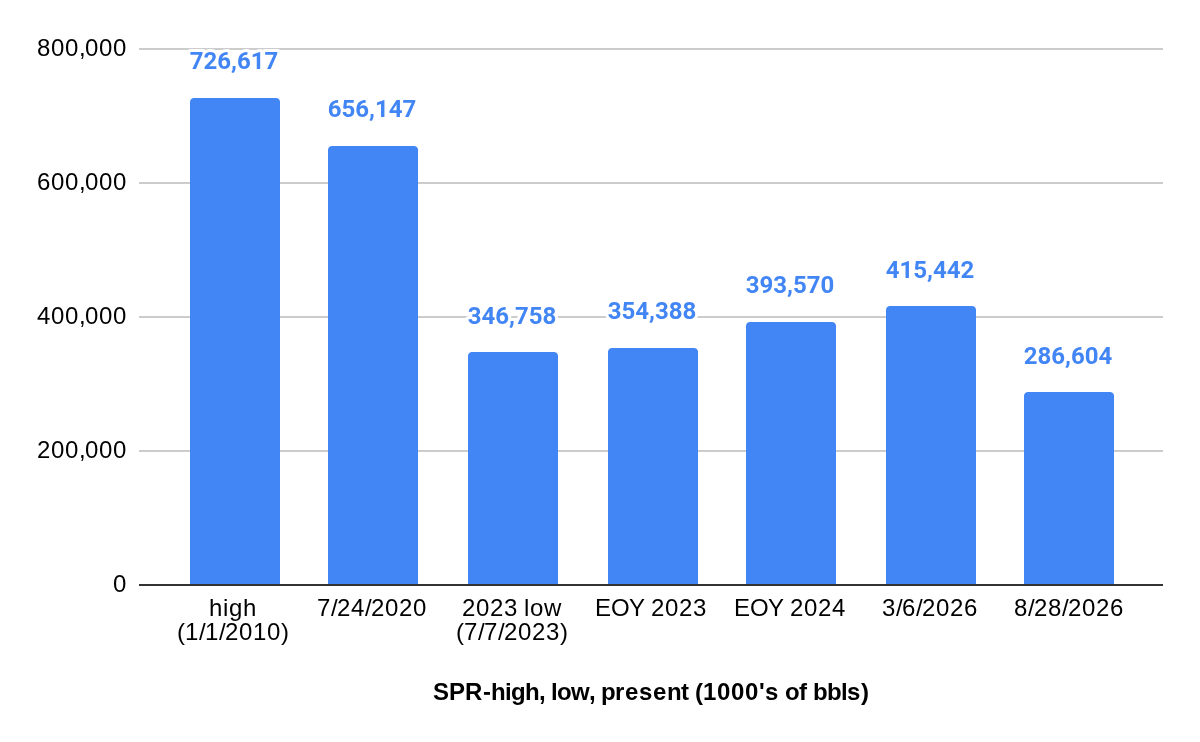
This article asserts that we do not need a Strategic Petroleum Reserve. The author’s arguments:
- Before this decade, there had been “emergency drawdowns” in response to the Gulf War in 1991, Hurricane Katrina in 2005, and the Libyan civil war of 2011. The combined total volume of oil released during these 3 emergencies was <60 million bbls (i.e. <10% of the SPR’s capacity).
- The Biden (290 million bbls net) and Trump (125 million bbls to date, 39 million bbls more promised) drawdowns were not for energy emergencies and will have tapped ~65% of the reserve.
- Deep international markets have done far more to ameliorate shortfalls than the SPR ever could.
- Unlike in the 1970s, the US is now the world’s leading energy superpower. OPECs control of oil markets has been reduced considerably.
- Since governmental price-fixing collapsed in the 1980s, the price of crude oil has been set internationally, bringing supply and demand into constant equilibrium. (Hence the absence of the gas lines that we experienced in the1970s.)
- The petroleum reserve is small relative to global oil supply. Markets hardly notice it.
- The strategic reserve today functions mostly as a political gimmick. Presidents turn to the reserve when gasoline prices rise so they can appear to be doing something helpful.
Drawdown limitations:
- Per DOE, 70 million barrels is the strict physical minimum needed at the top of the caverns to keep the extraction pipes safely submerged in oil rather than water.
- Siddharth Misra, a petroleum engineering professor at Texas A&M University, asserts “the practical operational floor for the crude inventory is between 250 million and 300 million barrels.” The current volume of the reserve is 286.6 million bbls.
- Analysts at Rapidan Energy estimated the SPR has a “soft-ish floor” of around 170 million barrels, below which “cavern integrity and pumping infrastructure limitations argue against further draws.”
Comment: Politicians are good at spending for near-term political purposes, but poor at managing expenditures and preserving assets. (Hence the $40 trillion deficit.) Fortunately, our production of petroleum and petroleum products has more than tripled in the last 20 years. That combined with freer, more efficient energy markets has significantly reduced the SPR’s importance. The case for the reserve is therefore far less compelling than it was 50 years ago. However, the political consensus needed for decommissioning the SPR is unlikely to be achieved.

