NOPSEMA’s June 8 safety alert implies that the June 2nd fatality at the North Rankin complex, offshore Western Australia, was the result of a crane/lifting incident. Per NOPSEMA:
A recent fatal incident involving a person working on an offshore oil and gas facility has provided a tragic reminder of the risks of work involving the rigging, manipulation and movement of loads, including people and equipment.
Despite the international focus on lifting operations over the past 30 years, Norwegian and US data do not suggest improved performance. PSA Norway’s “Trends in risk level on the Norwegian Continental Shelf” report shows an increase in lifting incident rates for both fixed and mobile facilities over the past 10 years (first chart below).
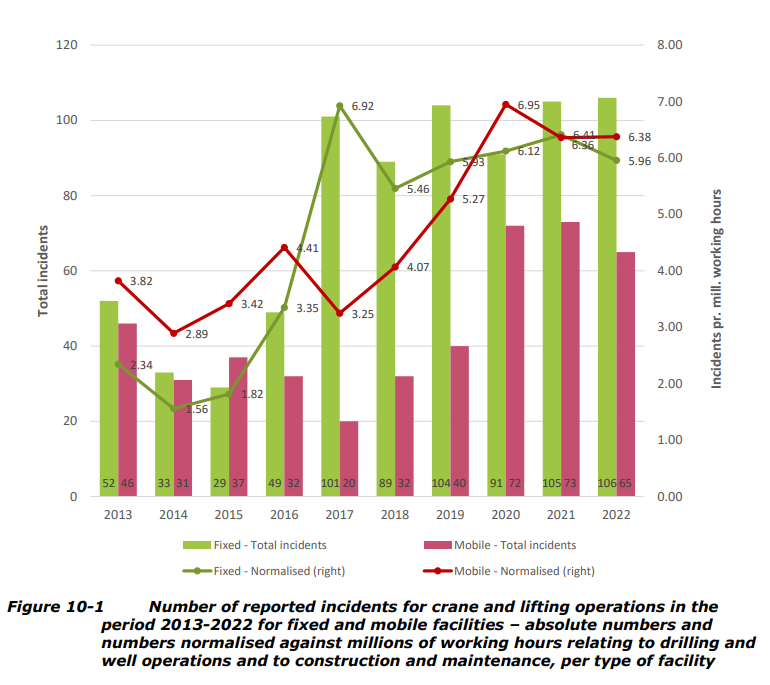
Similarly, recent lifting data from BSEE’s incident tables (summary below) and Jason Mathew’s June 2022 presentation (pages 48-63) suggest that lifting risks are not being effectively mitigated. Why are industy/regulator messages regarding hazard identification and controls not achieving the desired results? Perhaps a fresh look and renewed dialogue are needed.
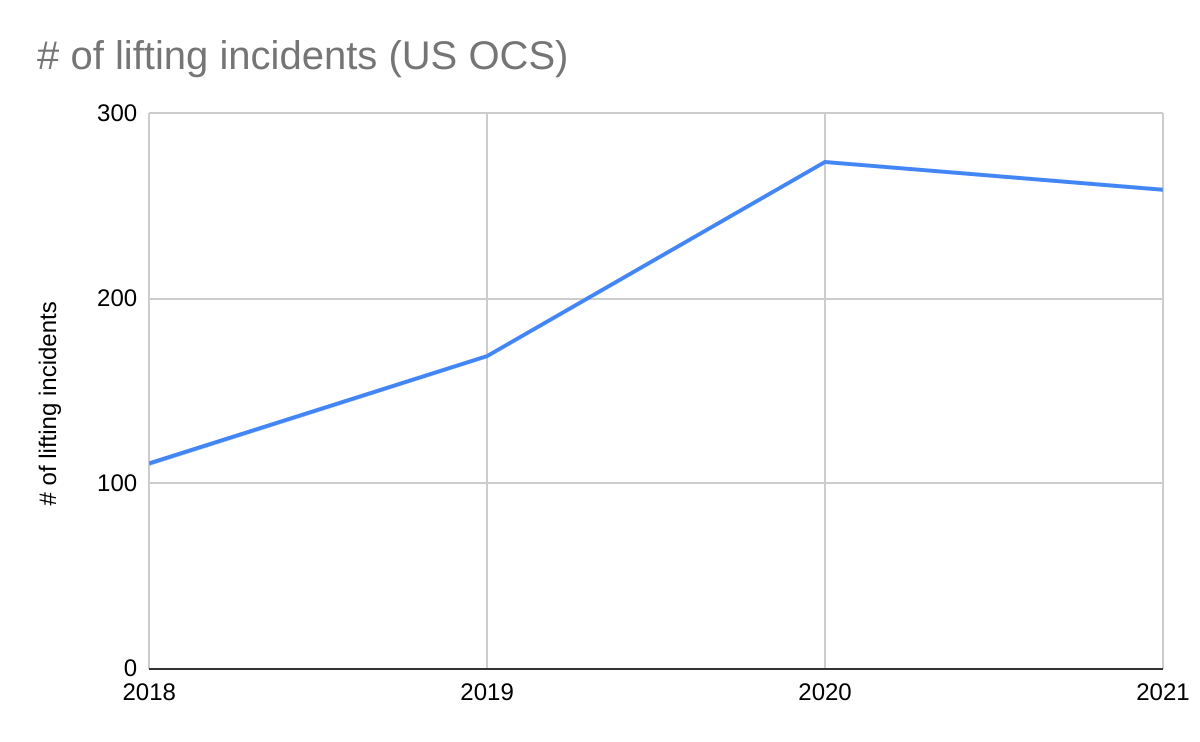
Crane or personnel/material handling incident (as used in 30 CFR 250.188(a)(8)) refers to an incident involving damage to, or a failure of, the crane itself (e.g., the boom, cables, winches, ballring), other lifting apparatuses (e.g., air tuggers, chain pulls), the rigging hardware (e.g., slings, shackles, turnbuckles), or the load (e.g., striking personnel, dropping the load, damaging the load, damaging the facility) at any time during exploration, development, or production operations on the OCS. This includes all incidents of shock loading that, upon inspection, reveals damage to any part of the crane, lifting apparatus, rigging hardware, or load. Personnel handling incidents include events involving swing ropes, personnel baskets, and any other means to move personnel. Material handling incidents include any activities involving the loading and unloading of material and moving it on, off, or around an OCS facility.

 Bud's Offshore Energy (BOE)