 Firstly, major kudos to the Canadians for organizing a great conference in Vancouver, a wonderful city. The Newfoundland-Labrador and Nova Scotia Petroleum Boards, and the National Energy Board were outstanding hosts, and Max, Howard, Stuart, Sean, Bharat, and the folks at Venue West did a great job with the arrangements. The International Regulators’ Offshore Safety Conference was a huge success thanks to their efforts.
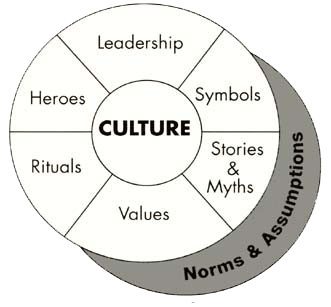
The international leaders in Vancouver were in full agreement that the key to long term safety achievement is the strength and vitality of the safety culture in the operating companies, contractors, and regulatory organizations. How is such a culture encouraged and achieved? As NOPSA CEO Jane Cutler has said “safety culture is what you do when no one is watching.” Inspections are a necessary regulatory tool, but if they are too frequent they send the message that the government is responsible for safety, and that operators and workers can relax their guard. As Magne Ognedal (PSA-Norway) has frequently said, safety must be managed by the “owner” of the facility and the risk, with the government holding the owner accountable and insisting on excellence.
Steve Walker, UK HSE chief, said that regulators must encourage a “beyond compliance” culture and serve as catalysts for learning and achievement. Regulators can never be satisfied; they should be negative thinkers searching for the operations, processes, and behaviors that might trigger the next major accident. Dr. Mark Fleming from St. Mary’s University in Halifax believes that safety culture can in fact be regulated, not in the traditional sense, but by requiring companies to have systems in place for promoting and measuring the organizational culture.
Regulators must also look at their own safety culture. Are they focused solely on compliance and “command and control,” or are they investigating risks, assessing management programs, and evaluating performance? Are regulatory employees free to investigate and inquire, or are they mere implementers of management directives? Are employees rewarded for sustaining the hierarchy or challenging the status quo? Are they expected to explain why accidents can’t happen again or figure out how they can?
Much more on these and other Vancouver topics in the near future.
 Bud's Offshore Energy (BOE)