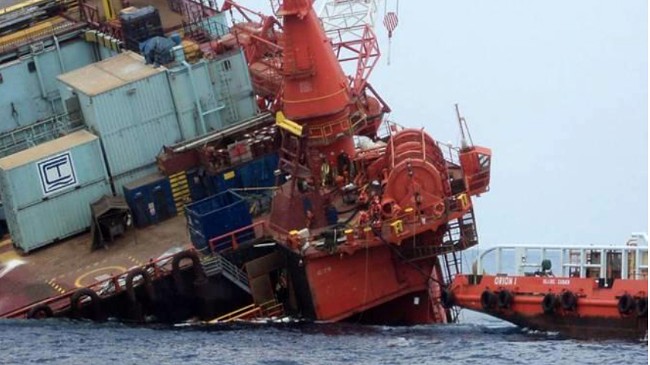
Jupiter Flotel
….interest in offshore accidents quickly diminishes. The Pemex Jupiter semisubmersible quarters facility sank last week with 713 workers aboard (fortunately all were safely evacuated). This stunning near-disaster received minimal coverage. Follow-up reports are non-existent. As our friend JL Daeschler asked, how does a flotel capsize in calm conditions and shallow water? What went wrong and why? Let’s hope that a comprehensive investigation is conducted and that the findings are shared worldwide (unlike Venezuela’s handling of the Aban Pearl sinking).
As we have noted before, Macondo would have disappeared from the news within a week if the deadly fire and explosion had not been followed by a sustained oil spill. The only investigation would have been by Coast Guard and the Minerals Management Service (which would likely still exist). There would have been no National Commission, National Academy, Chemical Safety Board, or congressional investigations, and prosecution by the Justice Department would have been unlikely.
In the US, offshore spills are media events; other accidents are not. How much attention did the horrific fire and explosion that killed seven workers on the South Pass 60 B Platform receive in 1989? Virtually none. How about the lives lost in helicopter crashes? While the crash that killed 17 off Newfoundland in 2009 has been well studied and reported, offshore helicopter crashes in the US receive almost no attention. Ditto for crane accidents. If we want to build a proper safety culture, we need to pay as much attention to the low-profile accidents as we do the pollution spectaculars, and everyone needs to participate.
 Bud's Offshore Energy (BOE)