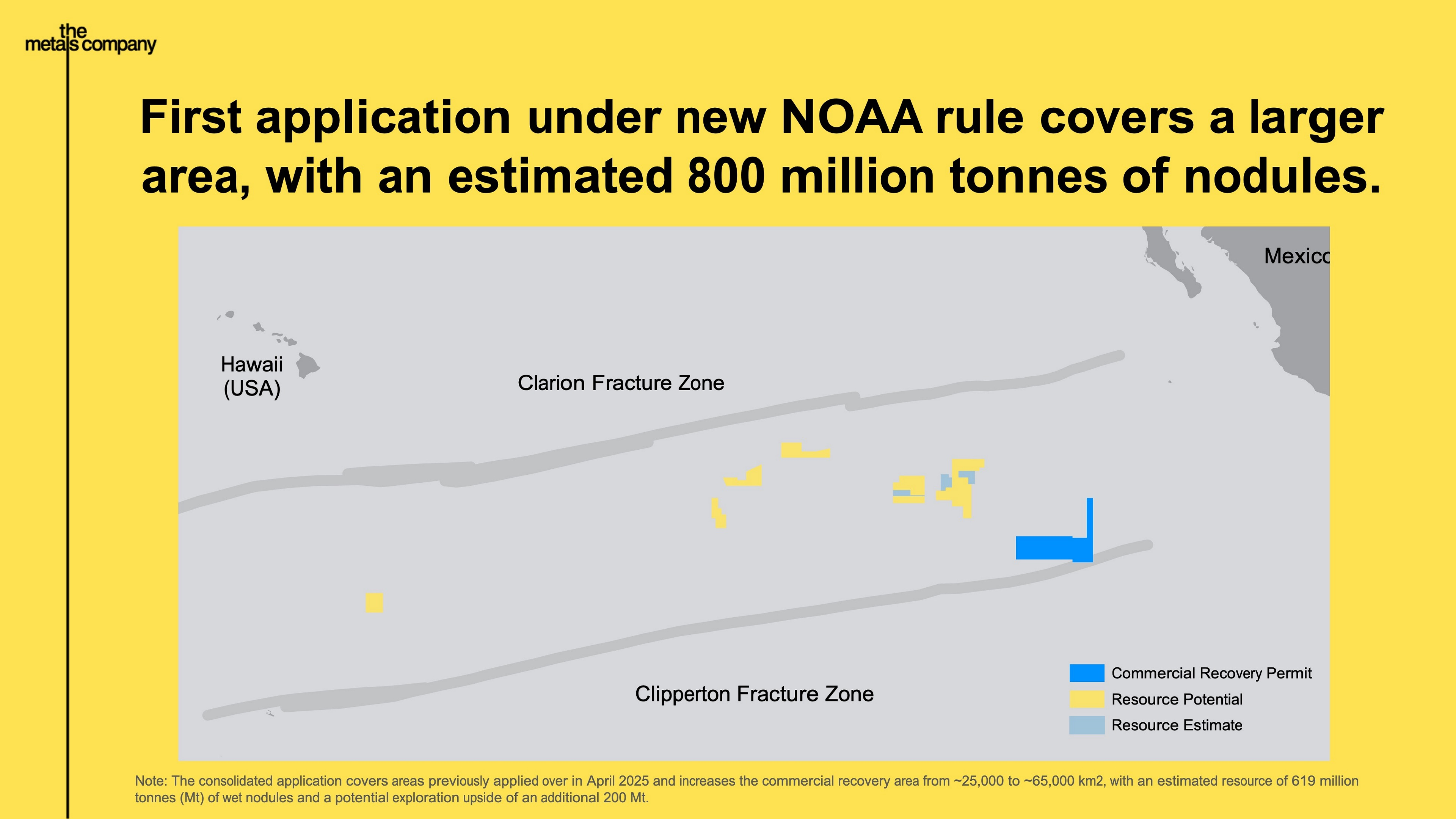
The Metals Company has filed the first consolidated application for an exploration license and commercial recovery permit under NOAA’s new regulations.
Posted in Regulation, energy policy, deep sea mining, tagged deepsea minerals, DSHMRA, first application, NOAA, The Metals Company, TMC on January 23, 2026| Leave a Comment »
The Metals Company has filed the first consolidated application for an exploration license and commercial recovery permit under NOAA’s new regulations.
Posted in deep sea mining, energy policy, Regulation, tagged consolidated licensing, deepsea minerals, DSHMRA, environmental issues, final rule, jurisdictional issues, NOAA, step forward on January 23, 2026| Leave a Comment »
Links to final rule and post about the draft rule
“The objective of this rule is to provide the option for a consolidated application streamlining the process for qualified applicants.”
Reflecting on advances in environmental science, seafloor mapping, and offshore mineral-collection technologies, the revised rule allows qualified companies that gather the necessary site information to proceed to the collection phase. Deepsea mining is now more closely aligned with offshore oil and gas in that companies acquiring licenses are able to proceed to production after regulatory approvals.
The preamble nicely summarizes the opposition to the rule for environmental and jurisdictional reasons:
“General opposition to deep seabed mining was expressed for a variety of stated reasons, including, but not limited to the following assertions: effects on the environment; effects on seabed habitat and to marine species including undiscovered species especially in the Clarion-Clipperton Fracture Zone; harm to cultural resources and Pacific Islander livelihoods and beliefs; inadequate scientific research and information; inadequate resource protection measures and regulations; uncertainties regarding environmental impacts and a nascent industry; significant technical challenges to deep seabed mining; opposition to deep seabed mining from many U.S. states, countries, and global companies; that deep seabed mining is contrary to international agreements and efforts; the need for moratoria; that deep seabed minerals are not needed to meet U.S. demand for critical minerals and domestic sources and recycling of such minerals should be used instead; the U.S. needs to focus on building domestic refineries; using renewable and alternative resources rather than deep-sea minerals; and jeopardizing vital carbon sinks.”
“Commenters stated that acting unilaterally on deep seabed mining undermines the ISA (International Seabed Authority) process, international norms, global stability, and the rule of law, and that it could result in harm to protected areas, such as Areas of Particular Environmental Interest designated by the ISA.”
Posted in deep sea mining, energy policy, Offshore Energy - General, tagged BOEM, deepsea minerals, Impossible Metals, International Seabed Authority, NOAA, rare earths, The Metals Company, underwater sculpture on April 29, 2025| Leave a Comment »
… and shared a mineral water toast! 😉 (Weak joke, but at least it’s original and topical!)


NOAA and TMC, a Canadian company, are working together to bypass the stifling UN deep sea minerals bureaucracy.
NOAA raises a glass: Yesterday, President Trump signed an Executive Order establishing a framework for American companies to identify and retrieve offshore critical minerals and resources. The Executive Order prioritizes U.S. leadership in seabed mapping and mineral exploration, ensuring reliable access to critical minerals like manganese, nickel, cobalt and rare earth elements.
In support of the Executive Order, NOAA is committed to an expeditious review of applications for exploration licenses and commercial recovery permits. The agency will provide the necessary resources for license and permit reviews to ensure that those reviews go forward without undue delays.
China boos: “The US authorization… violates international law and harms the overall interests of the international community,” Chinese foreign ministry spokesman Guo Jiakun said on Friday.
TMC and other companies like Impossible Metals (see below) have had enough of the endless delays at the United Nations’ International Seabed Authority, which is still developing regulations. Mining companies and others have spent years gathering data and providing input.
Meanwhile in US waters:
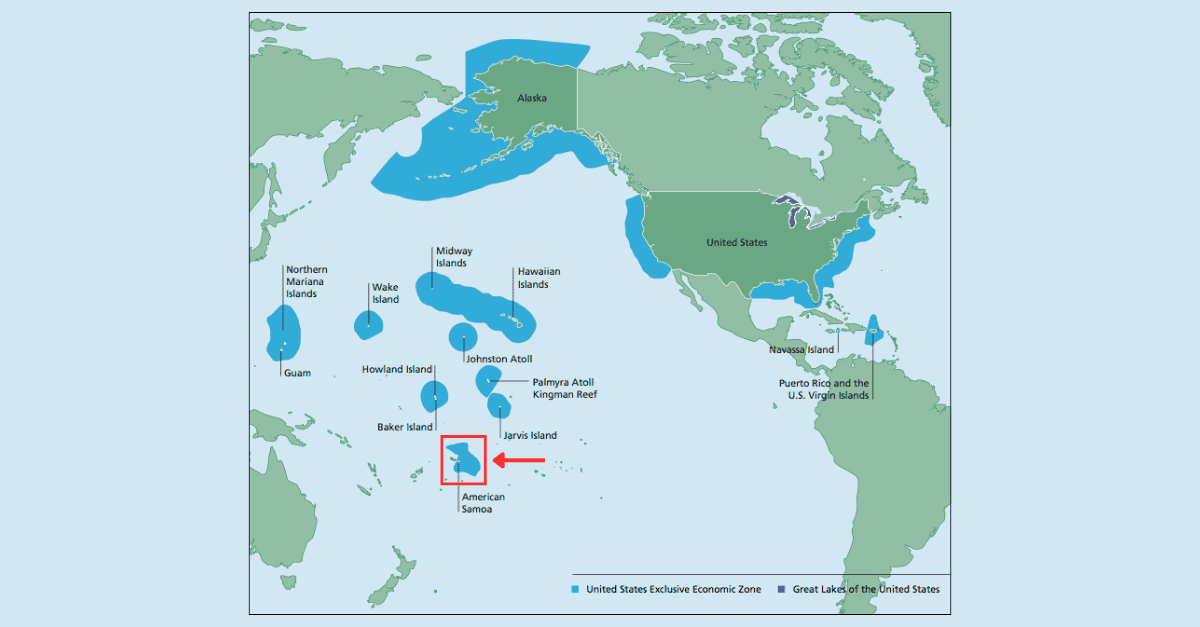
San Jose, CA – Impossible Metals, a pioneering US-based deep-sea mining company, has submitted a request to commence a leasing process for exploration and potential mining of critical minerals in the deep sea off the coast of American Samoa. Impossible Metals is the first company to request a lease of critical minerals under the Outer Continental Shelf Lands Act of 1953, which is regulated by the U.S. Bureau of Ocean Energy Management (BOEM), part of the U.S. Department of the Interior.
Impossible Metals has developed the only autonomous underwater robot (AUV) for selective harvesting. The novel underwater robot uses advanced robotics, AI, and a buoyancy engine to hover above the seabed, accurately identifying and avoiding nodules with visible life while minimizing disruption to the habitat and native biodiversity. This method will have the lowest environmental impact and cost among land and deep-sea mining approaches, setting a new standard for responsible resource collection.
 Bud's Offshore Energy (BOE)