The government’s decision to require that a capping stack be located in Guyanais prudent. Although the need for a capping stack is dependent on multiple barrier failures and is thus extremely low, the environmental and economic consequences of a prolonged well blowout warrant timely access to this tertiary well control option.
A capping stack must be properly maintained and deployable without delay. In that regard, BSEE has a good program for testing Gulf of Mexico capping stack readiness. Capping stack drills are an important post-Macondo addition to the unannounced oil spill response program that dates back to 1981.
“Troy Naquin, BSEE New Orleans District, observes as a capping stack is carefully lowered onto the deck of ship to be transported more than 100 miles offshore for a drill designed to test industry’s ability to successfully deploy it in case of an emergency, May 8, 2023.” BSEE photo/Bobby Nash
“Our knowledge and expertise in geoscience and petroleum engineering represent advantageous foundation for CCS development, leading us towards our carbon emissions reduction target.”
Those who closely followed Australia’s Montara Inquiry in 2010 may be less convinced about PTTEP’s expertise. The Montara well suspension program was completely irresponsible. Even though the production casing cement was clearly compromised, PTTEP suspended the well without a single barrier in the well bore. The company was extremely lucky to have avoided a major safety, environmental, and economic disaster. Perhaps they are a very different company now; I certainly hope so.
Montara blowout, Timor Sea
The PTTEP announcement adds to our skepticism about the motives of some CCS proponents. Is CCS prudent public policy? That question is by no means settled and there has been very little opportunity for comment and debate. BOE has raised concerns and there are no doubt many more that have yet to be addressed.
Industry standards are critical to safety achievement. They represent best practices as determined by leading experts in the many disciplines that support oil and gas exploration and development. Another plus for standards is that, unlike regulations, they can be developed in a timely manner, particularly where there is an immediate need. However, industry mergers and streamlining have reduced the diversity of input, and some companies either do not participate or participate primarily to promote or protect their particular interest. The need for a consensus can also result in “lowest common denominator” outcomes that lack the necessary rigor.
Minerals Management Service (MMS) reviews indicated that cementing issues were the leading contributing factor to well control incidents between 1992 and 1996 (see chart below). On August 16, 2000, MMS challenged a new API cementing work group to improve zonal isolation, reduce the occurrence of sustained casing pressure, and prevent annular flow incidents before, during, and after cementing operations. Unfortunately, the standard was long delayed because of internal disagreements within the work group. Feedback indicated that some participants preferred a watered down, less rigorous version.
It is undisputed that the primary cement at Macondo failed to isolate hydrocarbons in the formation from the wellbore—that is, it did not accomplish zonal isolation. If the cement had set properly in its intended location, the cement would have prevented hydrocarbons from flowing out of the formation and into the well. The cement would have been a stand-alone barrier that would have prevented a blowout even in the absence of any other barriers (such as closed blowout preventer rams, drilling mud, and cement plugs).
API Standard 65-2, Isolating Potential Flow Zones During Well Construction, if completed in a timely manner and complied with would likely have prevented not only the Macondo disaster, but also the 2009 Montara blowout in Australia. (The Montara investigation hearings were covered extensively on this blog in 2010.) This important standard was ultimately finalized in a reactive manner after the Macondo well blew out.
Standard 65-2 focuses on the prevention of flow through or past barriers that are installed during well construction. A few key elements that are pertinent from a Macondo perspective:
Companies are required to perform a risk assessment prior to utilizing foamed cement and make sure that the results of this assessment are incorporated in the cementing plan. In setting the production casing on the Macondo well, foamed cement was used in an oil-based mud environment, destablizing the cement and contributing to the failure to isolate the highly productive oil reservoir.
The framework in Annex D of the standard does a good job of outlining the questions that should be asked in conducting a cementing risk assessment. These issues identified in the Chief Counsel’s report, which includes an outstanding review of the technical and management issues associated with the cementing/zonal isolation of the Macondo reservoirs, should have been addressed by BP and their contractors before initiating the well suspension program:
narrow pore pressure/fracture gradient;
use of nitrogen foamed cement;
use of long string casing design;
short shoe track;
limited number of centralizers;
uncertainty regarding float conversion;
limited pre-cementing mud circulation;
decision not to spot heavy mud in rathole;
low cement volume;
low cement flow rate;
no cement evaluation log before temporary abandonment; and
temporary abandonment procedures that would severely underbalance the well and place greater stress than normal on the cement job.
Unfortunately, such an assessment was not conducted and critical operational decisions were made in a rash manner with the objective of saving time. We know the outcome – 11 lives lost, massive pollution, and enormous social costs
Despite making multiple changes over the last nine days before the blowout, the Macondo team did not formally analyze the risks that its temporary abandonment procedures created. The Macondo team never asked BP experts such as subsea wells team leader Merrick Kelley about the wisdom of setting a surface cement plug 3,000 feet below the mudline to accommodate setting the lockdown sleeve or displacing 8,300 feet of mud with seawater without first installing additional physical barriers. It never provided rig personnel a list of potential risks associated with the plan or instructions for mitigating those risks.
Almost every decision the Chief Counsel’s team identified as having potentially contributed to the blowout occurred during the execution phase.
While the official BOEMRE-USCG and National Commission/Chief Counsel investigation reports were quite good and there are countless court documents and ad hoc reviews of the blowout, some important Macondo issues have not been fully addressed. BOE will touch on these issues periodically starting with the decision to terminate the top kill operation on 5/28/2010.
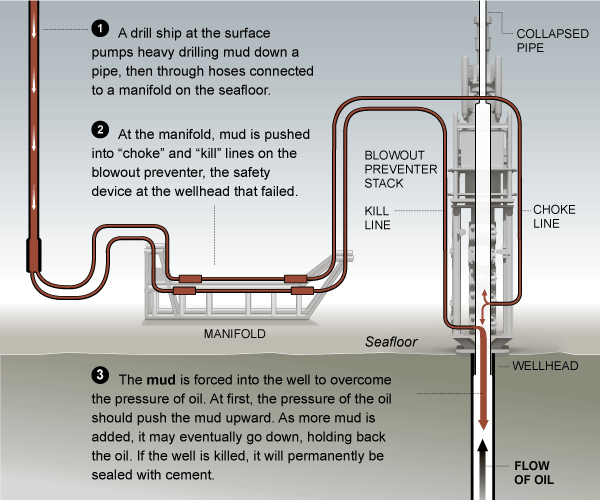
The top kill operation (see diagram above) was intended to overcome and halt the flow of oil by pumping heavy mud into the well bore. The operation was not successful because the pumping rate and mud weight did not generate sufficient pressure. Per an excellent paper by Dr. Mayank Tyagi and colleagues at LSU (Analysis of Well Containment and Control Attempts in the Aftermath of the Deepwater Blowout in MC252):
It is very likely that if the top kill had been designed to deliver more than 109 bpm of 16.4 ppg drilling fluid below the BOP stack for a sustained period, the Macondo blowout could have been stopped between May 26-28, 2010. Given that the well was successfully shut-in with the capping stack in July, and that the subsequent bullhead (static) kill was successful, certainly a higher rate top kill would have been successful at that time.
The American Thinker, citing the New York Times, reports that Energy Secretary Chu stopped the top kill operation over the objections of some BP engineers. While it was reasonable to be concerned about possible casing leaks and the fracturing of subsurface formations, the subsequent (7/15/2010) closure of the capping stack demonstrated that the well had sufficient integrity to support the top kill operation. Questions regarding why a higher rate top kill effort was not attempted and how that decision was made are therefore important and merit discussion. Did the Macondo well flow unnecessarily into the Gulf for an additional 48 days (5/28-7/15)? Did the National Incident Command facilitate or delay source control?
Keep in mind that the NIC almost made a similar mistake in July. Even after the capping stack successfully shut-in the well on 7/15, Incident Commander Thad Allen (USCG) continued to call the closure of the capping stack a temporary test and threatened to require BP to resume flow from the well. Fortunately, informed input from experienced engineers prevailed. The well remained shut-in and the static well-kill operation was successful.
The Atgas 2H well operated by Chesapeake Energy in Leroy Township blew out at around 2 a.m., according to Bradford County Emergency Management Agency Deputy Director Skip Roupp.
The well was in the process of being hydraulically fractured and Roupp characterized the spilled fluid as “mostly water … with some contaminants” but he did not know the exact composition of the fluid.
“Evidently the crack is in the top part of the well below the blowout preventer,” he said, referring to a device used in emergency situations to choke off flow from a well. “They don’t really know what happened yet because they don’t have it controlled yet.”
BOE applauds retired offshore regulators Ian Whewell (UK HSE) and John Clegg (NOPSA Australia) for their excellent participation in yesterday’s hearings. No one is wiser than a retired regulator. 😉



 Bud's Offshore Energy (BOE)