Archive for the ‘pipelines’ Category
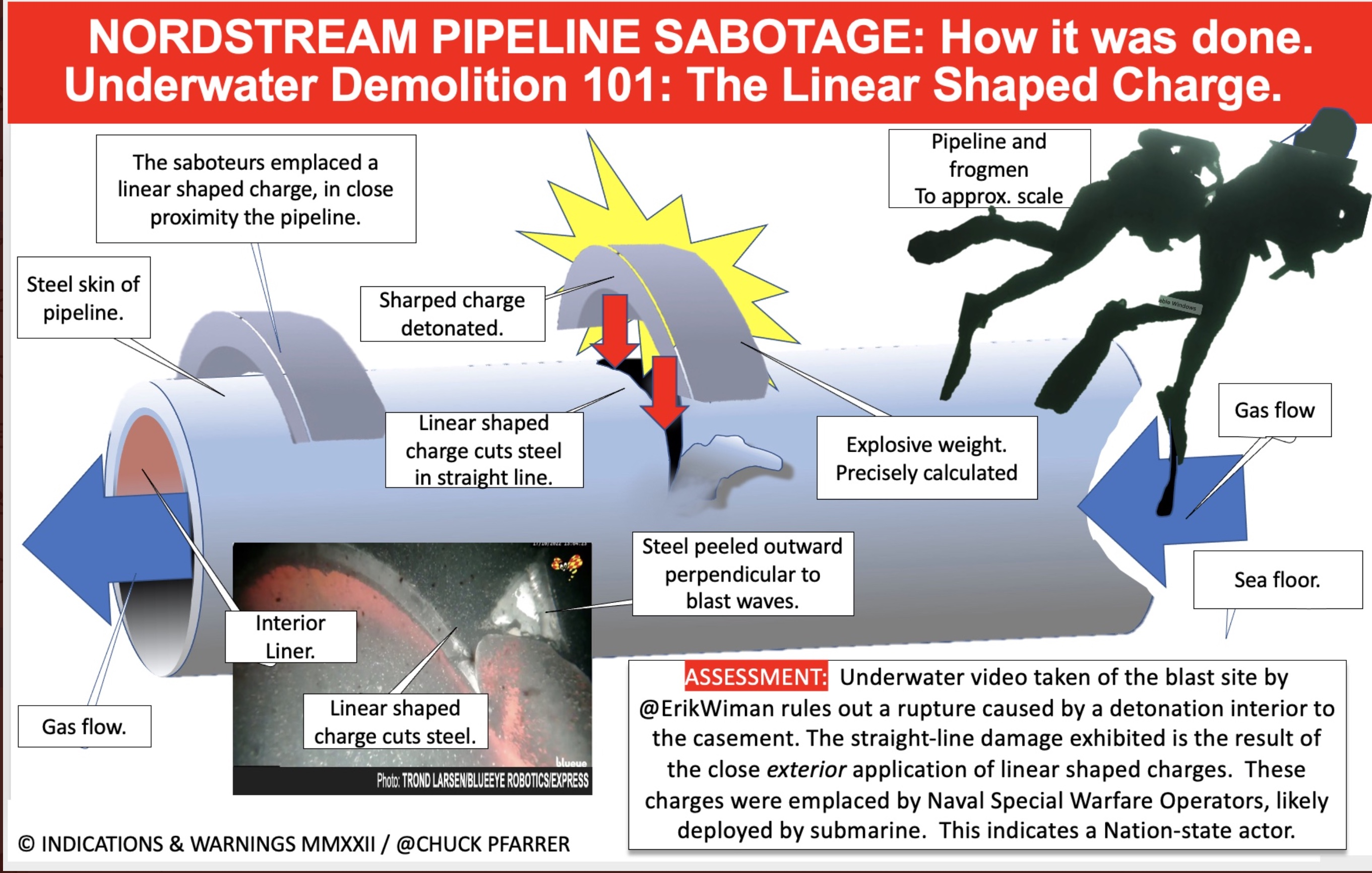
This Nord Stream scenario is credible, but the big question is “who,” not “how”
Posted in Offshore Energy - General, pipelines, Russia, tagged explosions, Nord Stream, pipelines, who did it? on November 28, 2022| Leave a Comment »
Nord Stream explosives confirmed
Posted in energy, Offshore Energy - General, pipelines, Russia, tagged explosives, Nord Stream, Sweden on November 18, 2022| Leave a Comment »
Sweden’s prosecutor’s office said Friday that an investigation into gas leaks from two underwater pipelines connecting Russia to Germany found traces of explosives, confirming that it is a case of “serious sabotage.”
CNBC
Nord Stream and the buzz about “dark ships”
Posted in pipelines, Russia, UK, tagged AIS, dark ships, Nord Stream, pipeline rupture on November 14, 2022| Leave a Comment »

Using satellite data, SpaceKnow detected 2 “dark ships” near the pipelines prior to the explosions. The ships were operating with their automatic identification system (AIS) transponders turned off or malfunctioning. While this is cause for suspicion, no data were provided on the frequency of such issues in the Baltic. Also, what were the specific routes and timelines for these vessels? Absent this information. the “dark ship” reports aren’t terribly meaningful.
Although the assumption that the explosions occurred outside the pipeline seems most likely, some observers have suggested that the explosions were internal. It’s unknown whether the investigators have ruled out this possibility.
Meanwhile, the folks in Germany and elsewhere in Europe are understandably impatient. They want answers from their governments!
Is Israel (plus Cyprus and Lebanon) the Guyana of natural gas?
Posted in energy policy, Guyana, Offshore Energy - General, pipelines, tagged Cyprus, Eastern Mediterranean, Israel, Lebanon, natural gas on November 9, 2022| Leave a Comment »
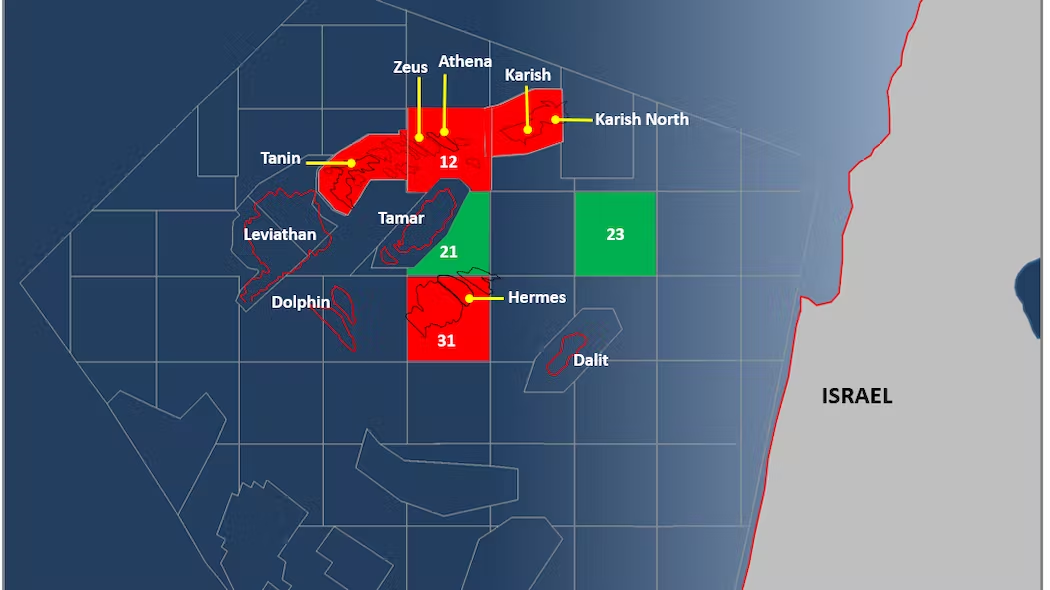
100+ tcf and the discoveries keep coming. Here’s the latest:
London, 7 November 2022 – Energean plc is pleased to announce that i) the Zeus 01 exploration well has made a commercial gas discovery of 13 bcm ii) contingent resources at Athena have been upgraded following post-well analysis; and iii) the Stena IceMax drilling rig has moved to block 23 to drill the Hercules structure, the final well in Energean’s 2022 drilling campaign.
Nord Stream: Russia blames UK navy
Posted in accidents, pipelines, Russia, tagged investigations, Nord Stream, Russia, UK on October 30, 2022| Leave a Comment »
LONDON, Oct 29 (Reuters) – Russia’s defence ministry said on Saturday that British navy personnel blew up the Nord Stream gas pipelines last month, a claim that London said was false and designed to distract from Russian military failures in Ukraine.
No evidence was presented to support the Russian claim; nor was any information provided on the results of their blitz investigation.
Will the Russian Nord Stream investigation be the first to be released?
Posted in accidents, Offshore Energy - General, pipelines, Russia, tagged investigation, Nord Stream, pipelines, Russia on October 27, 2022| Leave a Comment »
It looks like it might be.
Nord Stream AG, or the operator of Nord Stream 1 pipeline, sent a specially equipped vessel on Thursday to investigate damage to the pipelines under the Baltic Sea.
Nord Stream AG, whose majority shareholder is Russia’s state energy giant Gazprom, said the chartered vessel arrived at the location of damage in Sweden’s exclusive economic zone.
The vessel, bearing the Russian flag, would have specialists aboard to assess the damage within a day and investigation would take three to five days, the company said.
Nord Stream AG said it didn’t have relevant permits to conduct an investigation until now.
DW
That’s a fast investigation!
Danish police confirm that powerful explosions caused the Nord Stream pipeline leaks
Posted in energy policy, pipelines, tagged Denmark, Nord Stream, pipeline leaks, Sweden on October 19, 2022| Leave a Comment »
Nord Stream methane release – some perspective
Posted in climate, pipelines, seeps, tagged methane inputs, NordStream, Oil in the Sea, pipeline leaks on October 4, 2022| Leave a Comment »
Sept 30 (Reuters) – The ruptures on the Nord Stream natural gas pipeline system under the Baltic Sea have led to what is likely the biggest single release of climate-damaging methane ever recorded, the United Nations Environment Programme said on Friday.
“This is really bad, most likely the largest emission event ever detected,” Manfredi Caltagirone, head of the IMEO for UNEP, told Reuters. “This is not helpful in a moment when we absolutely need to reduce emissions.”
Researchers at GHGSat, which uses satellites to monitor methane emissions, estimated the leak rate from one of four rupture points was 22,920 kilograms per hour. That is equivalent to burning about 630,000 pounds of coal every hour, GHGSat said in a statement.
The Nord Stream methane release, while puzzling and rather frightening given the potential for escalating international tensions, was not an environmental disaster or even a major environmental setback.
Some perspective:
- estimate for the main Nord Stream leak (likely the maximum or near-maximum rate) = 22,930 kg/hr
- 22,930 kg/h = 550,320 kg/day = 550.320 x 10⁶ g/day
- total methane source for North American coastal waters (NASEM, Oil in the Sea, p. 63) = 4 – 20 Tg/yr
- 10 Tg/yr (i.e. 10 x 1012 g/yr) = 0.027 x 10¹² g/day = 27000 x 106 g/day
- This is ~50 times the temporary (maximum?) daily rate for the Nord Stream leak
- North American input from seafloor seepage only (NASEM, Oil in the Sea, p. 63) = 2 – 9 Tg/yr
- assuming 5 x 10¹² g/year or 13700 x 106 g/day
- This is ~25 times the temporary (maximum?) daily rate for the Nord Stream leak
German Navy to join Nord Stream investigation; Russia to investigate (presumably separately)
Posted in accidents, energy policy, pipelines, tagged German Navy, NordStream, pipeline leaks, Russia on September 29, 2022| Leave a Comment »
Germany’s navy is contributing to the investigation into the Nord Stream 1 and 2 gas pipeline leaks, said Defence Minister Christine Lambrecht, who added that the situation must be clarified and those responsible must be identified quickly.
Reuters
Russia’s FSB security service is investigating the damage sustained by the Nord Stream gas pipelines under the Baltic Sea as “international terrorism”, the Interfax news agency cited the general prosecutor’s office as saying on Wednesday.
Reuters
Meanwhile, “the U.S. is supporting efforts to investigate,” whatever that means.
Here is Al Jazeera’s summary video:
Worse than embarrassing
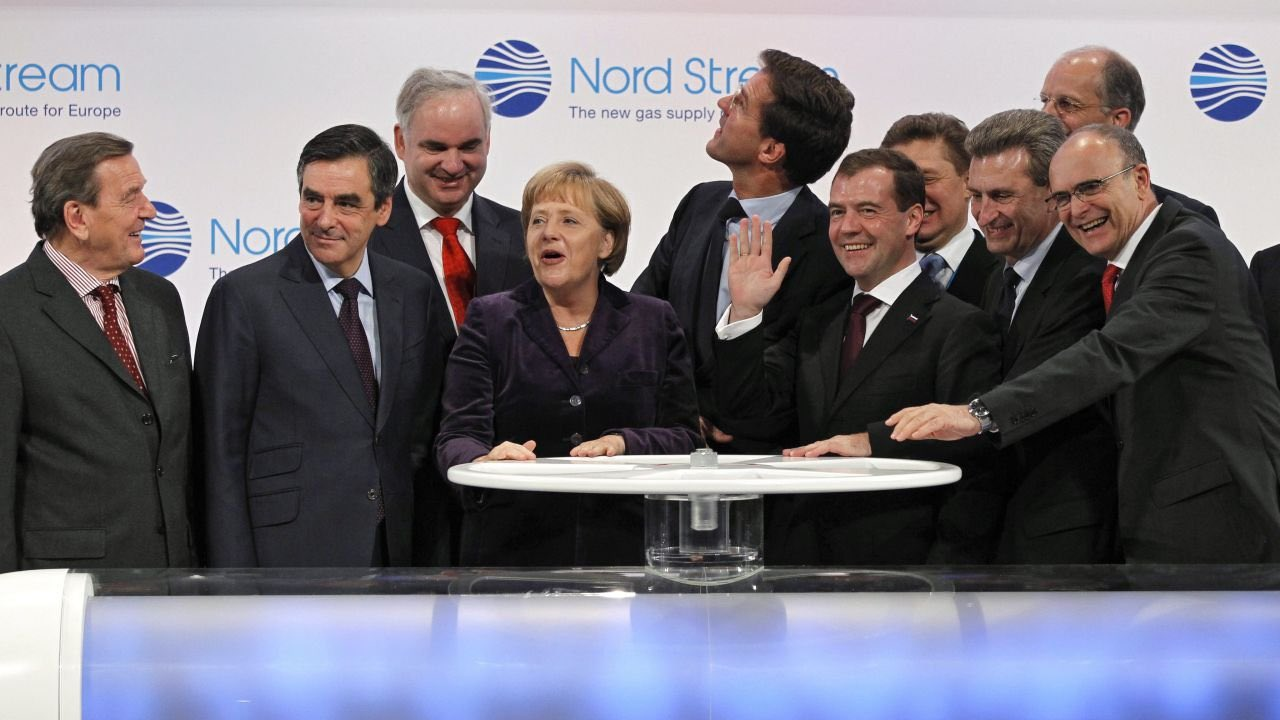
Posted in accidents, pipelines, Russia, tagged Angela Merkel, germany, NordStream on September 28, 2022| Leave a Comment »
 Bud's Offshore Energy (BOE)