Feeds:
Posts
Comments

Archive for the ‘IRF’ Category

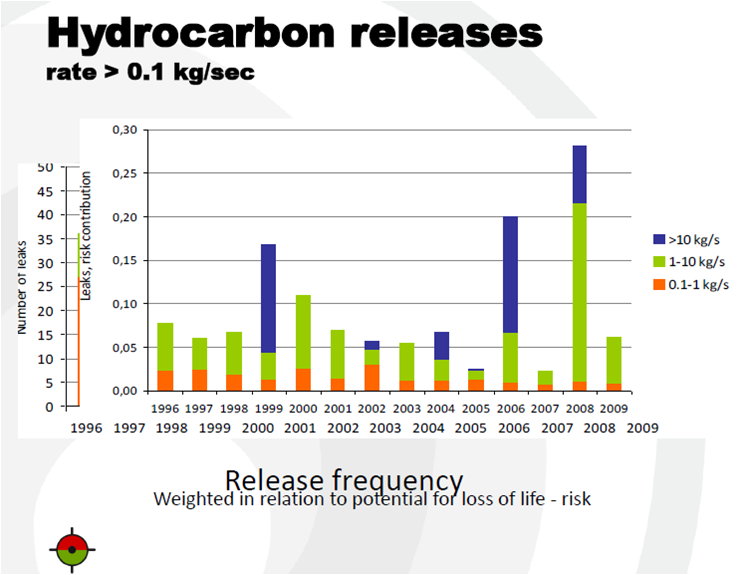
The above slide is excerpted from Torleif Husebo’s presentation at the Vancouver conference.  Since Piper Alpha in 1988, offshore safety leaders have been gathering and assessing hydrocarbon release data.  Norway, the UK, Australia, the Netherlands and other nations track these data because they are an important indicator of fire and explosion risks. The IRF reports these data as part of their performance measurement project.

Obviously, when hydrocarbons are unintentionally released at an offshore facility you have the potential for a very dangerous situation.   However, because of objections voiced when the MMS updated incident reporting requirements 5 years ago, the US government does not collect the detailed information needed to track the size and cause of these releases.  The US is thus unable to monitor trends and benchmark against other nations around the world.

Offshore companies have done well in responding to the drilling issues raised following the blowout.  However, the post-Macondo offshore industry needs to provide broad safety leadership.  A commitment to collecting performance data and assessing risk trends at OCS oil and gas facilities is absolutely essential.  A good place to start would be to initiate a cooperative hydrocarbon release data gathering program.
Read Full Post »


Vancouver, BC, Canada


The program for the International Regulators’ Offshore Safety Conference has been updated to include keynote presentations on the Montara and Macondo blowouts, and roundtable sessions that will address the lessons learned and how they should be applied by operators, contractors, and regulators.  The presentations, discussions, and debates are sure to be thought provoking and informative.  If you would like to participate, visit the conference website for more information.

Read Full Post »

Measuring and comparing international safety performance is not possible without consistent, verifiable data.  Most existing data sets suffer from one or more of the following shortcomings:

  • Some workers (e.g. contractors) are excluded
  • Dependent on voluntary submissions
  • No verification process
  • Inconsistent definitions and classification procedures

The International Regulators’ Forum has taken a major step forward in measuring and comparing safety performance.  Detailed definitions and guidelines have been established for classifying offshore safety incidents and compiling the data.  These criteria are now being used to compile incident data for IRF countries. The IRF definitions and classification procedures could be broadly applied by industry and regulators to better assess safety performance and identify operational concerns.  Learn more.

Read Full Post »

The acronym is awkward but the International Committee on Regulatory Authority Research and Development is a great source of information about offshore safety and pollution prevention research.  If you need more information about a design, operational, or management issue, there’s a good chance that an ICRARD member has conducted a relevant study.  Go to the ICRARD site and give it a try!

Read Full Post »

« Newer Posts