
Former President Bill Clinton said Friday that delays in offshore oil and gas drilling permits are “ridiculous” at a time when the economy is still rebuilding, according to attendees at the IHS CERAWeek conference. Politico.com
Archive for the ‘energy’ Category
Bill “Drill Baby” Clinton
Posted in drilling, energy, Offshore Energy - General, tagged Bill Clinton, drilling, Gulf of Mexico, IHS CERA, offshore oil on March 13, 2011| 1 Comment »
While we were gone
Posted in accidents, cuba, drilling, energy, Uncategorized, tagged Australia, Brazil, deepwater drilling, drilling, energy, ISO TC 67, Japan, macondo, Mexico, Montara, Ningaloo Reef, nuclear, offshore energy, offshore safety institute, Petrobras, standards on March 12, 2011| Leave a Comment »
The tragedy in Japan has added yet more uncertainty to nervous energy markets:
Japan will likely need more imported oil and natural gas due to closures of nuclear reactors caused by Friday’s earthquake and tsunami, but volumes can’t be calculated accurately as it is unclear how much industrial output has been affected by the disaster and how long power nuclear and thermal power plants will remain closed. Wall Street Journal
It’s much too early to gauge how the nuclear power industry, which some have touted as a model for safety achievement, will be affected.
- Proposed ISO/TC 67 programme for drilling, well construction and well operations standards, resulting from the Montara and Macondo accidents. TC 67 Post-Montara-Macondo action plan – This is an ambitious and comprehensive post-Macondo action plan for updating international standards.
- National Commission paper on the importance of international standards.
Standards news and discussion:
Offshore Safety Institute?
The CEOs of major oil and gascompanies will meet March 18 to decide how to proceed with the formation of a US offshore drilling safety institute, William Reilly, the co-chair of the National Oil Spill Commission, said March 8. Platts Oilgram News
New twist in Cuban drilling drama – Petrobras relinquishes interest
Marco Aurelio Garcia, foreign policy adviser to President Dilma Rousseff, told reporters in Havana exploratory work off Cuba’s northern coast had not shown good results and that Brazil wanted to concentrate on its own oil fields.
Since BP’s disastrous Deepwater Horizon accident in the Gulf of Mexico last April, the risks of offshore oil drilling have been a hot topic. One place it isn’t questioned much is Brazil, whose oil production industry is one of the fastest-growing in the world because of vast new deepwater oil reservoirs discovered in the past five years.
Mexican Deepwater Update (Platts Oilgram News)
Pemex has just begun to explore in Mexico’s Gulf of Mexico waters deeper than 1,000 feet, but 28 billion undiscovered barrels of oilequivalent are thought to exist in that area, some of which borders US territorial waters. Pemex officials said the company is forging a development plan for its first deepwater field, Lakach, located northeast of the state of Veracruz in about 3,200 feet of water. First production is expected in 2015.
Environmentalists are furious at a proposal by the petroleum company Shell to start exploration drilling off one of Western Australia’s most treasured reefs. Ningaloo Reef off the north-west coast, has been nominated for World Heritage listing.
Natural gas vehicles gaining momentum? Role for offshore gas?
Posted in energy, gas, natural gas, Offshore Energy - General, tagged green vehicles, natural gas, offshore gas, shale gas, transportation on March 3, 2011| Leave a Comment »
 “The Honda Civic GX (the only NGV available to U.S. consumers and repeat winner of the ACEEE Green List) has been so successful Honda predicts it will double GX sales in the U.S. this year after doubling them in 2009. Utah, Oklahoma and California have been very successful in building out natural gas infrastructure and deploying NGVs that are refueling with natural gas.” SeekingAlpha.com
While I don’t agree with everything in this article, the numbered points are right on target. Increased use of natural gas for transportation is the best near- and intermediate-term option for reducing oil consumption and imports, air emissions, and transportation costs.
Supply does not appear to be an issue in light of the numerous domestic options including shale gas, Alaskan gas, coalbed methane, and conventional onshore and offshore gas. Given the proximity of enormous shale gas resources to major markets, shale gas is the featured attraction. However, this is an offshore blog, and from a strictly environmental perspective, offshore gas is the preferred option. Why?
- No freshwater contamination issues
- Small environmental footprint – limited facilities needs and minimal space preemption
- No production in or near residential areas
- Potential production near major natural gas markets. For example, there is a natural gas discovery in the Atlantic approximately 100 miles southeast of the New York City area. (Before my geologist friends get upset, I will point out that the productive reservoirs are highly complex and further exploration is necessary to determine whether this field – the former Hudson Canyon Unit – and other Atlantic prospects are commercially viable.)
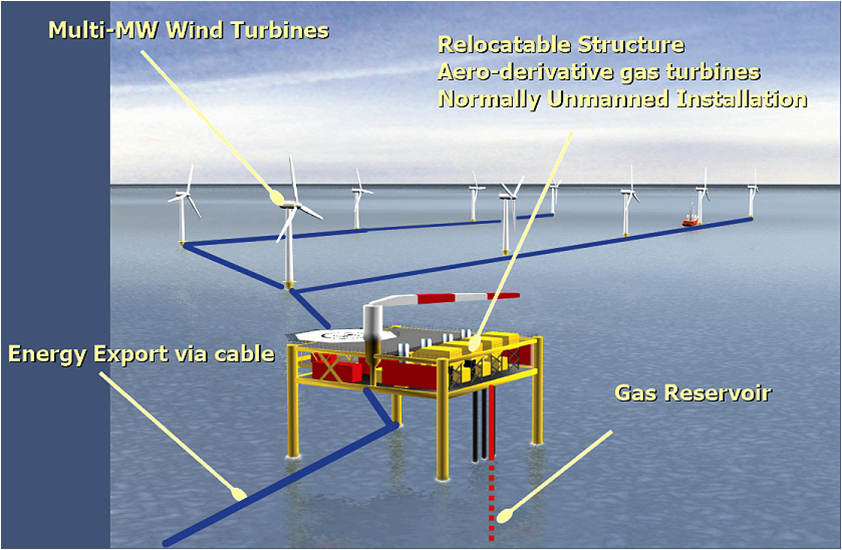
- Potential for combining offshore gas and wind projects into offshore energy units that can ensure consistent power supply. (See slide below from a presentation by George Hagerman, Virginia Tech Advanced Research Institute)
Groundhog Day should also be known as Energy Policy Day
Posted in energy, tagged energy policy, Groundhog Day on February 2, 2011| 2 Comments »
 Neither the rhetoric (produce more, consume less) nor our actions (produce less, consume more) ever change. When will we see the light? When will we break the cycle?
Egypt Crisis
Posted in energy, tagged Egypt, oil prices, Suez Canal, SUMED on January 30, 2011| 1 Comment »

Cheryl Anderson is monitoring the energy issues associated with the crisis in Egypt. According to Cheryl, news reports are careful to note that the Suez Canal has not been specifically threatened by the unrest at this time. However, that possibility will have a significant effect on energy markets.
The Suez Canal is located in Egypt, and connects the Red Sea and Gulf of Suez with the Mediterranean Sea, covering 120 miles. Petroleum (both crude oil and refined products) accounted for 16 percent of Suez cargos, measured by cargo tonnage, in 2009. An estimated 1.0 million bbl/d of crude oil and refined petroleum products flowed northbound through the Suez Canal to the Mediterranean Sea in 2009, while 0.8 million bbl/d travelled southbound into the Red Sea. This represents a decline from 2008, when 1.6 million bbl/d of oil transited northbound to Europe and other developed economies.
The 200-mile long SUMED Pipeline, or Suez-Mediterranean Pipeline provides an alternative to the Suez Canal for those cargos too large to transit the Canal. The pipeline moves crude oil northbound from the Red Sea to the Mediterranean Sea, and is owned by Arab Petroleum Pipeline Co., a joint venture between the Egyptian General Petroleum Corporation (EGPC), Saudi Aramco, Abu Dhabi’s ADNOC, and Kuwaiti companies. Transit through the pipeline declined from approximately 2.3 million bbl/d of crude oil in 2007 to 1.1 million bbl/d in 2009.
Record Worldwide Oil Demand
Posted in energy, Offshore Energy - General, oil, tagged IEA, offshore oil, oil demand on January 18, 2011| Leave a Comment »
The International Energy Agency (IEA) said preliminary data showed oil demand hit a record high of 87.7 million barrels per day over the past 12 months.
Related Wall Street Journal story:
The Organization of Petroleum Exporting Countries Monday said demand for its oil in 2011 will be stronger than it previously forecast owing to the recovery in the global economy.
BOE Comment: The deep water sector is the only option for significant near and intermediate-term increases in US oil production. Ditto for many other non-OPEC producers. We better get our act together soon.
President Obama’s Announcement – Very Encouraging
Posted in drilling, energy, gas, Offshore Energy - General, oil, tagged drilling, energy, offshore oil, oil and gas leasing on March 31, 2010| Leave a Comment »

Offshore Energy Awakening?
When you wake up after a long nap (in this case 25 years), you don’t just leap out of bed. You first squint at the light, yawn, flex an arm, stretch your legs, and prepare to rise and actually do something. The President’s decision to open a small slice of the Atlantic to exploration and consider new areas in the Atlantic and Eastern Gulf of Mexico in the new 5- Year Program may seem modest, but it demonstrates that the nation is waking up to the importance of our offshore energy resources. After 25 years of neglect, almost everyone agrees that US energy policy has been an economic and national security disaster. More and more Americans are also recognizing that denying access to offshore resources is not in the best interest of the environment – regionally, nationally, and globally.
Some political leaders remain in dreamland as evidenced by the large blue areas in the map below. When you have cried “wolf” about offshore drilling for your entire political career, you either believe what you have been preaching or are concerned about the political implications of changing your position. However, demonizing offshore energy development is no longer a smart political strategy, and the views of these anti-energy stalwarts may finally be challenged, even in their own states and districts.
We operations, safety, pollution prevention, and regulatory professionals have to hold up our end. Safety disasters or pollution spectaculars are not acceptable. We need to examine our programs, operations, and incidents openly and honestly, and anticipate what might go wrong. When an accident occurs, we need to learn what happened and why, and make sure it doesn’t happen again – anywhere in the world.

Natural Gas Bonanza – Why Aren’t We Celebrating?
Posted in energy, natural gas, Uncategorized, tagged energy, natural gas, shale gas on February 4, 2010| Leave a Comment »
In 1973, while a graduate student at Penn State, I wrote a paper entitled “The Use of Natural Gas in Improving Air Quality.” My professor, Richard Gordon, a terrific economist who greatly influenced my thinking about energy, liked the paper but thought I was too optimistic about the availability of natural gas. The sense at the time was that natural gas was a premium energy source in short supply.
Fast forward to 2010. Another Penn State professor, Terry Englander, estimates recoverable natural gas resources of 500 tcf for the Marcellus shale alone. Annual gas consumption for the entire US is only about 23 tcf. The whole world consumed about 113 tcf in 2008.
Dan Yergin is calling it the natural gas revolution. Boone Pickens has called the US the “Saudi Arabia of natural gas.” In addition to the shale gas, we have huge Alaskan gas reserves awaiting a pipeline (the economic viability of which may be threatened by the major discoveries in the lower 48). Prospects for ultra-deep gas in the Gulf of Mexico are also looking brighter in the wake of McMoRans major deep gas discovery. There is excellent natural gas potential in the eastern Gulf near major gas markets, and at least one Atlantic state (Virginia) has expressed interest in renewed exploration in the Atlantic.
Given the dearth of good economic news, why isn’t more attention being given to this natural gas bonanza? Boone Pickens and others are doing their part, but there should be a national dialogue on how we can use these resources to improve our economy, energy security, and the environment.
How about a parade down Constitution Avenue to celebrate our good fortune?

Celebrating the Natural Gas Revolution?
 Bud's Offshore Energy (BOE)