Feeds:
Posts
Comments

Archive for the ‘climate’ Category

While it’s highly unlikely that wind turbine siting activities are responsible for the alarming number of whale deaths, some of the vociferous wind industry defenders would have been among the first to point the finger at oil and gas operations if there were any in the US Atlantic.

Some quotes from a recent USA Today article followed by BOE comments:

It’s just a cynical disinformation campaign,” said Greenpeace’s oceans director John Hocevar. “It doesn’t seem to worry them that it’s not based in any kind of evidence.” (Comment: World class chutzpah on the part of Greenpeace, the master of disinformation.)

Gib Brogan, a campaign director with Oceana, an international ocean advocacy group, said those opposed to wind power are using a spate of whale deaths in the area as an opportunity. (Comment: Does Oceana suddenly find this type of opportunism to be shocking?)

Groups opposed to clean energy projects spread baseless misinformation that has been debunked by scientists and experts,” said JC Sandberg, chief advocacy officer with the American Clean Power Association, a renewable energy trade group. (Comments: Use of the term “clean energy” is clever advocacy that serves to discredit other forms of energy. All energy sources have pros and cons, environmentally and otherwise. Wind and solar have significant visual, space preemption, navigation, wildlife risk, and intermittency issues, and are heavily dependent on subsidies and mandates. When all issues are considered, one could argue, as we have, that offshore gas, particularly nonassociated gas, is perhaps the environmentally preferred energy alternative.)

Read Full Post »

15 Minute Cities

Read Full Post »

The Nord Stream sabotage likely released more methane than the complete lifecycle of a GoM lease sale (upstream and downstream). Also, the Nord Stream explosions may have released more methane than is emitted by all US offshore producers in an entire year. Here are the numbers:

Source of MethaneCH4 emissions (1000s of tons)
Nord Stream (probable range)100-400
Nord Stream (maximum)500
Nord Stream – first 48 hrs (CAMS est)175
all US offshore production in 2020 (EPA)193
all US on- and offshore exploration in 2020 (EPA)12
lifecycle upstream emissions from a typical GoM lease sale (BOEM)118
lifecycle up- and downstream emissions from a typical GoM sale (BOEM)151

Finally, remember that offshore oil and gas leasing results in a net reduction in GHG emissions.

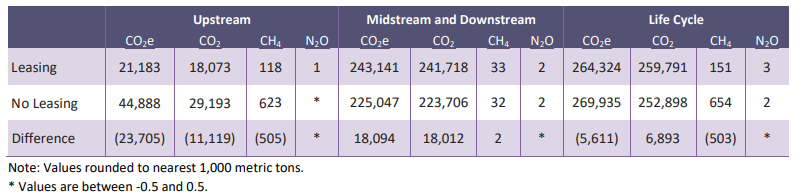
The No Leasing scenario results in roughly double the CO2e emissions for upstream activities compared to those of the Leasing scenario, given that, collectively, the substitute energy sources have higher GHG emissions per unit of production (also known as “GHG intensity”) compared to the forgone domestically produced OCS oil and natural gas of the Leasing scenario.

BOEM

Even when mid- and downstream emissions are included, leasing is preferable to no leasing. See the table below from the BOEM report:

Bottom line: we need more energy leasing and less military aggression!

Read Full Post »

This misleading headline was featured in Reuters’ “Power Up” newsletter (26 Jan 2023):

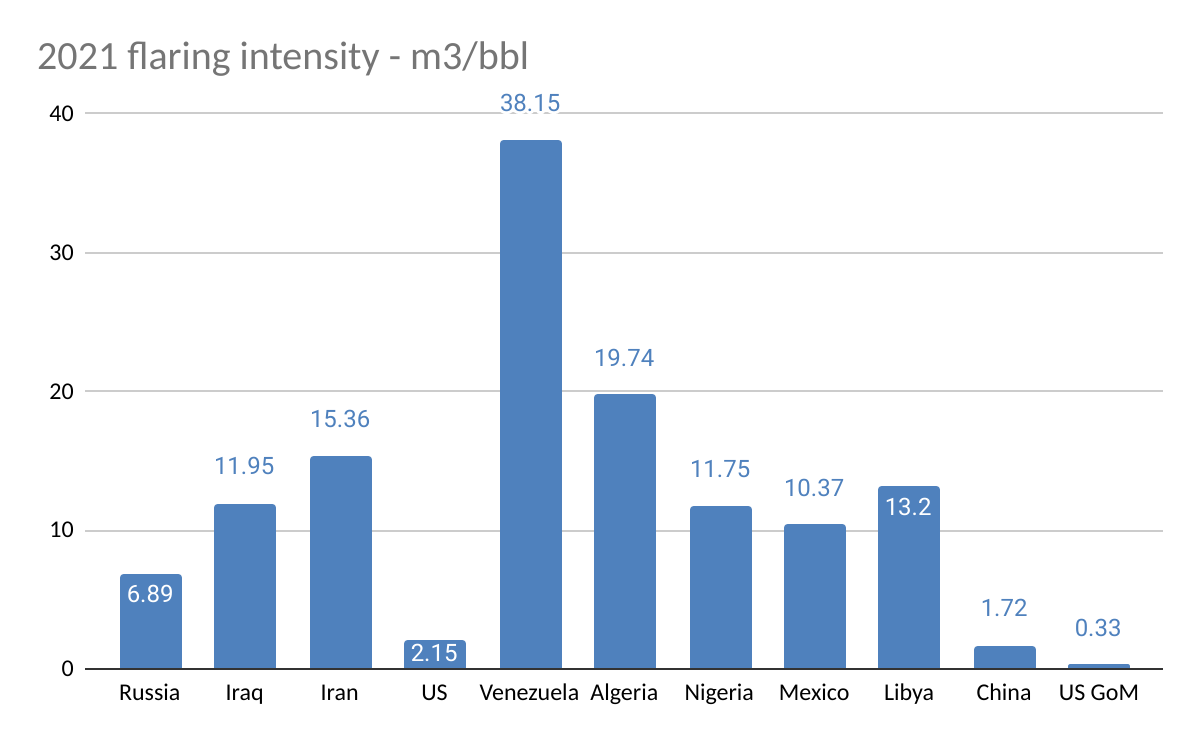
An objective flaring assessment would have also considered the volume of oil and gas produced. The World Bank uses flaring intensity (m3 flared per bbl of oil produced) to normalize their flaring data and provide perspective. The chart below is derived from World Bank flaring intensity data and Gulf of Mexico data from mandatory flaring and venting reports for the same year (2021). These normalized data sharply contradict the Reuters message.

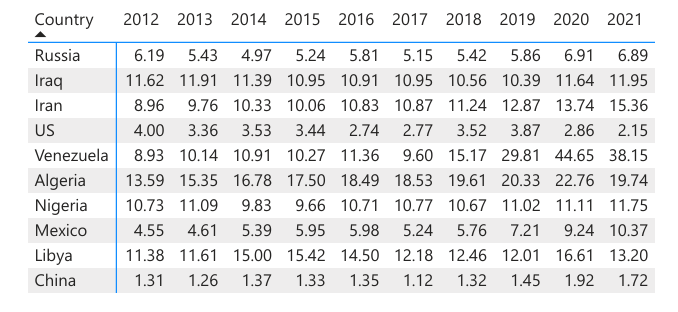
Reuters might also have noted (World Bank table below) that the US flaring intensity score declined by 46% between 2012 and 2021. Each of the other “top flaring” countries had flaring intensity increases during that period.

World Bank

Finally, while I applaud the World Bank’s efforts to monitor worldwide flaring, some issues with their methodology were identified in a prior BOE post.

Read Full Post »

Konstantin Kisin

Read Full Post »

Read Full Post »

Read Full Post »

This rather arrogant and condescending policy makes neither good business sense nor good social sense (unless you support energy poverty), but I’m sure the executive team is proud. That said, they do seem to have left themselves with a fair amount of wiggle room.

In line with the policy, we will no longer provide new lending or capital markets finance for the specific purpose of projects pertaining to new oil and gas fields and related infrastructure when the primary use is in conjunction with new fields.

We will continue to provide finance or advisory services to energy sector clients at the corporate level, where clients’ transition plans are consistent with our 2030 portfolio-level targets and net zero by 2050 commitment.

HSBC

Read Full Post »

Read Full Post »

Update on the most promising renewable energy alternative:

Quaise has received a grant from the Department of Energy to scale up Woskov’s experiments using a larger gyrotron. With the larger machine, the team hopes to vaporize a hole 10 times the depth of Woskov’s lab experiments by the end of this year. After that, the team will vaporize a hole 10 times the depth of the previous one — what co-founder Matt Houde calls a 100-to-1 hole.

“That’s something [the DOE] is particularly interested in, because they want to address the challenges posed by material removal over those greater lengths — in other words, can we show we’re fully flushing out the rock vapors?” Houde explains. “We believe the 100-to-1 test also gives us the confidence to go out and mobilize a prototype gyrotron drilling rig in the field for the first field demonstrations.”

Rather than getting deep in the weeds of carbon capture, imagine powering those existing facilities with steam generated without carbon emissions at all.

The key is that ultradeep geothermal has the power density and scalability of fossil fuels.

Read Full Post »

« Newer Posts - Older Posts »