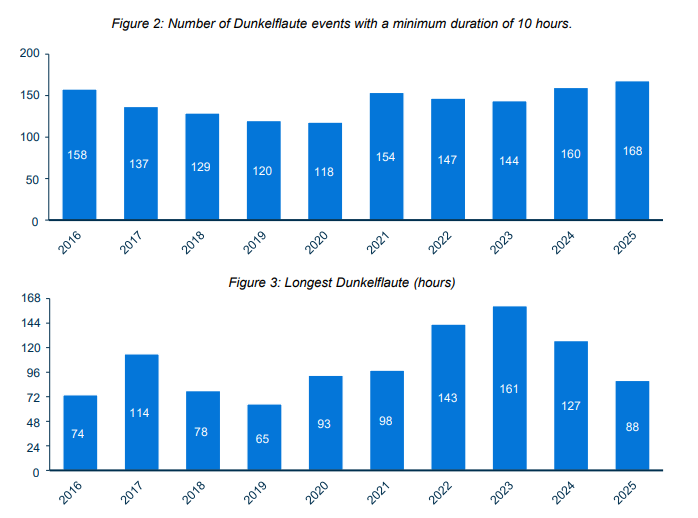
The attached Uniper study provides interesting data on the frequency and duration of German Dunkelflauten:
- A Dunkelflaute was recorded whenever combined national wind and solar output fell below 10% of Germany’s total installed capacity for at least 10 consecutive hours (smoothed using a rolling 6-hour average).
- Over the past ten years, 1,435 Dunkelflauten lasting longer than 10 hours occurred (see Figure 2). On average, this means that a Dunkelflaute occurs every third day.
- Over the period 2016–2025, Dunkelflauten lasted an average of 12.9 hours.
- Longer events (Figure 3) are less frequent but still occur regularly. A 24-hour Dunkelflaute occurs almost every month, while three-day Dunkelflauten occur around twice per year.
- Extreme Dunkelflauten lasting more than five days occur every three and a half years.
- In 2023, there was even a nearly week-long Dunkelflaute (161 hours).
- Storage and flexibility measures cannot bridge these long periods. Therefore, power plants that can generate electricity reliably and flexibly regardless of weather conditions remain a central component to ensure security of supply.


I used a similar approach twelve years ago to show that the proposed Illinois high volume fracking regulations were guaranteed to cause every proposed well to be violate surface water quality standards, even if a well was never actually drilled. I used 30 years of historical water quality monitoring data from a river monitoring station. The fracking regulations covered 27 different water quality parameters. If any of post-drilling sample collected in the next three years and it had “statistically higher” results for any of the 27 analytes when compared to three background samples collected prior to drilling, the well was to be cited for violation, with no ability to contest the conclusion. Guilty unless proven innocent. There were a multitude of situations that would cause a violation. One very real one was if a farmer applied lime to his fields. That would cause both pH and alkalinity to rise in drainage from the field, and those were two of the monitored parameters.