Feeds:
Posts
Comments

Archive for October, 2010

Bad News from Burma

Odd Finnestad alerted me to this tragic incident reported in the Bangkok Post:

At least 14 people have been killed and 58 more injured in a fire at an oil well in central Burma, an official in the military-ruled country said Monday.

Will we ever learn the details?

Read Full Post »

Firstly, major kudos to the Canadians for organizing a great conference in Vancouver, a wonderful city.  The Newfoundland-Labrador and Nova Scotia Petroleum Boards, and the National Energy Board were outstanding hosts, and Max, Howard, Stuart, Sean, Bharat, and the folks at Venue West did a great job with the arrangements. The International Regulators’ Offshore Safety Conference was a huge success thanks to their efforts.

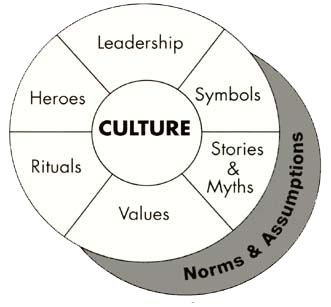
The international leaders in Vancouver were in full agreement that the key to long term safety achievement is the strength and vitality of the safety culture in the operating companies, contractors, and regulatory organizations.  How is such a culture encouraged and achieved?  As NOPSA CEO Jane Cutler has said “safety culture is what you do when no one is watching.”  Inspections are a necessary regulatory tool, but if they are too frequent they send the message that the government is responsible for safety, and that operators and workers can relax their guard.  As Magne Ognedal (PSA-Norway) has frequently said, safety must be managed by the “owner” of the facility and the risk, with the government holding the owner accountable and insisting on excellence.

Steve Walker, UK HSE chief, said that regulators must encourage a “beyond compliance” culture and serve as catalysts for learning and achievement. Regulators can never be satisfied; they should be negative thinkers searching for the operations, processes, and behaviors that might trigger the next major accident.  Dr. Mark Fleming from St. Mary’s University in Halifax believes that safety culture can in fact be regulated, not in the traditional sense, but by requiring companies to have systems in place for promoting and measuring the organizational culture.

Regulators must also look at their own safety culture.  Are they focused solely on compliance and “command and control,” or are they investigating risks, assessing management programs, and evaluating performance?  Are regulatory employees free to investigate and inquire, or are they mere implementers of management directives?  Are employees rewarded for sustaining the hierarchy or challenging  the status quo?  Are they expected to explain why accidents can’t happen again or figure out how they can?

Much more on these and other Vancouver topics in the near future.

Read Full Post »

In case you haven’t seen this video from the Atwood Eagle offshore Australia.

Read Full Post »

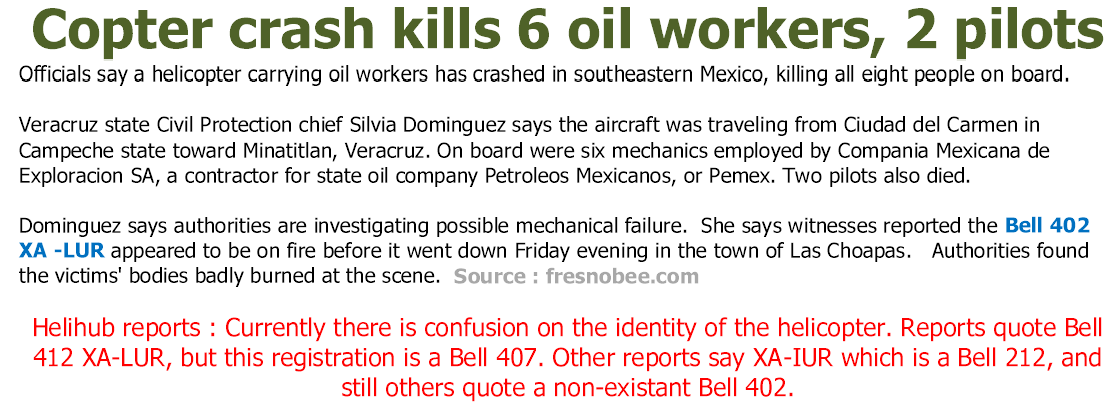
Helicopter Crash

From the Fresno Bee (18 Oct).  Click on visual to enlarge:


Read Full Post »

Posting will be suspended (hold the applause :)) while our large international staff attends the IRF Safety Conference and engages in deep thought and meditation. After this period of reflection and renewal, BOE’s revitalized staff will resume posting (on or about 25 October).

Kudos to the overwhelming majority of offshore energy sector employees for their unwavering commitment to safety achievement and pollution prevention.

Read Full Post »

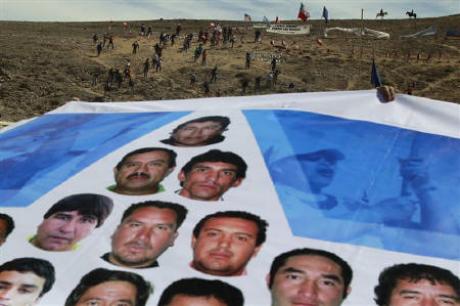
Now that Chile, with the help of the international community (including two companies from the Commonwealth of Pennsylvania where the drilling industry began), has rescued the 33 miners, can we drill into the Australian government and rescue the Montara and Varanus Island reports?

While we are at it, can we learn more about these accidents?

Let’s learn from past accidents, so we don’t need dramatic rescues in the future.

The offshore safety record will be suspect until industry and governments have credible, internationally accepted programs and policies for ensuring that accidents are independently investigated and that investigation updates and reports are released in a timely manner.

Read Full Post »

It’s nice to have a day of uplifting news for a change, and it’s drilling related!

Chi-chi-chi, le-le-le, viva Chile!


Read Full Post »

China is the world’s largest energy user, moving ahead of the United States, the head of the International Energy Agency said on Tuesday.

link

Read Full Post »

I’ve been saving  this interesting comment from the CEO of the company that drilled the successful rescue well. Now that the miners are being rescued and we can smile, I’ve pasted it below 🙂

The pressure really started to build. We’re not used to drilling for people. Andrew Schmitt, CEO, Layne Christensen Co.

Here is a little information on the rescue well:

The Layne-Geotec team worked carefully, starting with a 5-inch hole dug through 2,300 feet of the hard rock until they broke through. From there, they made another pass, this time expanding it to 12 inches. Finally, with a third pass, they increased the hole to the 26 inches needed for the rescue capsule, all the while concerned about a collapse. They finished the job in 33 days, well ahead of predictions.

Comment: In the past year, we have seen the tragic consequences of a drilling operation that went awry.  We have also seen the industry’s technical precision demonstrated in drilling the Macondo relief well and have watched drillers save lives in Chile. Regardless of how you feel about drilling, the intentions are good – to find and produce commodities that are in much demand (typically oil, gas, or freshwater) , and to make a return on your investment.  The challenge is to minimize the safety and environmental risks associated with these operations, and to do so consistently, effectively, and efficiently.

Read Full Post »

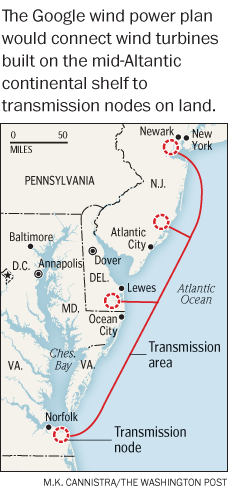
Washington Post diagram

Comment: Kudos to Google for their leadership in financing a power grid for Atlantic wind projects.  The grid should greatly improve the economics of offshore wind development.  The challenge for the  Google team and other wind developers will be demonstrating that they can manage complex offshore projects, protect workers, and maintain the integrity of their assets.

Read Full Post »

« Newer Posts - Older Posts »