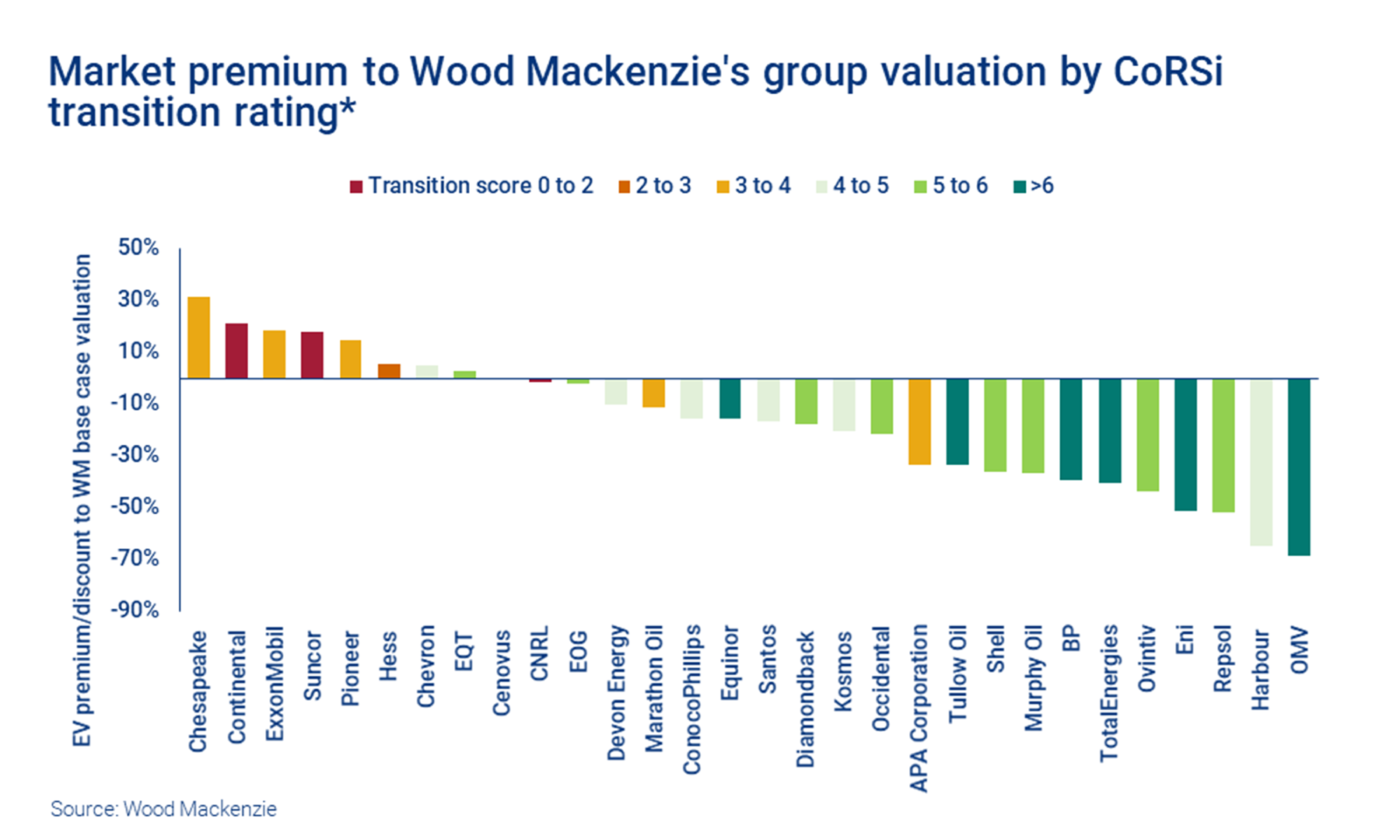
Per Wood Mackenzie, companies with low transition scores (i.e. the purer oil and gas plays) command higher valuations. I’d like to see the scores for other US independents.
“First, investors piled into the pure play oil and gas producers that are most leveraged to oil prices, much as they would in any upcycle. US independents led the sector rise through early June before the oil price and shares fell back over the last month.“
“Euro Majors are also reaping the earnings and cash flow boom. Share price performance has been strong relative to the wider stock market, but most have lagged their US peers. US Majors have long commanded a premium rating to their European counterparts, partly a function of the relatively high rating of the US stock market. The gap though has widened.”
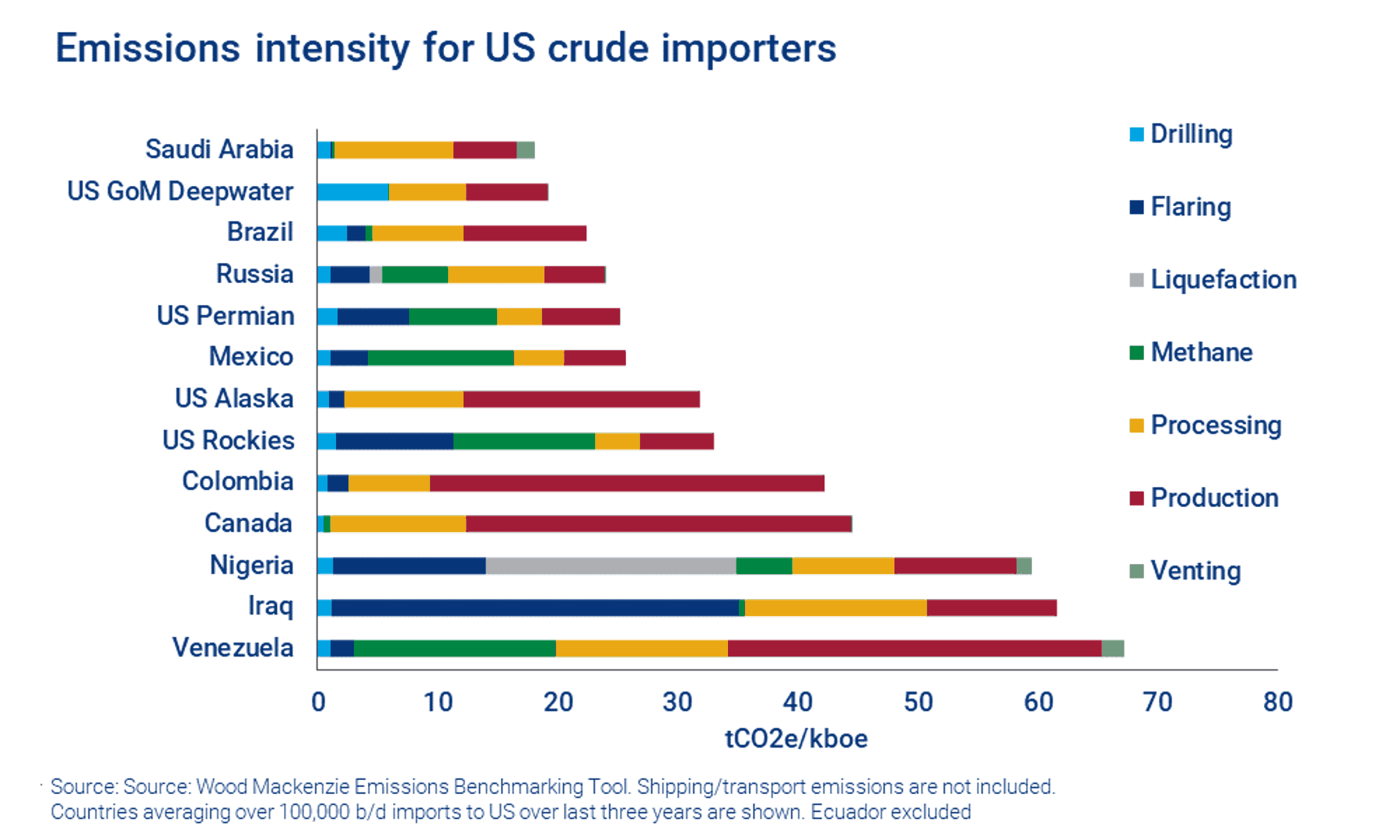
With regard to air emissions, the advantages of deepwater Gulf of Mexico production are rather obvious:
High production rates per well
Few surface facilities (57 deepwater platforms, 3% of GoM total, produce 90+% of oil)
Modern gas turbines for power generation
Tightly enforced restrictions on flaring and venting
Better control of fugitive emissions
Distant from shore (not a factor for GHG effects)
Wood Mackenzie, NOIA, and others contend that restrictions on GoM leasing are contrary to carbon reduction goals.
An important and unintended consequence of enacting more restrictive policies such as a lease ban or increase in royalty rate in the Gulf of Mexico is that it could give rise to carbon leakage to countries that export crude to US.
In light of the policy implications of GHG emissions, a Carbon Intensity Workshop is highly recommended. The estimates generated by Wood Mackenzie, Rystad, and others need to be explored in depth. Is data quality an issue? How are the data verified? Is there regulator or third party oversight? What are the assumptions behind the estimates? Also, for the purposes of US policy decisions, product transportation emissions should certainly be included. A barrel produced in the Middle East is not the same as a barrel produced in the GoM.
Looking at the chart above, I have immediate questions about the drilling emissions (blue). What wells are included? What about workovers and other well operations? I’m surprised that the deepwater GoM drilling emissions are so high relative to the other regions. While dynamically positioned MODUs have high fuel consumption rates, deepwater wells are few in number relative to shale drilling. Also, why are Brazil’s drilling emissions, which I assume are primarily associated with deepwater operations, so much lower that those for the GoM.
BOEM/BSEE and/or the Gulf Research Program (NASEM) would seem to be good sponsors for such a workshop.
 Bud's Offshore Energy (BOE)