Feeds:
Posts
Comments

Posts Tagged ‘wind turbine incidents’

Kudos to Scotland Against Spin (SAS) for compiling and updating turbine incident data. Their latest summary through Sept. 30, 2025 is attached. Their detailed historical table (334 pages) is linked.

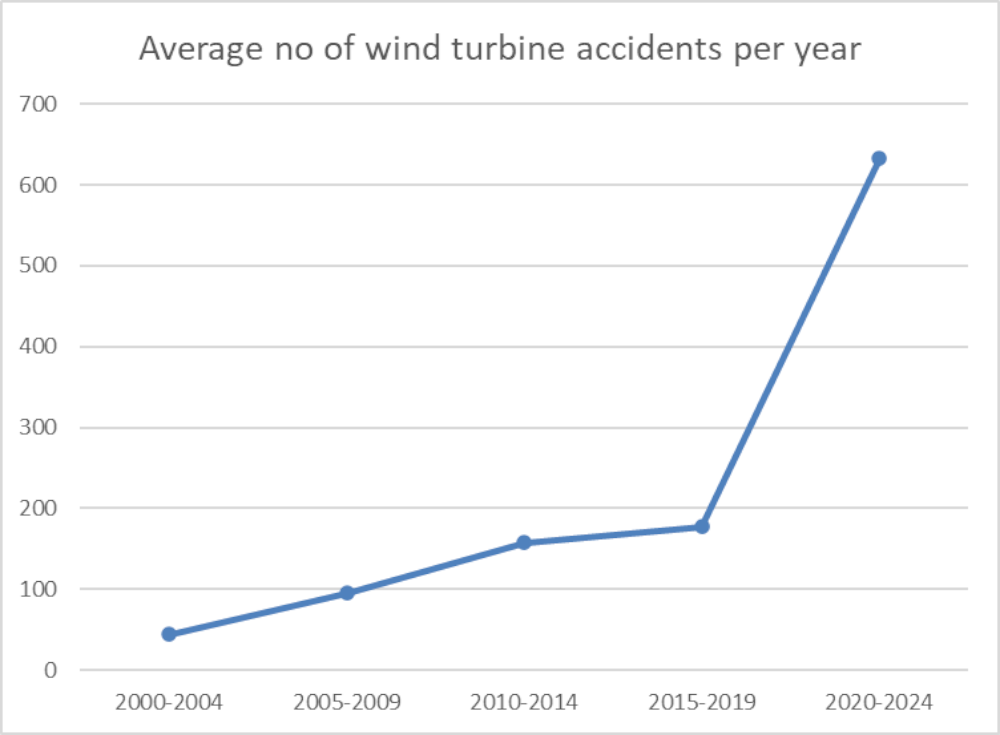
The SAS data indicate that the number of wind turbine incidents has risen sharply in recent years (see chart below). The increased number of turbines worldwide, and perhaps better news coverage of incidents, presumably contributed to the sharp increase. Nonetheless, the growing number of incidents is disconcerting, as is the absence of industry and government summaries and reports.
SAS acknowledges that their list, which is dependent on publicly available reports, is merely the “tip of the iceberg.” For example, the list does not include the June 2, 2025, Empire Wind project fatality.

The SAS list does capture the 2018 collapse of the Russell Peterson liftboat, which was collecting data offshore Delaware for a wind project. One worker died and another was seriously endangered. The Coast Guard never issued a report on this tragic incident. Serious questions remain about the positioning of a liftboat in the Mid-Atlantic for several months beginning in March when major storms are likely, the liftboat’s failure mechanisms, the operator’s authority to be conducting this research, and the actions that were taken in preparation for storm conditions.
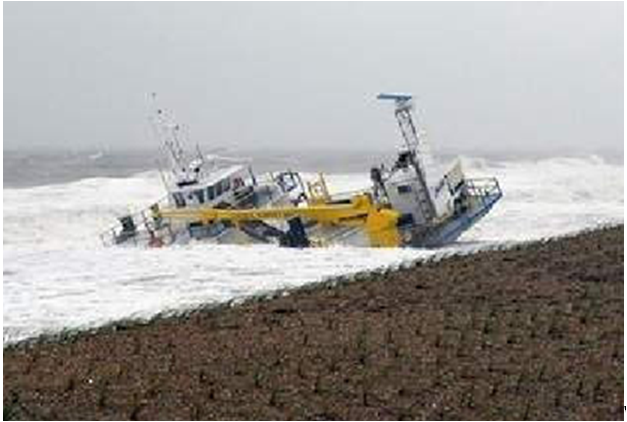

Liftboat Russell Peterson, May 12, 2008

Read Full Post »

Scotland Against Spin (SAS) continues to provide an important public service by compiling wind turbine incident data from press reports and official releases. Their updated table includes 327 pages of incidents.

Oregon Live found out about the state of industry and government data on wind turbine incidents while investigating a turbine blade failure in Biglow Canyon, Oregon:

Accident and safety data is hard to come by for the wind industry.

There is no national database of incidents. Owners don’t publicize them. Vendors are reluctant to discuss it. And reporting rules vary by state, or even by county.”

Thankfully, SAS diligently gathers publicly available reports and updates their tables in a timely manner. Their data indicate that the number of wind turbine incidents has risen sharply in recent years (see chart below). So, of course, has the number of turbines.

The World Wind Energy Assoc. reports an increase of ~60% in wind turbine capacity between 2019 and 2023. This capacity increase would only partially account for the recent tripling in annual incidents reported by SAS, and SAS believes their list is merely the “tip of the iceberg.”

A high priority for wind industry regulators in the US and internationally should be establishing a consistent wind energy incident reporting regime and making the data available to the public in a timely and organized manner.

complete SAS wind turbine incident table (327 pages)

Read Full Post »

Given the absence of industry and government data on wind turbine incidents, Scotland Against Spin (SAS) has done yeoman’s work in filling the void. SAS gathers information from press reports and official releases. A PDF of the latest SAS update summary is attached. You can view their complete incident compilation (318 pages) here. Kudos to SAS for their diligence.

As good as their work has been, SAS acknowledges that their information is far from complete and may only represent the tip of the wind turbine incident iceberg. Per SAS:

  • In 2011, RenewableUK confirmed that there had been 1500 wind turbine incidents in the UK alone in the previous 5 years.
  • In July 2019, EnergyVoice reported a total of 81 cases where workers had been injured on UK windfarms since 2014. The SAS table includes only 15 of these incidents (<19%).
  • In February 2021, the industry publication Wind Power Engineering and Development admitted to 865 offshore accidents during 2019. SAS captured only 4 (<0.5%).
  • A 13 August 2018 publication by Power Technology reported 737 incidents from UK offshore windfarms during 2016 alone, with the majority occurring during operations rather than development. 44% of medical emergencies were turbine related. In comparison, only 4 UK offshore incidents are listed in the SAS data – equivalent to 0.5%.

    Lars Herbst had previously reported, based on the Wind Power article cited above, that “with an estimated 700,000 blades in operation globally, there are, on average, 3,800 incidents of blade failure each year.” Lars noted that the annual blade failure rate of about 0.5% translates to 1.5% of all operating wind turbines experiencing a blade failure every year, a remarkably high failure frequency.

    A sad irony is that one of the five operational Vineyard Wind turbines experienced a very impactful blade failure less than 5 months after the project had begun delivering a limited amount of power and government officials were patting themselves on their backs and declaring victory.

    “This marks a turning point in the clean energy transition. After many decades of advocacy, research, policymaking, and finally construction, America’s offshore wind industry has gone from a dream to reality,” said Governor Maura Healey. “Across Massachusetts, in 30,000 homes and businesses, when you turn on the light, you will now be using clean, affordable energy. This will make the air we breathe safer and healthier, save customers money, and bring us one step closer to achieving net-zero emissions.” 

    Read Full Post »