Feeds:
Posts
Comments

Posts Tagged ‘well control’

11 workers still not accounted for.

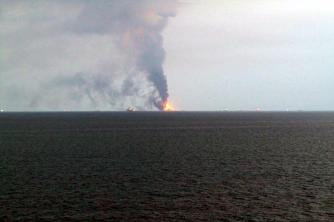
According to the latest US Coast Guard release:

Updated reports indicate that there were 126 people on board the MODU at the time of the explosion.

One-hundred-fifteen crewmembers have been accounted for.  Of those accounted for:

  • Seventeen crewmembers were medevaced from the scene
  • Ninety-four crewmembers are being transferred to shore at Port Fourchon aboard the Damien Baxton, an offshore supply vessel.  There are no major injuries reported for these members.
  • Four crewmembers have been transferred to another vessel

Read Full Post »

Contrary to an earlier report (see below),  the Coast Guard has told Upstream that the 11 workers are still missing and the search continues.

Read Full Post »

Correction from nola.com

Read Full Post »

Coast Guard Photo

“It’s burning pretty good and there’s no estimate on when the fire will be put out.”  Mike O’Berry, US Coast Guard

The Coast Guard is hoping to locate the missing in an escape capsule or life raft. link

All BP personnel are reported to be safe.

Read Full Post »

Like mowing a 40 acre field with a 1/4 inch lawn mower. ~ Ed Tennyson, 1989

Reading today’s transcript reminded me of my colleague Ed Tennyson’s famous comment about the response to the Valdez spill in Prince William Sound, Alaska.  Ed’s comment, which appeared on the front page of the Wall Street Journal, was typically colorful and fitting.  A media darling, Ed was given a time-out for that one, but rebounded nicely.

I’m not suggesting that the Montara spill and response were a mismatch of Valdez proportions.  The Montara responders seemed to be competent and made reasonable decisions.  However, the testimony does suggest the need for some improvements in the response regime.  A few observations:

  1. There appears to be a need to clarify responsibilities and liability limits for studies and damages.  Also, consideration should be given to an oil spill trust fund (paid for by a per barrel production and transportation fee) to cover any additional authorized costs.
  2. It seems that all of the slick monitoring was visual.  Mr. Berger is right in alleging that there are now more accurate methods.  AMSA should investigate  aerial slick mapping and thickness measurement capabilities.
  3. It seems at least one Federal agency did not step up and provide requested assistance during the crisis.  Further explanation is necessary.
  4. When a well is blowing out, you shouldn’t rely solely on slick data to estimate the spill rate.  PTTEP should have used reservoir and well design data to model the flow and estimate the spillage rate.

Howe (Commission): I have been absolutely struck by the technology and the accuracy of the transcript and the promptness with which it comes up

Amen to that; great job by the recorders!

Read Full Post »

Q. Mr. Berger (Commission): Do you recall my putting to both Mr Marozzi and Mr Whitfield a commentary on Mr Marozzi’s evidence to the effect that it was not a good day for the Northern Territory?
A. Mr. Trier (NT DoR) Yes.
Q. Having sat through Mr Marozzi’s evidence and the other evidence that you have heard in the Inquiry, you would agree with that assessment, wouldn’t you?
A. Yes, I agree
Q. That would be fairly sobering evidence, I take it, for you to hear, given your role within the department?
A. I am not trying to be smart. That’s an understatement.

Comment: Mr. Trier and Mr. Whitfield, senior managers with the Northern Territory Department of Resources, demonstrated the approach that managers should take when their organization is partially or fully accountable for a major accident – be contrite, promise changes, and seek external guidance.  The Montara blowout was a pollution spectacular that reflects poorly on all of us.  While assigning blame, we should make sure that our own houses are in order and that we are doing everything we can to prevent a recurrence – anywhere in the world.

Q. Berger: You also heard evidence that Mr Marozzi considered PTT one of the less risky, or safest, operators that he was dealing with; do you remember that evidence?
A.  Trier: Yes, I do.

Comment: I wonder what the other NT operators think about that statement?  How would you like to be like to be ranked below PTTEP?

Other comments:

  1. While some of the PTTEP witnesses appear to get it, the official company position still seems to be that it’s okay to withhold internal reports, that corrosion caps are equivalent to cement plugs and packers, and that barrier policies are fluid and negotiable.
  2. It seems that the current NT regime allows operators to specify how they will submit data.  Assuming information is only required for important resource, safety, or environmental management purposes, submission requirements should, in my view, be as prescriptive as possible (even in a goal-setting regime).  How else can the responsible agency compile data, assess trends, and conduct comparative analyses?
  3. According to the testimony, a governmental auditing agency identified staffing and resource needs in the NT DoR.  While this may be the case for DoR, what percentage of internal government audits draw similar conclusions?  How many of these audits find that you have sufficient resources, and that they are appropriately managed and distributed?  None that I’ve ever seen.
  4. The hearings close tomorrow.  Who’s hosting the party?  Can we participate online? 🙂

Read Full Post »

Sometimes I feel a little foolish spending hours each day reading Montara transcripts and commenting to my small blog audience.  Then I get a call or an email message from people who are closely following this investigation and understand its significance – regulatory experts like Odd Finnestad in Norway, experienced engineers like Tom Maunder in Alaska, serious reporters like Anthea Pitt with Upstream and Kevin Spear with the Orlando Sentinel, and representatives from all sectors of the offshore industry.  That’s when I realize the effort is worthwhile.  Even more gratifying was Mr. Berger’s acknowledgment (beginning on page 109 of today’s transcript) of my Day 18 blog entry.  I appreciate the Commission’s outstanding efforts on behalf of offshore safety, and their interest in the opinions expressed on BOE.

Q. Mr. Berger (Commission): So you say it is not your job to read the daily drilling report to determine whether things like barriers have been installed offline in a batch drilling operation?
A. Mr. Marozzi (Northern Territory Department of Resources): I’m not saying that.
Q. That’s someone else’s job, is it?
A. I’m not saying that. It is my job, but I can only do it to a level that our resources allow.
Q. These daily drilling reports are hardly War and Peace, are they? They’re typically two or three pages; that’s right, isn’t it?
A. That’s true, yes.

Comment: I couldn’t resist this entirely fitting “Not My Job” mention.  If an important task is not your job, you need to either make it your job, or see to it that the operations cease until someone has been identified to do the job and do it well.

THE COMMISSIONER: All I’ve heard is that Mr Marozzi and his unit don’t have the resources to respond properly. I doubt very much if the department doesn’t have sufficient resources, should it so choose, to allocate sufficient resources to this task. It’s a matter of choice on their behalf, I would have thought, but that’s something that can be established at some stage over the next day or do.

Comment: The Commissioner has clearly been in the government long enough to know it’s all about priorities, and perhaps senses that the NT DoR’s were a bit misplaced.

Other comments:

  1. Mr. Marozzi indicated that he had limited experience with horizontal wells.  One gets a sense that neither the operator nor the regulator dedicated sufficient resources to technical training.
  2. It seems that Mr. Marozzi may have been thinking more in terms of a casing shoe that was about to be drilled out than about a shoe in a well that was going to be suspended.  If the well was drilled out, the cement channels would have been less of an issue and the Formation Integrity Test would have evaluated the integrity of the shoe.
  3. In reading the NT submission on the Commission’s website, I was surprised that the NT DoR refused to admit that the cementing of the 9 5/8″ casing and the absence of barriers were contributing factors to the blowout.  Thanks to Mr. Berger’s questioning, the NT has finally conceded on these points.
  4. The legislative response in Australia will be very interesting.  The Commonwealth-State jurisdictional issues clearly need to be sorted out.  While the Montara review does not reflect well on the NT, the WA and Victoria regulators seem to have acquitted themselves well.
  5. Most countries have jurisdictional challenges similar to Australia.  Will they learn the lessons from Montara?  Regulatory mosaics don’t work.  Gaps, overlap, confusion, finger-pointing, and turf battles increase safety and environmental risks and regulatory and operational costs.

Read Full Post »

Q. Berger (Commission): Even if you do have a drilling background, Mr Marozzi, I suggest that how drilling activities are undertaken is often as important, if not more so, than what is going to be undertaken?
A. Marozzi (Northern Territory Department of Resources): Not really. To the operator, yes, but not really to the regulator. It doesn’t really matter how it is done, to  the regulator, in a lot of cases.

Transcript

To this outside observer, it was not a good day for the Northern Territory Department of Resources.  While it is premature to speculate on the Commission’s conclusions and the followup actions by the Australian government, today’s testimony has not helped the NT cause.   The witness’s attitude seems to be that if it’s good enough for the operator, it’s good enough for the regulator; and it’s not a good time to be giving that impression.  While, operator responsibility should be a fundamental tenet of any regulatory regime, the regulator needs to verify the effectiveness of the management and operational systems.  This can be accomplished through some combination of audits, inspections, program and plan reviews, performance measures, and other means.  However, the regulator cannot be passive in any type of regime – performance-based, prescriptive, or hybrid.

Read Full Post »

Q. Commissioner: Over the course of this Inquiry, I’ve been keen to engage Alert Well Control myself, unsuccessfully up until this point of time. Does that surprise you?
A. Mr. Jacob (PTTEP COO): Yes. I’m surprised.

It is good to see that the Commissioner is pressing the issue of testimony by ALERT, PTEEP’s well control contractor.  My guess is that there has been a glitch in communications between the Commission and ALERT, and that the company will cooperate.  If not, I would assume that the Commissioner can compel them to testify.

Highlights of an interesting day:

  1. The Commissioner asked questions about the risks associated with a surface capping operation.  We need to hear from ALERT on these issues, and the specifics of ALERT’s capping plan.  As previously noted, a surface capping operation would have been very difficult, and may not have been feasible.  ALERT’s testimony is very important.
  2. There was some questioning about the availability of the Ocean Shield to drill the relief well.  Issues associated with the relief -well rig selection, particularly the contractual concerns, need to be fully explored.  Do regulators need to require that relief well contracts be executed in advance?  I hope not, but these contractual issues need to be fully aired.
  3. The Commissioner asked good questions about igniting the flowing well.  While igniting the well would have destroyed the rig and platform and complicated the resumption of operations at Montara, ignition would have significantly reduced the environmental damage.  On balance, I think the correct decision (not to ignite) was probably made.  However, that decision should have been made by the Federal official leading the response (in the US that would be the Coast Guard’s On Scene Commander), not by PTTEP.
  4. The mud weight needed to kill the well was significantly higher than had been initially calculated by the well control specialists.
  5. Mr. Abbott (PTTEP attorney) drew attention to the burden of questions and input from multiple agencies and organizations during the emergency response.  In this regard, I think Mr. Abbott has a good point.  During an emergency response, all communications should be through a single Federal official (e.g. the On Scene Commander).
  6. Mr. Abbott also pointed to confusion resulting from the  multiple safety cases.  Again, this may be a good point.  In my view, one party should be accountable for all operations within a licensed area.
  7. I have never heard of a case where (1) the operator waited for government to investigate before conducting an internal review or (2) a company asserted attorney-client privilege to withhold an accident investigation report from a government authority.
  8. Apparently, PTTEP only recently considered the condition of the other wells at Montara.
  9. PTTEP’s spill estimate (400 bopd) is based solely on visual observations.  I agree with the commissioner that flow modeling should have been conducted.
  10. According to testimony, PTTEP operates other facilities in the Timor Sea including 2 FPSO’s.   What is their safety and compliance record?
  11. PTTEP considered developing Montara with subsea wells before opting for a production platform.

Other quotes of interest:

Jacob: When the safety case regime came into play in 2005, it was a fairly significant change from the previous one, in
that it then identified facility operators, being a rig contractor, a diving support vessel, a lay barge operator, et cetera, as having legal responsibility for the safety of the workforce at that site and a safe site. It was not the traditional way that things had worked in the past. Previously, it had been the titleholder who had had ultimate responsibility across everything.

Q. Howe: You see, sir, the evidence you are giving gets close to an assertion that you kept yourself in a state of
steadfast ignorance as to what was being offered to this Inquiry concerning the possible causes of the blowout.  Do
you agree with that?
A. Jacob: I can see how you can come to that, yes.

Q. Howe: I want to suggest to you an alternative way of approaching the evidence, namely, that PTT, at a corporate
level, seems to have accepted a level of responsibility only when it became apparent that it could not do
otherwise?
A. Jacob: I wouldn’t agree with that.

Q. Howe: Will you accept, sir, that the nature of the evidence canvassed in the course of this Inquiry indicates
deficiencies right up the line to and including the CEO of PTT?
A. Jacob: Yes, based on the line of questioning you have been following, yes.

Read Full Post »

Q. Howe (Commission): I want to suggest to you, sir, that you have rather reversed the direction of responsibility, in giving that answer, because PTT should have placed itself in a position properly to assist this Commission rather than taking a passive role, sending you along to listen to the evidence so that you could find out what had happened; do you agree with that?
A. Jacob (PTTEP): Yes, that would not be an appropriate response, and I don’t believe it was the intent of the company to do that.

Comment: PTTEP has seemingly been as passive in their investigation as they were in their well planning.  Why has there been no modeling of well fluid movement prior and subsequent to the removal of the 9 5/8″ cap?

Jacob: I was advised that, on an initial assessment, there was a high risk of a fatality should the capping option be followed through; that the Alert personnel were willing to carry it out. I called a management meeting, and that was presented to us by the well construction manager, Craig Duncan, and at that point the company’s decision was that the capping operation was not an acceptable solution at that time, that they were to continue looking at it as to ways to improve the safety ability of it.

Comment: Given the status of batch tieback operations at the time of the blowout, a surface capping operation would have been extremely dangerous and perhaps infeasible.  Not only was the well left with no barriers, it was also left in a state that virtually precluded surface capping.  Only the 20″ casing was accessible and there was no cement in the 20″ x 13 3/8″ annulus.  Even if they were able to slip BOPE or some other type of specialty valving over the 20″ and seal it hydraulically (or by some other means), the 20″ casing would not have had sufficient integrity to shut-in or kill the well.  To kill the well, they would have probably had to tie-back  the 13 3/8 with the well flowing and connect BOPE.   If feasible, that would be very risky.

That said, PTTEP’s submission and testimony advise that ALERT, a well control specialist company, had a plan for a surface capping operation.  According to Mr. Jacob,  ALERT was willing to proceed with that plan.  ALERT is an emergency well control responder, and their plan should have been fully vetted with the regulators.  I cannot understand why the Commission has no plans for ALERT to testify at these hearings.  How do you assess the blowout response without questioning ALERT?

Other comments:

  1. Will there be any questioning about the selection process for the relief well rig?  The reasoning provided in the PTTEP submission raises contractual issues that should not be a factor in an emergency response.
  2. PTTEP’s report to NOPSA (Federal regulator) included information on key Montara issues that was (at best) misleading.
  3. Mr. Jacob made several comments about how the company has learned from its mistakes.  Should the company be given that opportunity?  While the industry as a whole must learn from disasters like this, should the responsible company be allowed to simply return to business?  Australia should consider legislation that allows the regulator to disqualify companies that so flagrantly disregard their safety management responsibilities.
  4. More evidence was presented that drilling contractor safety cases have created confusion about accountability and responsibility.
  5. According to the testimony, the Northern Territory Department of Resources converted to a non-prescriptive regulatory regime in 2004.  Why are they still approving well plans and deviations?  This would seem to be contrary to the “operator responsibility” regulatory philosophy.  What standards are applied by NT in their reviews?  How do they act on significant program revisions (e.g. substituting corrosion caps for cement plugs) so quickly?
  6. PTTEP’s attorney spent most of his time drawing attention to how hard Mr. Jacob and his staff worked after the blowout.  Is the Commissioner supposed to be surprised? Impressed? Sympathetic?
  7. Like Mr. Jacob, I had no idea what “tendentious” meant.  According to Mr. Howe, it means “seeking to persuade in terms of allaying such concerns as the regulator might have.”  Not exactly the dictionary definition, but highly apt in this case 🙂

Read Full Post »
« Newer Posts - Older Posts »