Feeds:
Posts
Comments

Posts Tagged ‘resource estimates’

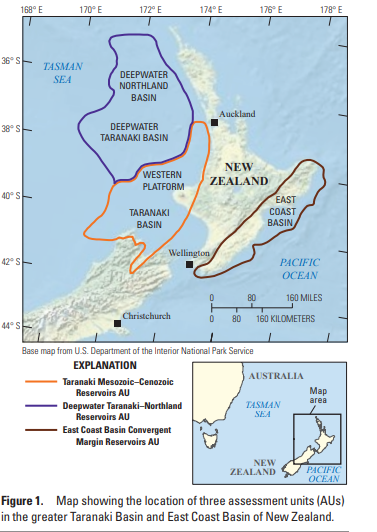
USGS diagram

New Zealand may again issue new oil and gas permits following yesterday’s action by parliament.

The extent to which this will result in new exploration remains to be seen. Increased natural gas production is the primary objective.

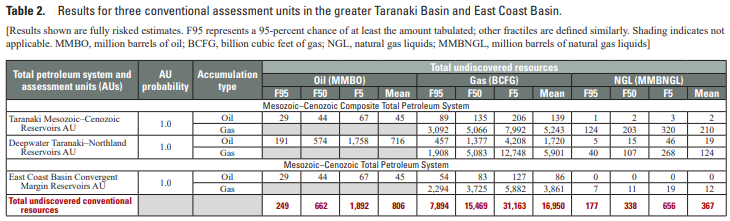
USGS (2020) undiscovered resource estimates are encouraging. The fully risked total for natural gas is 17 Tcf (mean), with a range of 7.9 to 31.1 Tcf. See the table pasted below.
Policy shift at a glance:

April 2018: New Zealand is halting all new offshore oil and gas exploration to become a global leader in the fight against climate change, the centre-left government said Thursday, but opponents accused it of “economic vandalism”.

June 2024The country’s coalition government is preparing to invite energy companies to resume exploration in the three major offshore fields that supply most of its gas. It comes after National Grid operator Transpower was last month forced to warn families to limit their electricity usage to avoid a shutdown during a cold snap.

July 31, 2025: Parliament reverses the law banning new offshore oil and gas exploration permits.
Read Full Post »

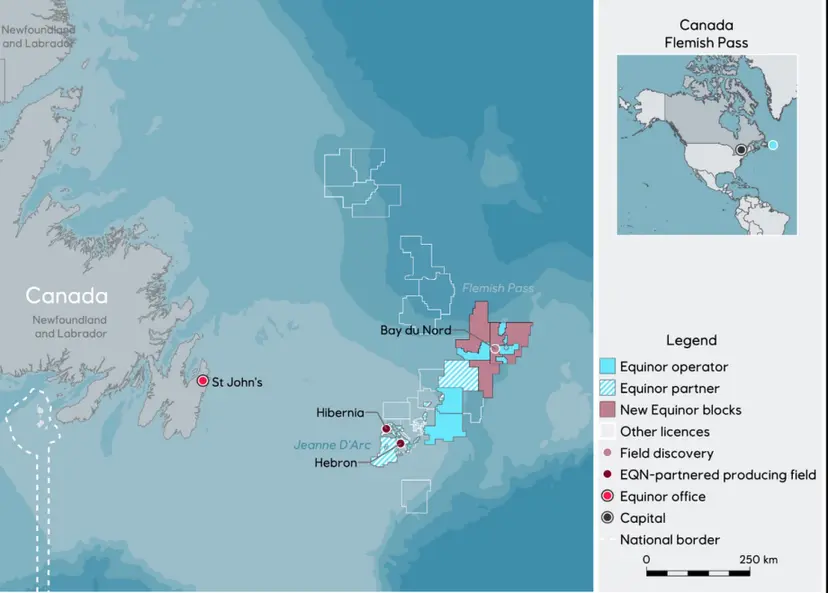
The CNLOPB has announced contingent resources of 340 million bbls for the Cambriol discovery which would be co-developed with 2 nearby discoveries as part of Equinor’s Bay du Nord project. Per CNLOPB estimates, this brings the Bay du Nord resource total to 1.132 billion bbls. Equinor has announced that 2 exploratory wells will be spudded this summer. Positive results would further strengthen the case for Bay du Nord development.

contingent resources per CNLOPB (million bbls)
Bay du Nord407
Cappahayden385
Cambriol340
project area total1132
“Contingent Resources” are volumes of hydrocarbons, expressed at 50% probability, assessed to be technically recoverable that have not been delineated and have unknown economic viability.

Meanwhile, Terra Nova production is ramping up after a long hiatus for FPSO refurbishment, remarkable Hibernia has produced more than double the original resource estimate of 520 million bbls and is still producing about 60,000-70,000 bopd, and Hebron is impressively producing about 120,000 bopd on average.

There is indeed reason for optimism about North America’s only Atlantic production in what is arguably the continent’s (world’s?) most challenging operating environment.

Read Full Post »