Feeds:
Posts
Comments

Posts Tagged ‘pipelines’

Wall Street Journal: U.S. Wants More Oil From Canada but Not a New Pipeline to Bring It

WSJ

This WSJ report, if accurate, reflects the mindset that you can increase oil production on demand when absolutely necessary, and avoid committing to longer term oil and gas supplies. The goal of such thinking is to address supply crises without alienating the uncompromising climate ultras. You suspend lease sales, deny new pipelines, and demonize oil and gas and the people who produce it. When supplies tighten and prices spike, you tap the strategic reserve, appeal to OPEC, talk to Venezuela and Iran, and ask Canada to ship more oil in rail cars or trucks (but no new pipelines please!). .

Below is a pie chart constructed using data from a 2018 DOT report to Congress. For logistical and economic reasons, pipelines are overwhelmingly the crude oil transport method of choice. Rail cars and trucks are called on where there are no pipeline options.
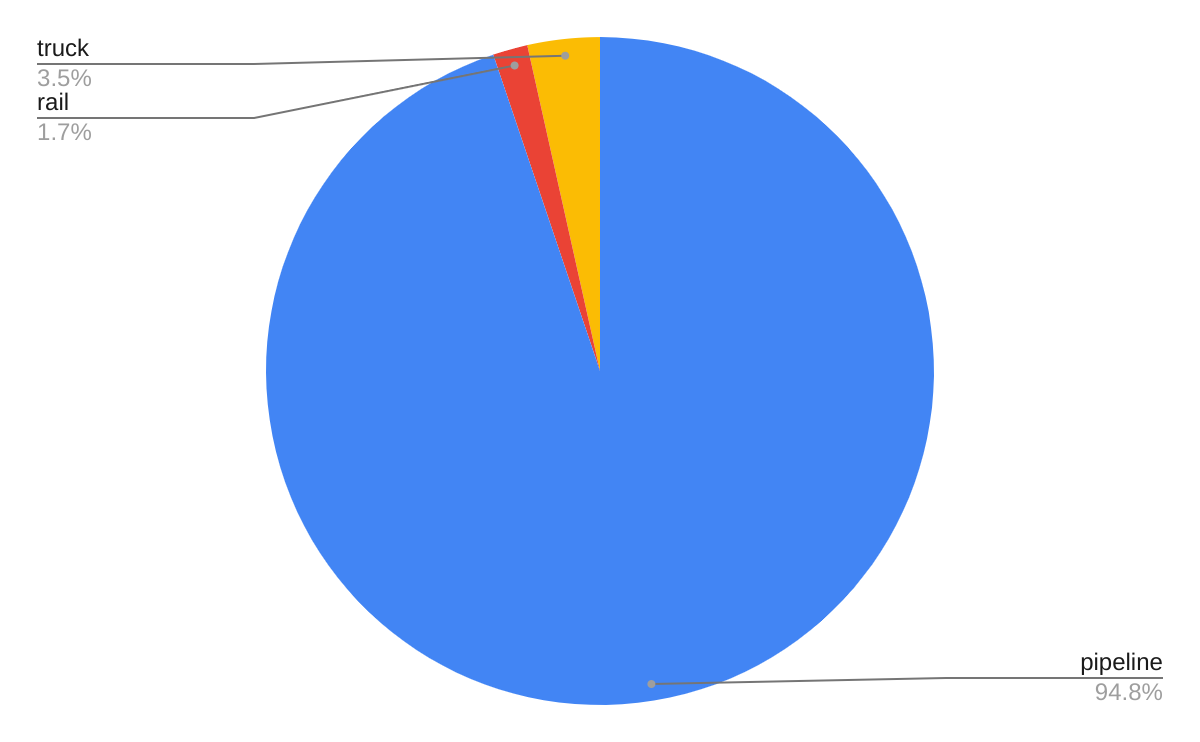
data from 2018 DOT report

Looking at the systems, one would assume that pipelines have safety and environmental advantages. Loading and unloading hundreds of tanks would seem to be inviting spills, although most would presumably be small. The DOT data bear this out. On a volume transported basis, spill incidents occurred nearly 15 times more frequently for rail cars and trucks than they did for pipelines.

For pipeline(s), an incident occurred approximately once every 720 million gallons of crude oil shipped. For rail, an incident occurred approximately once every 50 million gallons of crude oil shipped. For truck(s), an incident occurred approximately once every 55 million gallons of crude oil shipped.

Looking at the percentage spilled, pipelines also had a significant (7.6 times) advantage over rail, but only a slight advantage over trucks.

Volume of Crude Oil Shipped and Spilled by Pipeline, Rail, and Truck, 2007-2016

Pipeline
volume shipped (k gal)1,298,630,088
volume spilled (k gal)13,161
% spilled0.0010%
Rail
volume shipped (k gal)23,052,960
volume spilled (k gal)1,751
% spilled0.0076%
Truck
volume shipped (k gal)47,894,868
volume spilled (k gal)521
% spilled0.0011%

Because fatalities or hospitalizations were extremely rare, DOT chose not to normalize those data. There were a total of 3 fatalities associated with both pipeline and truck shipments. While no fatalities were associated with rail shipments, DOT noted that 47 deaths resulted from a crude oil derailment in Lac Megantic, Quebec in 2013. BOE further reminds readers that this train was transporting Bakken crude from North Dakota to a refinery in St. John, New Brunswick.

The bottom line is that you have to plan ahead to satisfy future supply needs. This is particularly true for the offshore sector where the lead times are longer, but the production volumes relative to the number of wells and facilities are higher (a good thing). The need for oil and gas is not going away, nor are threats to energy security. There are plenty of people in the U.S. Department of the Interior who understand this. Empower them to safely expedite leasing, exploration, and development!

Read Full Post »

New PHMSA (DOT) regulation

At the behest of Congress, coastal areas and beaches are now designated as Unusually Sensitive Areas (USAs). Given that any offshore liquids pipeline has the potential to affect coastal waters or beaches, the rule would seem to require that all such pipelines be included in Integrity Management Programs, which are mandatory for pipelines that could affect USAs. (The IMP requirements would almost certainly apply to all DOT regulated offshore pipelines. Their applicability to DOI/producer pipelines is less certain. Of course, very little is clear and consistent in US offshore pipeline regulation.)

As one would expect, the recent Huntington Beach pipeline spill is among the incidents cited in the justification for this regulation. More surprisingly, the Santa Barbara well blowout was also cited. This incident occurred 53 years ago, was the result of a reckless drilling program, and had nothing to do with production operations or pipelines.

As noted in a recent BOE post, the regulatory regime for offshore pipelines is badly in need of overhaul. DOT and DOI, with inconsistent jurisdictional boundaries, regulations, and approaches, have primary responsibility and multiple regulatory entities have roles.

Lastly, PHMSA seems to have inadvertently posted a highlighted copy of the new regulation. Nothing at all scandalous (looks like someone was highlighting potential talking points), but possibly amusing to other regulation nerds. 😃

Read Full Post »

Scandpower study (2004) for MMS:

Overall Conclusion
Currently, there are no regulations that require removal of subsea pipelines if they are not an obstruction to navigation. Based on the high costs for removing the pipelines, the personnel risk involved in the removal operations, the negative effect on overall emissions to air and the very limited reduction in discharges to sea, the overall conclusion is that it is better to leave the pipelines in place. If possible, re-use of the pipelines is the optimal solution.

Environmental Impacts
The impacts on the environment and the marine environment from pipelines and cables left in place were found to be very minor. Conversely recovery operations will have a negative impact on the environment. The number of vessels required for removal operations and long operating hours will result in considerably more releases and emissions than leaving the pipelines in place. In addition the energy savings benefit from recycling the pipeline materials will be exceeded by the energy required to remove the pipelines and separate the materials.

Pipeline Decommissioning: Environmental Impact Metric (per Scandpower)

Remove/
recycle
Remove/
landfill
Reuse or
preserve
Bury Abandon
in place
EnergyHighHighLowModerateNone
EmissionsHighHighLowLowLow
DischargesLowLowModerateLowLow
HabitatLowLowModerateLowLow
AestheticsLowModerateNoneNoneNone
Resource
Utilization
HighNoneHighNoneNone
LitteringLowLowLowLowModerate

The “Habitat” impacts row seems questionable. Pipeline removal certainly has a greater impact on habitat than abandonment in place, particularly for buried pipelines.

Read Full Post »

A: Not according to this 2012 INGAA study:

Findings of INGAA Study:

  1. 85% of pipeline incidents reported to PHMSA from 2002-2009 occurred irrespective of the age of the pipeline, with just 15% related in some way to the age of the pipeline.
  2. The properties of the steels which comprise natural gas pipelines do not change with time; that is, pipe does not “wear out.”
  3. The fitness of a pipeline for service does not necessarily expire at some point in time.
  4. The integrity of those pipelines for which the fitness for service may degrade with the passage of time can be assessed periodically. Timely repairs – and other mitigation efforts – based on those assessments will ensure the pipeline’s continued fitness for service.
  5. A well-maintained and periodically assessed pipeline can safely transport natural gas indefinitely.

Read Full Post »

« Newer Posts