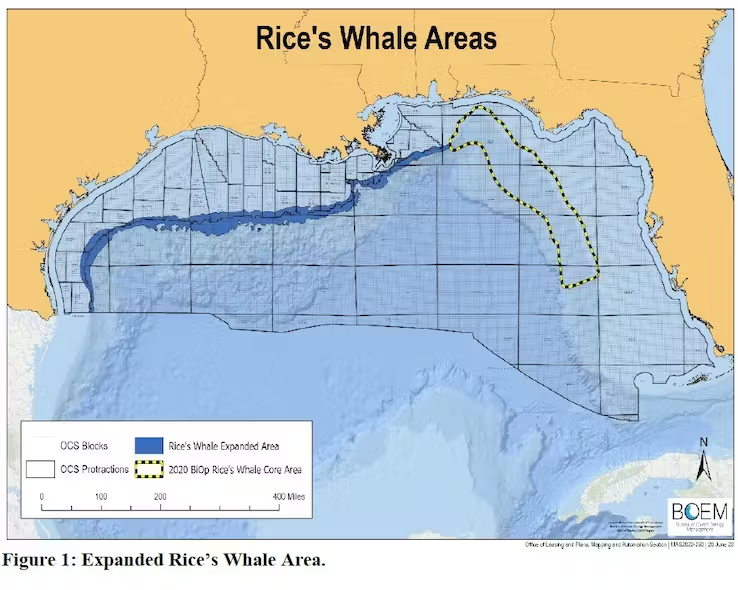
API’s comments on the Rice’s whale restrictions include a balanced assessment by Darren Ireland (begins on p. 22), a respected marine mammal scientist, and a good analysis of the economic impacts by EIAP.
Darren Ireland concludes (emphasis added):
“The proposed critical habitat has been deemed, by NMFS, to have the essential physical and biological features needed for the Rice’s whale to feed, breed, and reproduce. However, direct evidence for what oceanographic features within the 100-400 m isobath band identified by NMFS are required to sustain the Rice’s whale is lacking, and the extent of those truly important features elsewhere in the GOMx is uncertain and may not reach into the central or northwestern GOMx as predicted by the habitat based density model (Garrison et al. 2023). Even though there is evidence to support the possible occurrence of Rice’s whale near the FGBNMS in the northwestern GOMx, there are no data that show this area is being used to support important life history functions such as breeding, feeding, or migrating. Additionally, the sightings and acoustic detections that have been recorded there are much less frequent than those recorded for Rice’s whale in the core habitat in the northeastern GOMx. Based on the limited data available on the use and occurrence of Rice’s whale in the central and northwestern GOMx (one acoustic study (Soldevilla et al. 2022b), one confirmed sighting (NMFS 2018a) and a few unconfirmed sightings (Rosel et al. 2021)), there is insufficient scientific evidence to determine that essential features for Rice’s whale conservation are indeed present in the central and northwestern GOMx. In fact, data on the life-history requirements of Rice’s whale even in the core habitat are still lacking and need further investigation.“
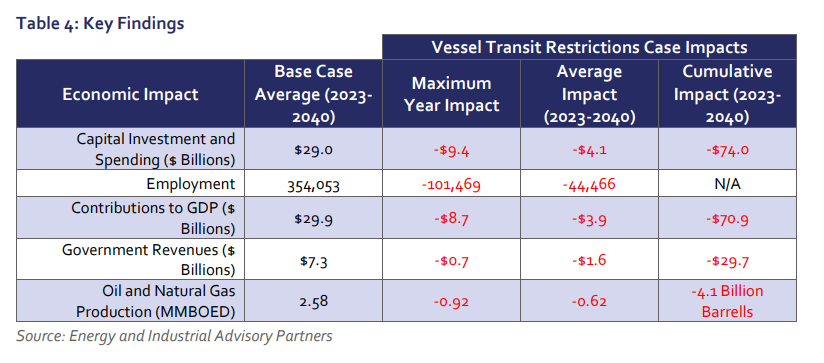
EIAP’s key findings on the estimated economic impacts from these restrictions are summarized in the table below. Those are very significant costs given the uncertainty of the whale habitat in the central and western GoM.
Separate comments submitted by the Offshore Operators Committee are also quite strong. Their letter is attached.



 Bud's Offshore Energy (BOE)