Feeds:
Posts
Comments

Posts Tagged ‘oil and gas exploration’

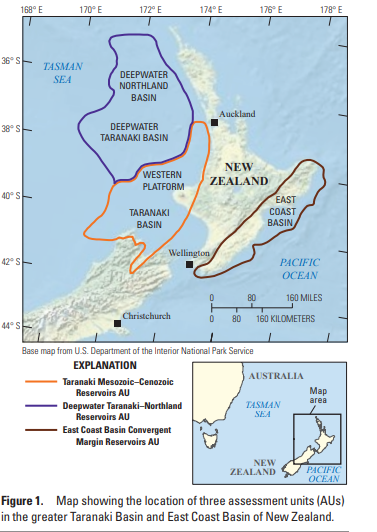
USGS diagram

New Zealand may again issue new oil and gas permits following yesterday’s action by parliament.

The extent to which this will result in new exploration remains to be seen. Increased natural gas production is the primary objective.

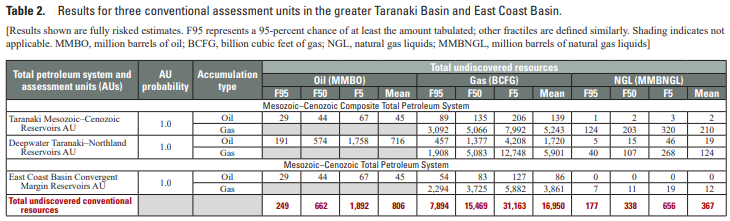
USGS (2020) undiscovered resource estimates are encouraging. The fully risked total for natural gas is 17 Tcf (mean), with a range of 7.9 to 31.1 Tcf. See the table pasted below.
Policy shift at a glance:

April 2018: New Zealand is halting all new offshore oil and gas exploration to become a global leader in the fight against climate change, the centre-left government said Thursday, but opponents accused it of “economic vandalism”.

June 2024The country’s coalition government is preparing to invite energy companies to resume exploration in the three major offshore fields that supply most of its gas. It comes after National Grid operator Transpower was last month forced to warn families to limit their electricity usage to avoid a shutdown during a cold snap.

July 31, 2025: Parliament reverses the law banning new offshore oil and gas exploration permits.
Read Full Post »

As the table below illustrates, Denmark’s highly publicized oil and gas exploration ban is more pragmatic than has been reported in the media. The expansion of production from existing fields is not restricted.

12/4/2020 policy announcement10/29/2024 discovery announcement
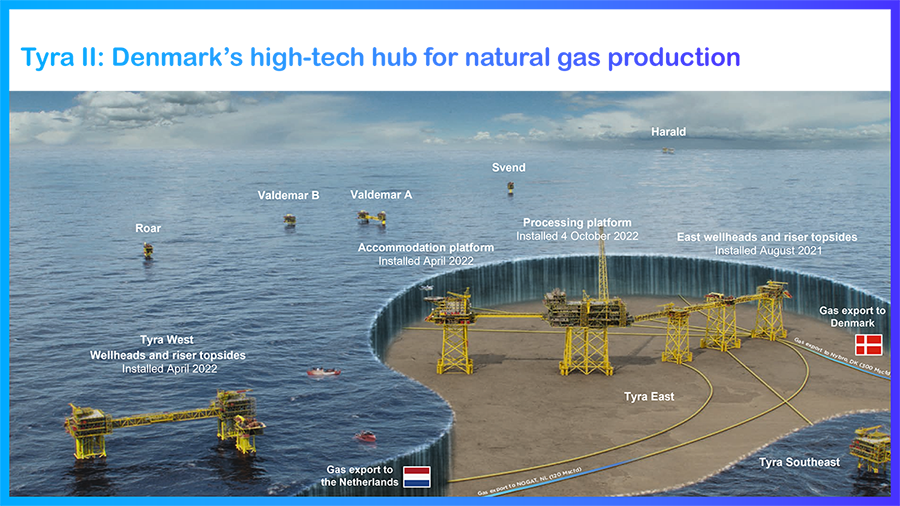
Denmark has brought an immediate end to new oil and gas exploration in the Danish North Sea as part of a plan to phase out fossil fuel extraction by 2050. TotalEnergies announces that the Harald East Middle Jurassic nearby exploration well (HEMJ-1X) has discovered additional gas condensate resources in the Harald field, in the Danish North Sea.“The success of the Harald East Middle Jurassic well, nearby our Harald facilities in Denmark, demonstrates the strength of our Exploration strategy.” 

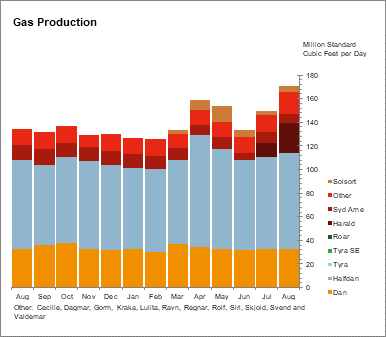
As a result of new exploration, Danish gas production is on the rise (graphic below) after two decades of decline. August 2024 production (165.8 MMCFD) was 21% higher than August 2023 production (136.9 MMCFD)

While Total has proven to be resourceful in sustaining North Sea gas production, Denmark’s refusal to hold new licensing rounds dooms their production over the longer term. This is consistent with Denmark’s intent to cease domestic production by 2050. (Those of you who are young enough can report on whether that deadline is met 😉).

The demand for fossil fuels, which has yet to peak, will still be strong in 2050 and beyond. Phasing out domestic production may be Denmark’s choice, but it’s not a good choice for much of the world.

Denmark is a lovely country, but their rather smug commitment to “lead a global campaign on the role of fossil-fuel producing countries” is not universally welcome. Similarly, companies like Orsted (50.1% Danish govt ownership) are not always the best ambassadors for exporting Danish energy policy.

Other governments, including the US, are quite capable of risking their economic growth and energy security without Denmark’s help.

Related posts:

Read Full Post »

From the Amsterdam News:

Encouraged by the Guyana Suriname finds, several other regional bloc member nations, including Barbados and Jamaica, have been ramping up efforts to attract companies to explore offshore acreages. The most determined of them seems to be Grenada, which is just north of oil and gas producers Trinidad and Venezuela.”

“Officials there say they are preparing to put out bids to attract some of the world’s largest exploration companies, but the 14-month new administration has said the previous government secreted away all the documents and data obtained from a 2018 exploration campaign by a little-known Russian firm, the Global Petroleum Group (GPG).”

The group had told the previous administration that it had found commercial quantities of oil and gas in a well labeled Nutmeg 2, in about 400 feet of water, and that there were other promising prospects right nearby. But as the current Dickon Mitchell government gets ready to assess the island’s prospects, it has said there is nothing to work with.”

Grenada will no doubt be more careful about whom they issue future exploration licenses to and how they manage the data.

Read Full Post »

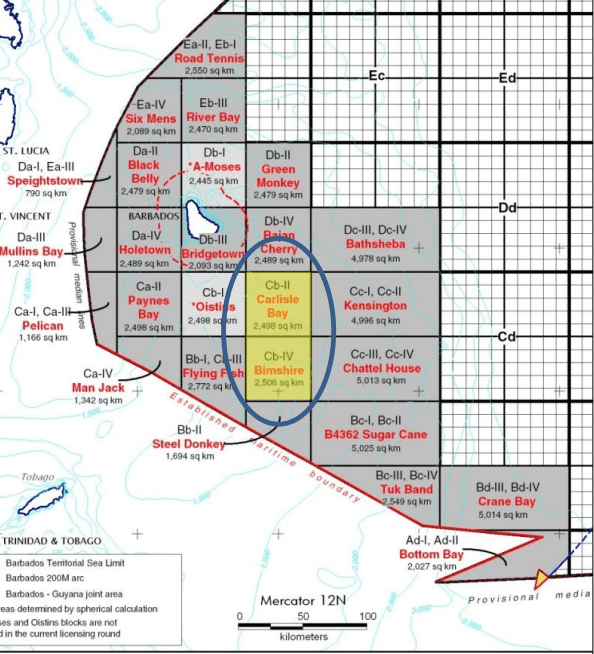
Barbados is opening a licensing round for 22 offshore blocks. Interested companies may begin sending in offers on November 1 for a duration of 11 months. Blocks will be awarded to successful applicants on December 11, 2023. The BOE bid is being drafted; partners are welcome.😉

Why Barbados?

 Under-explored acreage.
 Untapped potential.
 Good prospectivity.
 Large potential structures with stacked targets and DHI support.
 Good data coverage.
 Proven onshore petroleum system.
 Stable government.
 Strong legal, fiscal and regulatory framework.
 Great place to live and work.

Barbados offshore blocks; existing BHP/Shell licenses in yellow

Read Full Post »