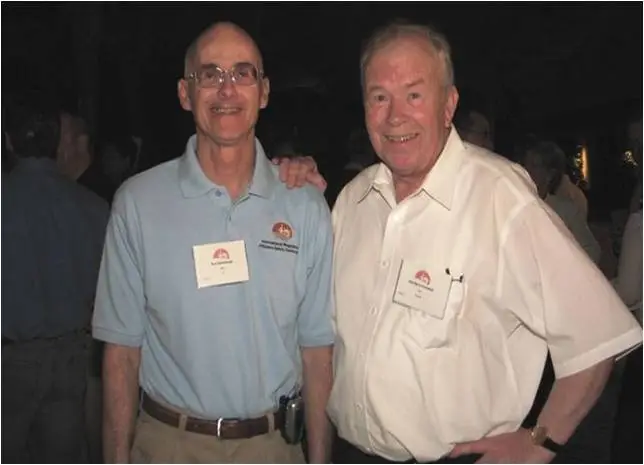
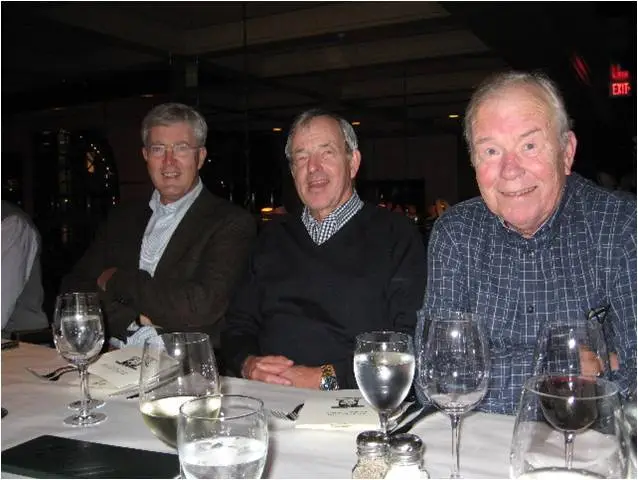
Yesterday, I learned that Odd Bjerre Finnestad passed away on Christmas Eve, 2021. Odd was an international safety leader, a founder of the International Regulators’ Forum (IRF), and a driving force behind the IRF book, “A legacy of safety.”
In 2003, the US Minerals Management Service honored Odd, two other Norwegians, Magne Ognedal and Gunnar Berge, and Taf Powell from the UK, with International Leadership Awards for their outstanding leadership in facilitating the exchange of information among offshore regulatory agencies, encouraging cooperation on offshore safety and pollution prevention issues, coordinating participation in the development of international standards, cooperating on safety audits and research projects, compiling incident data, exchanging training information and discussing materials and equipment issues.
Odd was also an important contributor to this blog during the difficult times following the Montara and Macondo blowouts in 2009 and 2010.
Pasted below is the English language version of the excellent obituary that appeared in the Stavanger Aftenblad. RIP Odd; your impressive contributions to offshore safety are greatly appreciated.
Memorial: Odd Bjerre Finnestad died on Christmas Eve 2021, aged 79.
Odd was employed by the Norwegian Petroleum Directorate (OD) in 1980, later the Petroleum Safety Authority (Ptil) when resource and safety management was divided into two agencies in 2004. He worked there until his retirement in 2013.
Born in the maritime city of Stavanger, he chose a maritime career. As a young naval officer, he met his Anna Dorothy in Londonderry in Northern Ireland. They married in 1967, and our thoughts go out to her and the rest of the family today.
His maritime education and experience led Odd to a scholarship position at the Norwegian Institute of Maritime Research and a research program focusing on personal safety at sea. This was an important experience as head of the Section for Worker Protection and the Working Environment in NPD.
Even though most of the Working Environment Act had been applied to permanent installations on the Norwegian continental shelf as early as 1977, demands for employee participation and tripartite cooperation met resistance in parts of the industry.
Odd took on the big challenges with great commitment. On the drilling deck there was still something of the cowboy culture, where safety and the working environment had poor conditions. Several of the residential quarters appeared to be barrack-like accommodation and little had yet been arranged for women in the new industry.
He was concerned that the professional environment should have professional diversity, and that the work should be anchored in research and development. At a time when the share of women offshore was minimal, he was a driving force behind realizing the film project “Norwegian continental shelf – also for women”.
The major accidents with the Bravo blowout in 1977 and the Alexander L Kielland disaster in 1980 had documented the risks in the business in the worst possible way. With these as a backdrop, he participated in the work to develop a new supervision scheme with subsequent information work. This laid the foundation for a three-year engagement at the International Labor Organization (ILO) in Geneva from 1989, where he worked on a global study on various inspection regimes related to the working environment.
For the rest of his professional life, Odd was closely linked to international cooperation at government level. The most important arena was the International Regulators ́ Forum (IRF) where the Ptil director represented the Norwegian authorities. The forum meets annually, but much of the work takes place through ongoing contact between the participating countries. This is where Odd’s ability to see connections and make strategic contacts came in handy. He actively contributed to the IRF developing a culture for rapid and effective exchange of information on risk levels, regulations and supervision.
Odd monitored all channels almost around the clock, in order to convey news of interest. Often before these were picked up by the world press. He thereby also became an important contributor to Ptil’s information environment.
It is a pioneer in Ptil’s role as watchdog and promoter of safety and the working environment in the petroleum industry who has now passed away. We will remember Odd as a committed colleague and friend.

 Bud's Offshore Energy (BOE)