Feeds:
Posts
Comments

Posts Tagged ‘OCS oil and gas program’

In honor of President Carter:

Opinions on Jimmy Carter’s presidency vary, but he merits praise for his administration of the OCS program from 1/1977 to 1/1981. Carter oversaw an active leasing program in all OCS regions. On the operations side, he appointed Don Kash to head the Conservation Division of the US Geological Survey, the OCS regulator at the time. Dr. Kash was an outstanding leader and a gifted communicator and program manager.

Some of the Carter administration’s impressive accomplishments during his 4 year term:

  • 15 lease sales including 3 offshore Alaska, 3 in the Atlantic, and 1 offshore California
  • Drilling activity in all 4 regions: GoM, Pacific, Alaska, and Atlantic
  • Natural gas discovery in the Mid Atlantic (Hudson Canyon Unit)
  • North, Mid, and South Atlantic District offices for permitting and inspections
  • 5300 well starts including 97 in water depths > 1000′
  • 314 new platforms including Cognac, the world’s first platform in > 1000′ of water
  • Comprehensive amendments to the OCS Lands Act (1978)
  • Annual natural gas production reached nearly 5 tcf (approximately 6 times current OCS gas production)
  • Annual oil production was approximately 1/2 current levels which is impressive given that the deepwater era was just beginning and shelf wells had relatively low productivity.

Thank you Jimmy. RIP.

Read Full Post »

15,531 of the 15,537 comments on the bid adequacy rule were from a single organization, Friends of the Earth. I have no problem with the Friends of the Earth campaign given that their comment letter is pertinent to the topic. Their main point is that the bid adequacy process fails “to factor in the climate and social costs of continued Outer Continental Shelf oil and gas lease sales into the bid process.” Although that may be a reasonable position, those issues are addressed in the programmatic and sale specific environmental reviews which factor into when and where sales are held, tract exclusions, special lease stipulations, and the comprehensive operating regulations. Once bids are submitted, the issue (and the sole purpose of the bid adequacy rule) is whether those bids represent fair market value for the oil and gas resource potential of the leases being offered.

Given that 96.3% of the US OCS is off-limits to oil and gas leasing, only 0.7% is currently open to exploration, and the new 5 year plan includes the fewest lease sales in OCS program history, it’s rather a stretch to argue that environmental concerns are not being prioritized.

The State of Alaska submitted very good comments (attached) that point to the historical differences in Gulf of Mexico and Alaska leasing. The State argues that a simpler approach to determining fair market value would encourage exploration and development on offshore lands that have seen little of either in recent years. Knowing BOEM’s expectations prior to the sale, perhaps through higher minimum bid requirements, would ensure that companies do not underbid and that tracts are successfully leased.

The Gulf of Mexico leasing program of today is looking more like the frontier area leasing of the past. As previously noted, the uncertainty regarding future sales changes the historic GoM leasing dynamic. The next opportunity for purchasing unleased GoM tracts is now a troubling unknown. This would seem to make it less prudent to reject bids based on uncertain prospect evaluations. Absent leasing and exploration, the true resource and revenue potential will never be known.

It was good to see the strong comments submitted by my former Minerals Management Service colleagues Dr. Marshall Rose and Ted Tupper. Marshall, who was our Chief Economist, commented that the proposed rule did not identify the problem and explain how the rule addressed that problem. Ted, a senior statistician, points to past failures of the bid adequacy process and proposes specific changes. It’s great to see the passion that our retired employees have for the program they were so instrumental in developing and managing.

The rule was finalized without any substantive changes.

Read Full Post »
The Nord Stream sabotage likely released more methane than the complete lifecycle of a GoM lease sale (upstream and downstream). Also, the Nord Stream explosions may have released more methane than is emitted by all US offshore producers in an entire year. Here are the numbers:

Source of MethaneCH4 emissions (1000s of tons)
Nord Stream (probable range)100-400
Nord Stream (maximum)500
Nord Stream – first 48 hrs (CAMS est)175
all US offshore production in 2020 (EPA)193
all US on- and offshore exploration in 2020 (EPA)12
lifecycle upstream emissions from a typical GoM lease sale (BOEM)118
lifecycle up- and downstream emissions from a typical GoM sale (BOEM)151

Finally, remember that offshore oil and gas leasing results in a net reduction in GHG emissions.

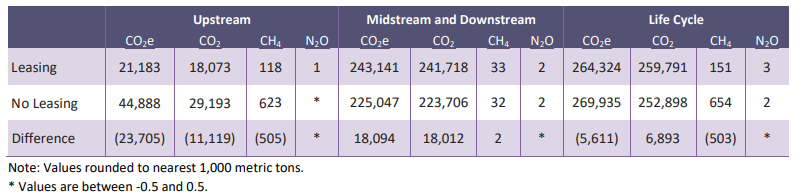
The No Leasing scenario results in roughly double the CO2e emissions for upstream activities compared to those of the Leasing scenario, given that, collectively, the substitute energy sources have higher GHG emissions per unit of production (also known as “GHG intensity”) compared to the forgone domestically produced OCS oil and natural gas of the Leasing scenario.

BOEM

Even when mid- and downstream emissions are included, leasing is preferable to no leasing. See the table below from the BOEM report:

Bottom line: we need more energy leasing and less military aggression!

Read Full Post »

Netherlands climate activist Niklas Hohne succinctly summarizes the “end of fossil fuels” strategy (first quote) that the US Department of the Interior seems intent on implementing in the proposed 5 Year OCS Leasing Plan (second quote). What is DOI’s legislative authority for phasing out offshore oil and gas production? It’s certainly not the OCS Lands Act which calls for the expeditious and orderly development of OCS resources. Neither the EIA nor any other reputable forecaster believes we can even reduce, let alone eliminate, oil and gas consumption in the next 20-30 years.

“The plan was not to build any new infrastructure, because everything new you build has to run for 20 or 30 years to pencil out, long past the point we want to be off fossil fuels,” Hohne said. 

Niklas Hohne, founder of the New Climate Institute (Netherlands) to the Washington Post

The long-term nature of OCS oil and gas development, such that production on a lease can continue for decades makes consideration of future climate pathways relevant to the Secretary’s determinations with respect to how the OCS leasing program best meets the Nation’s energy needs.

5 Year Leasing Program, p.3

Read Full Post »

As we await the outcome of the nationally important gubernatorial race here in the Commonwealth of Virginia, I wanted to acknowledge the political appointees whom I had the opportunity to work for in the OCS oil and gas program. While they had different backgrounds and interests, all respected the importance of the program and were committed to safe operations and protection of the marine environment. Remarkably, they all managed the OCS program in a rather non-partisan manner.

Republican AppointeesDemocrat AppointeesNotes
Harold DoleyDon KashDr. Kash was Chief of the Conservation Div. (USGS), which was roughly the equivalent of BSEE Director
Bill BettenbergTom FryBill Bettenberg was a career Federal employee appointed as MMS Director by a Republican administration
Bob KallmanCynthia Quarterman
Barry WilliamsonWalt Rosenbusch
Scott SewellTom KitsosDr. Kitsos was a career Federal employee appointed MMS Director by a Democrat administration
Johnnie
Burton
Liz
Birnbaum
Randall Luthi

Read Full Post »