Congratulations to Dr. Ned Mamula on his confirmation as Director of the US Geological Survey. I had the pleasure of working with Ned when he was a young geologist in the Conservation Division (CD) of USGS. At the time, CD was the safety and environmental regulator for OCS oil and gas operations. Ned is a great guy and a dedicated geologist!
Ned’s statement at his confirmation hearing is attached. “Map Baby Map!”
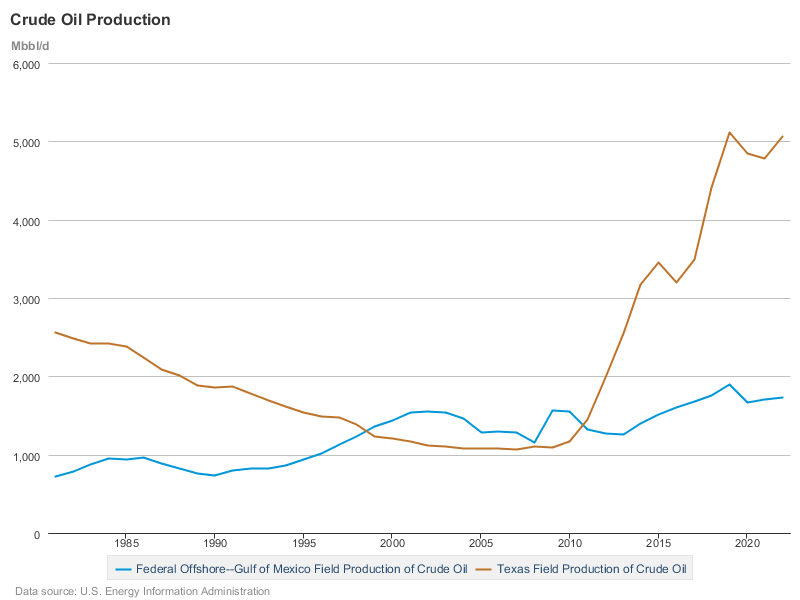
A friend owns land in the Texas Permian. His family gets a nice royalty check every month that has helped them get through some difficult times. Texas Permian production is almost entirely from private land, which is a big part of the success story. Payments to private land owners by responsible producers engender public support, access to resources, and growth in production. Add to that the continuous improvements in horizontal drilling, well stimulation and completion practices, and you have the success story that is the Texas Permian.
Similarly, private and state land plus technology launched the natural gas boom in my native state of Pennsylvania. When I was a student, we looked back at the Titusville/Colonel Drake glory days, and no one dreamed that the state would become a major natural gas exporter. Today, pipeline constraints, particularly in NJ and NY (which has managed to prevent access to the state’s substantial Marcellus and Utica shale resources) are preventing PA from further increasing gas sales.
The offshore lands on the US Outer Continental Shelf are a different story. Unfriendly, bordering on hostile, leasing policy (and not just during the current administration) has been partially overcome by advances in deepwater well and facility design that have lowered costs and increased productivity. However, OCS oil production is a fraction of what it could be.
OCS gas production has fallen dramatically since the turn of the century. Ultradeep (subsurface) gas production was not economically viable and production was fading even before onshore shale gas began to dominate US gas markets. Most of the current OCS gas production is associated with deepwater oil production.
The bill neither repeals nor amends the massive land withdrawals by Presidents Obama, Trump, and Biden that have fenced the OCS program into portions of the central and western Gulf of Mexico. Worse yet, the bill tacitly endorses those withdrawals by specifically stating that they are not affected in any way (Sec. 20114).
Sec. 20107 mandates that at least 2 lease sales be held annually in the GoM. The certainty would provide some incremental benefit, but is unlikely to stem the decline in GoM reserves. We are becoming increasingly dependent on the 4% of our OCS that may be leased, about 3/4 of which is not prospective or has limited production potential.
Sec. 20601 lowers the revenue to the US Treasury and increases the revenue to Gulf producing states. This would garner further support from those states, but will have little effect on production.
Sec. 20106 requires DOI to publish information and report to Congress on the processing of drilling permits. However, delayed drilling permit approvals do not seem to be a significant issue on the OCS.


 Bud's Offshore Energy (BOE)