Abstract from a German study published in Nature – “Projected impacts of future offshore wind farms on coastal precipitation over the Northwest European shelf”:
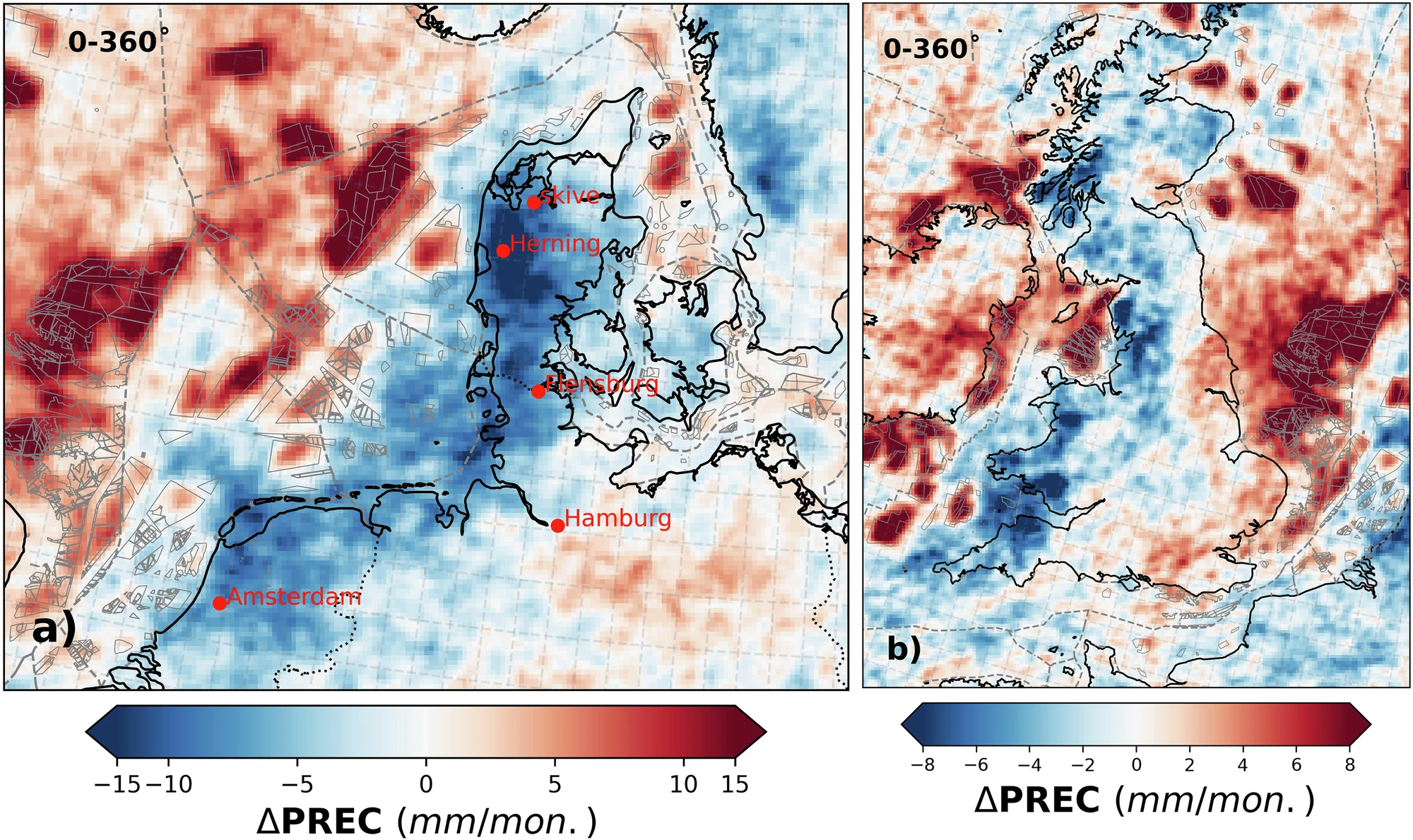
“Offshore wind energy plays a central role in reaching the European Green Deal target of a climate-neutral Europe by 2050. In this study, we simulate offshore wind development for 2023, 2030, and beyond 2050 across the Northwest-European Shelf, using various turbine sizes over a 10-year period, an approach not previously undertaken. For the post-2050 scenario, we assess the maximum potential deployment within all currently identified development zones in North Sea countries. Results indicate that large-scale offshore wind farm expansion can reduce surface wind speeds by up to 2–3 m s⁻¹. Notably for post-2050 scenario, precipitation decreases by 10–12% in coastal regions of Germany, the Netherlands, and the United Kingdom, and by more than 15% in parts of Jutland, Denmark, particularly under south-westerly winds. Conversely, precipitation increases over the wind farm areas. These findings suggest that extensive offshore wind deployment may significantly alter regional climate patterns, highlighting the need for further multi-model investigations to reduce uncertainty.”
The study found that existing wind farms under the 2023 and 2030 scenarios indicate small effects on precipitation, with effects primarily confined to marine areas. However, the large-scale deployment of offshore wind farms in the Northwest-European shelf, as projected for 2050, has a significant and spatially distinct impact on regional precipitation patterns, specifically in the regions over northern Germany and Denmark, highlighting the critical role of scale and turbine density in driving these changes.

