This impressive NOAA study confirms the importance of Nantucket Shoals as a feeding ground for right whales and implies a need for protective measures in months (October through December) when the existing restrictions do not apply.
“The importance of Nantucket Shoals as a feeding ground for the critically endangered North Atlantic right whales within the southern New England wind energy is well understood (Leiter et al., 2017; Quintana-Rizzo et al., 2021; Estabrook et al., 2022). Similarly, year round presence of this species has been demonstrated since as early as 2011 (Quintana-Rizzo et al., 2021; Estabrook et al., 2022), showing that North Atlantic right whales have consistently used this region for well over a decade. Currently, the National Marine Fisheries Services and Bureau of Ocean Energy Managements policy is to exclude pile driving during the months of January through April in the southern New England wind energy area. Evaluation of the need for further management protections are needed for North Atlantic right whales especially in October through December, along with further assessment of risk to this species (Southall et al., 2023).
A map of the southern New England planned offshore wind energy lease areas off the East Coast of the United States (insert). Passive acoustic recorders (SoundTrap and F-POD recorders) were deployed for varying time periods (see Table 1) between January 2020 and November 2022 at seven sites surrounding the wind energy areas.
Note (below) the acoustic presence of the North Atlantic Right Whale (NARW) from Oct. through April.
Weekly acoustic presence summary of eight cetacean species (harbour porpoise, sperm whale, humpback whale, minke whale, North Atlantic right whale (NARW), sei whale, fin whale, blue whale) and one family (Delphinid sp.). The boxplots represent the median number of days of acoustic presence per calendar week across all data at four recording sites, in the southern New England offshore wind energy area. Only recorders with 2 or more years of data (NS01, NS02, COX01, and COX02) were used. Horizontal lines within the boxes indicate the median, box boundaries indicate the 25th (lower quartile) and 75th (upper quartile) percentiles, vertical lines indicate the largest (upper whisker) and smallest (lower whisker) values no further than 1.5 times the interquartile range, and black dots represent outliers.
Kudos to BOEM for sponsoring this important study which identifies the potential ecological effects of offshore wind farms on the endangered North Atlantic Right Whale.
BOEM must now consider, and presumably implement, the committee’s recommendations. This could prove to be especially challenging given BOEM’s prominent wind advocacy role.
All 9 of the study committee members are scientists with appropriate backgrounds and specialties (see Appendix A of the report).
As a rule, the NAS notes potential conflicts of interest in the biographical statements. Two possible conflicts were identified: one committee member was a “compensated member of a review panel for Ortsted’s Offshore Wind Research Plan in 2021,” and another works for a firm that “has been partially funded by offshore wind development companies.”
The panel recommends robust monitoring during all phases of wind development and operations in the North Atlantic region. Is that sufficient given that hundreds of turbines could be installed before the data have been acquired and analyzed?
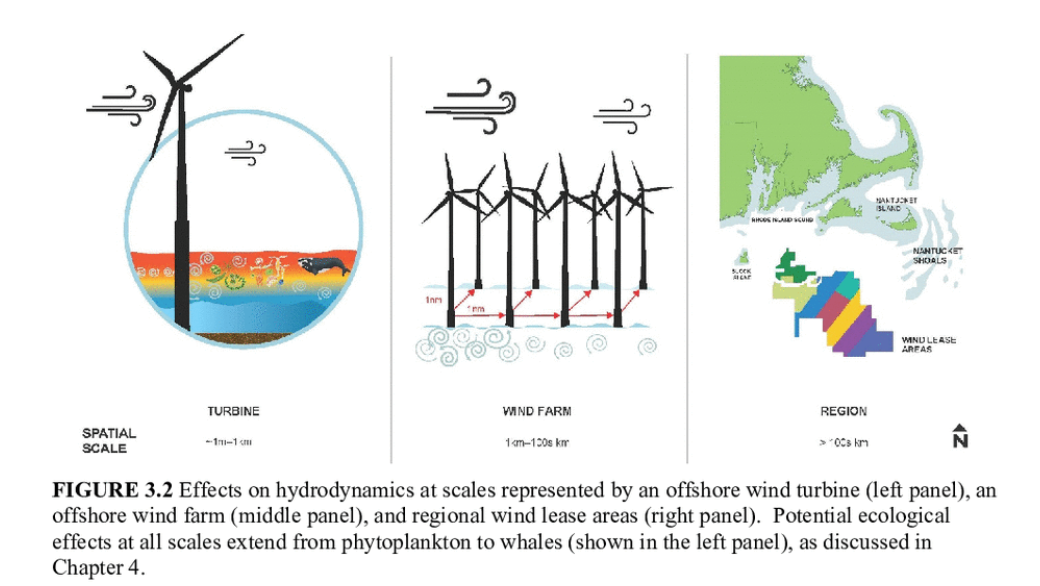
. Background graphics, excerpts, and recommendations are pasted below.
Important excerpts:
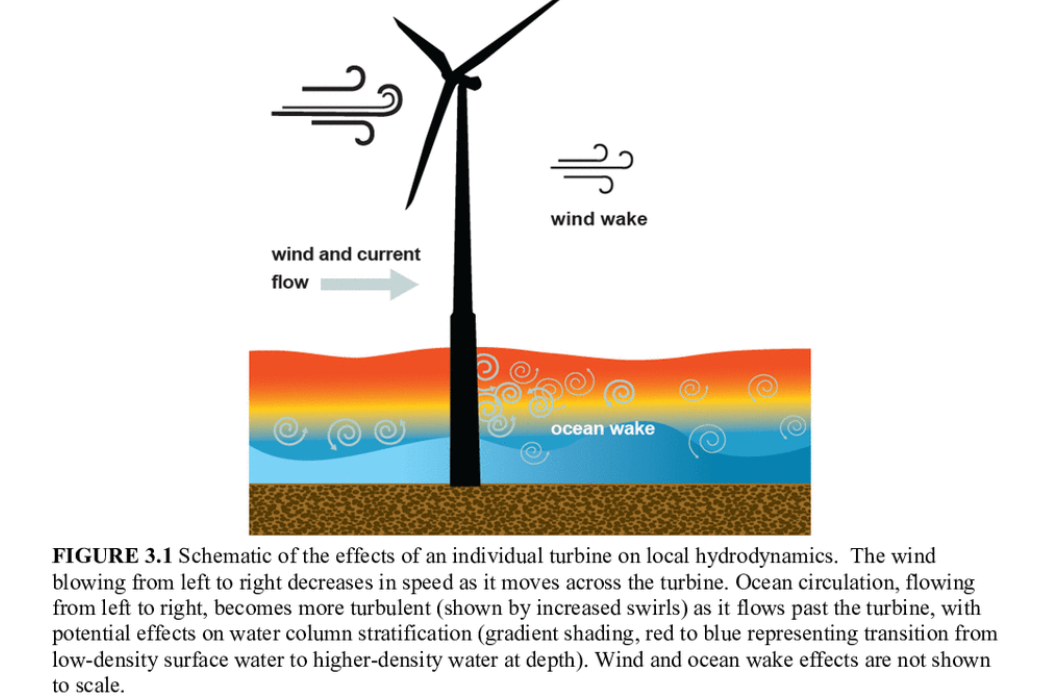
p.2: A single offshore wind turbine can alter local hydrodynamics by interrupting circulation processes through a wake effect and induce turbulence in the water column surrounding and downstream of the turbine supporting structure, the pile. Moving away from single turbine effects and looking at arrays of turbines in a wind farm or at multiple adjacent offshore wind farms, these effects become more complex with implications for both local and regional circulation.
p.4: At the wind farm scale, the potential impacts include reductions in ocean current speeds, stratification, ocean surface wind speed, and deflection of the pycnocline. At the regional scale, perturbations due to offshore wind turbines are difficult to quantify because of the natural processes that drive significant environmental variability across the region.
p.6: Recommendation: The Bureau of Ocean Energy Management, National Oceanic Atmospheric Administration, and others should support, and where possible require, the collection of oceanographic and ecological observations through robust integrated monitoring programs within the Nantucket Shoals region and in the region surrounding wind energy areas before and during all phases of wind energy development: surveying, construction, operation, and decommissioning. This is especially important as right whale use of the Nantucket Shoals region continues to evolve due to oceanographic changes and/or the activities and conditions relevant to offshore wind farms.
p.7: Recommendation: The Bureau of Ocean Energy Management, National Oceanic Atmospheric Administration, and others should support, and where possible require, oceanographic and ecological modeling of the Nantucket Shoals region before and during all phases of wind energy development: surveying, construction, operation, and decommissioning. This critical information will help guide regional policies that protect right whales and improve predictions of ecological impacts from wind development at other lease sites.


 Bud's Offshore Energy (BOE)