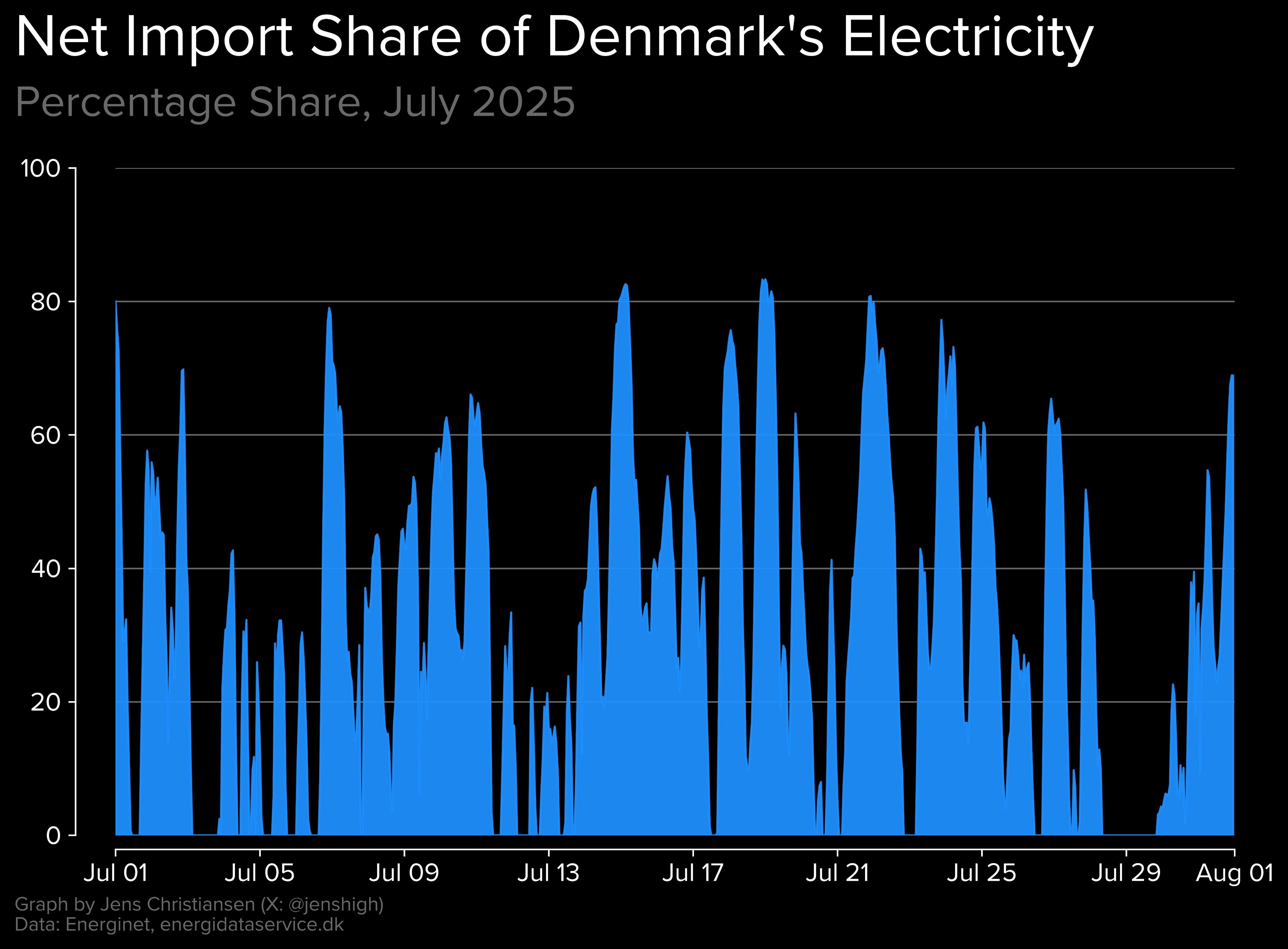
As indicated in the Jens Christiansen graphic above, Denmark’s net imports exceeded 80% of demand several times in July. Per Jens, a Danish physicist, “this is the downside of being a wind leader we have to talk about.”
Posted in climate, energy policy, Offshore Wind, tagged Denmark, electricity imports, Jens Christiansen, Wind Energy on August 6, 2025| Leave a Comment »
As indicated in the Jens Christiansen graphic above, Denmark’s net imports exceeded 80% of demand several times in July. Per Jens, a Danish physicist, “this is the downside of being a wind leader we have to talk about.”
Posted in energy policy, Offshore Wind, tagged Denmark, Die Dunkelflaute, Europe, Jens Christiansen, Wind Energy on December 12, 2024| Leave a Comment »
Posted in climate, energy policy, Offshore Wind, tagged decline in bidding, Denmark wind sale, Jens Christiansen, no bids, US Atlantic on December 6, 2024| Leave a Comment »
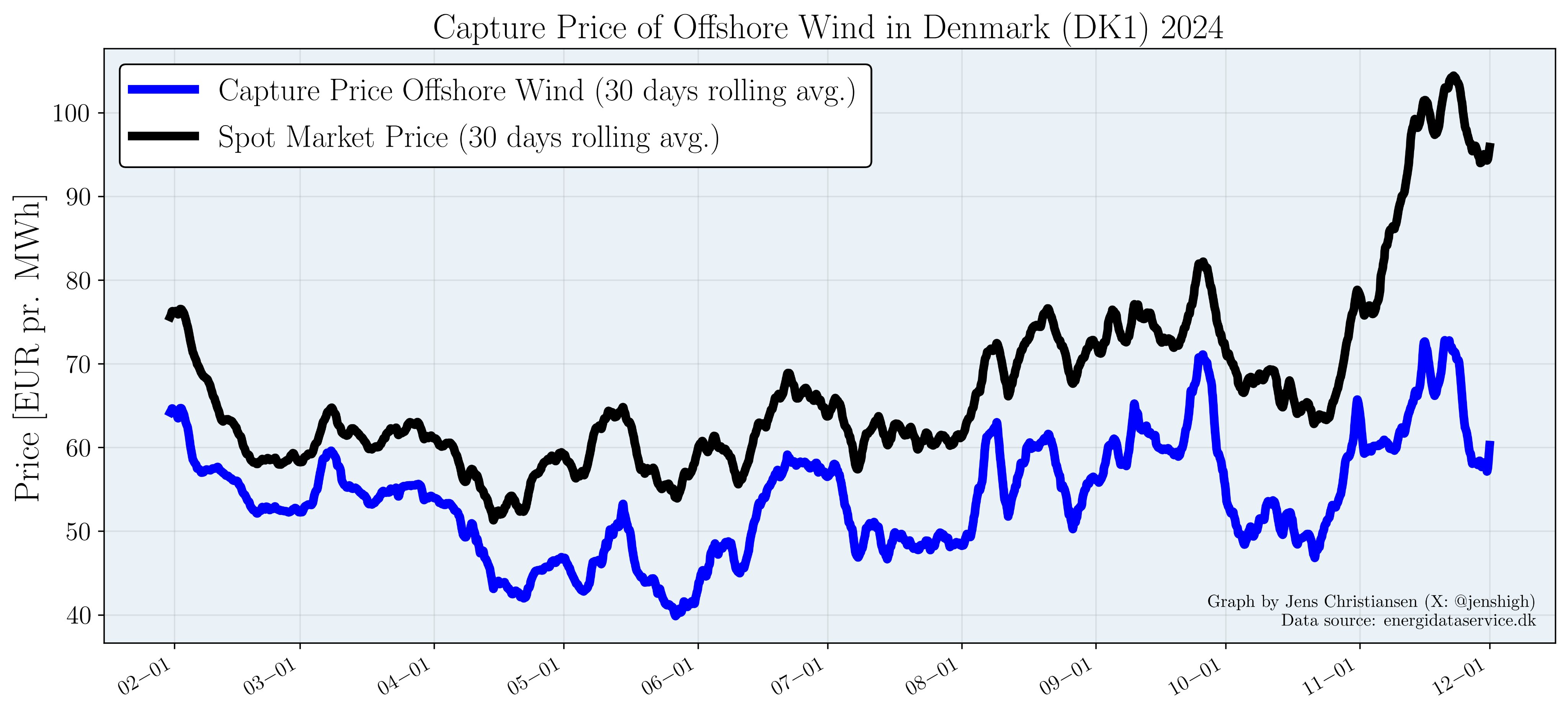
Jens Christiansen offers this explanation for the absence of bids for wind leases offered in the recent Danish sale:
“The value of offshore wind energy in Denmark has declined.
The capture price remains consistently lower than the market price throughout 2024. When the wind blows, the market saturates and the capture price drops This is why the latest offshore wind tender yielded nothing.”
A related BOE post points to the sharp decline in bids for US offshore wind leases.
Posted in climate, Offshore Wind, tagged Die Dunkelflaute, electricity prices, Jens Christiansen, no wind November, windless Europe on November 7, 2024| Leave a Comment »
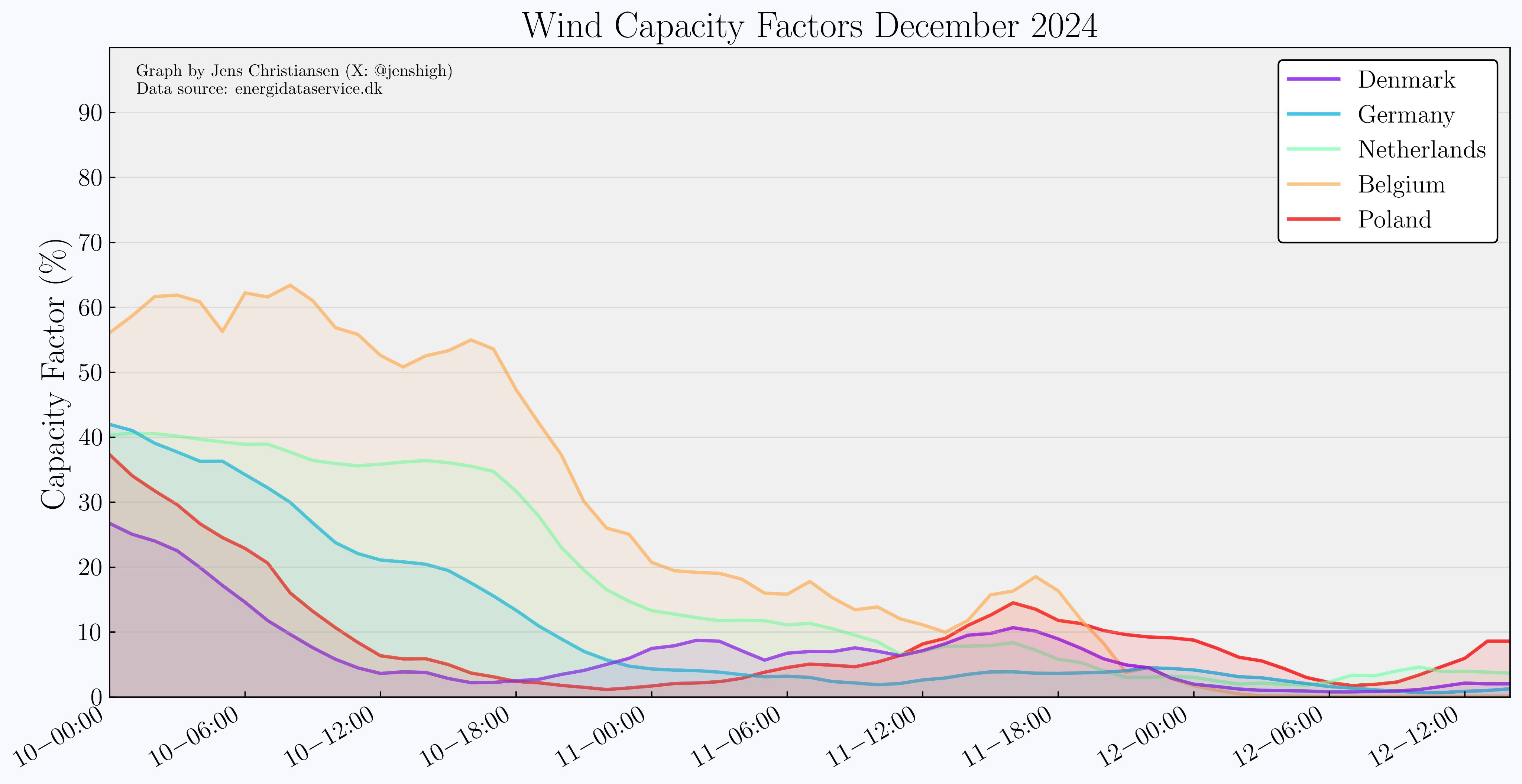
Check out these capacity factors in Western Europe:
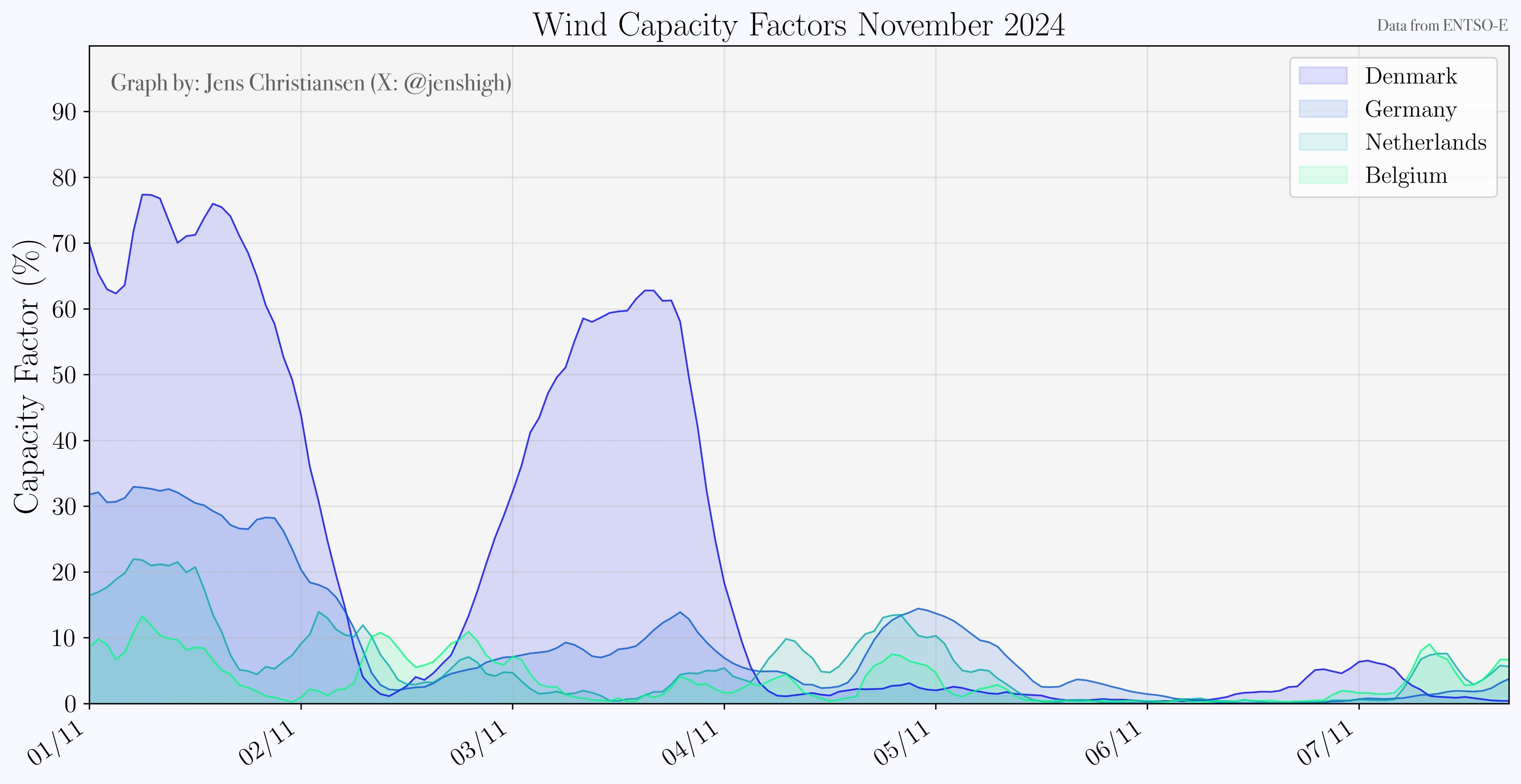
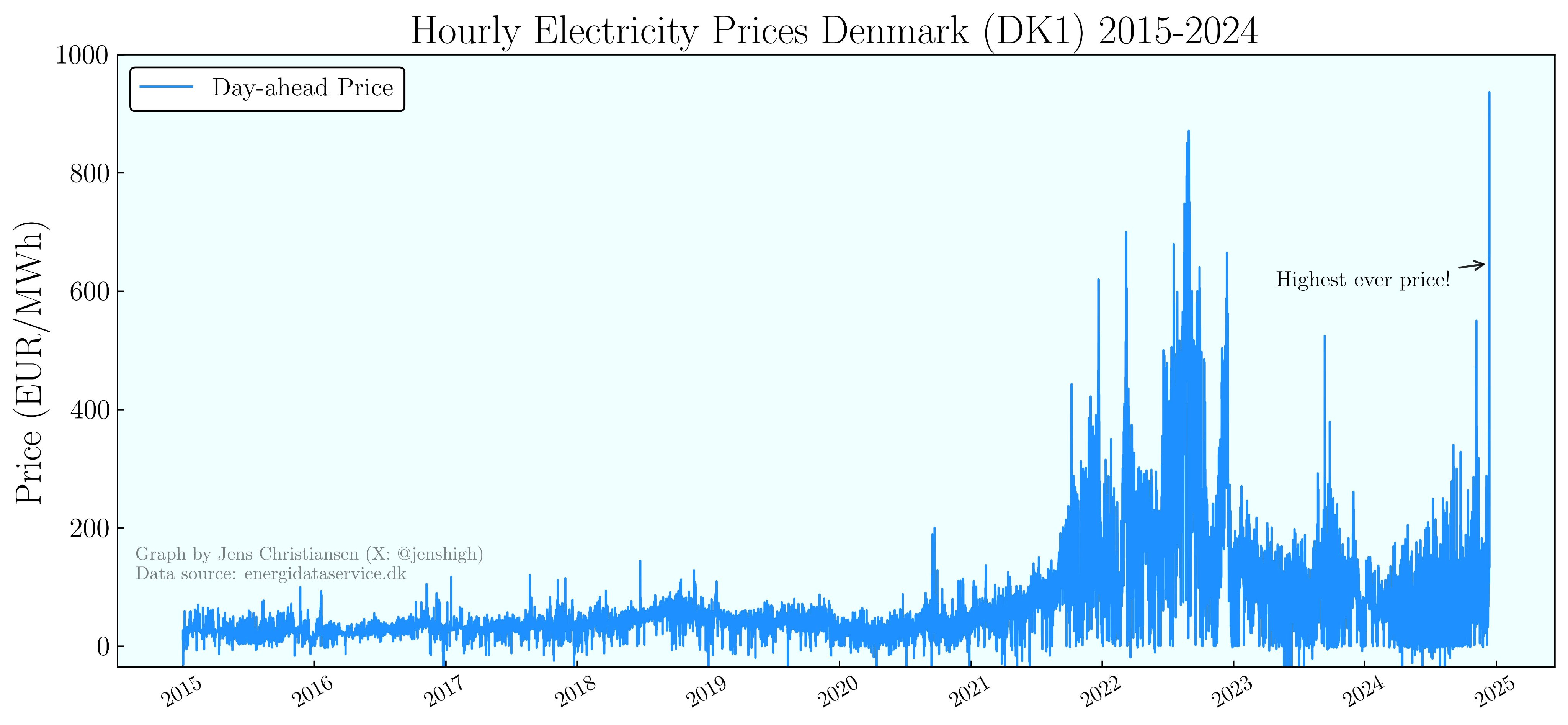
Die Dunkelflaute: wholesale electricity prices spiked to >€800 per megawatt hour—10 times the usual avg.
Posted in climate, energy policy, natural gas, Wind Energy, tagged Denmark power grid, dunkelflaute, Jens Christiansen, kryptonite, natural gas, wind and solar power on April 4, 2024| Leave a Comment »
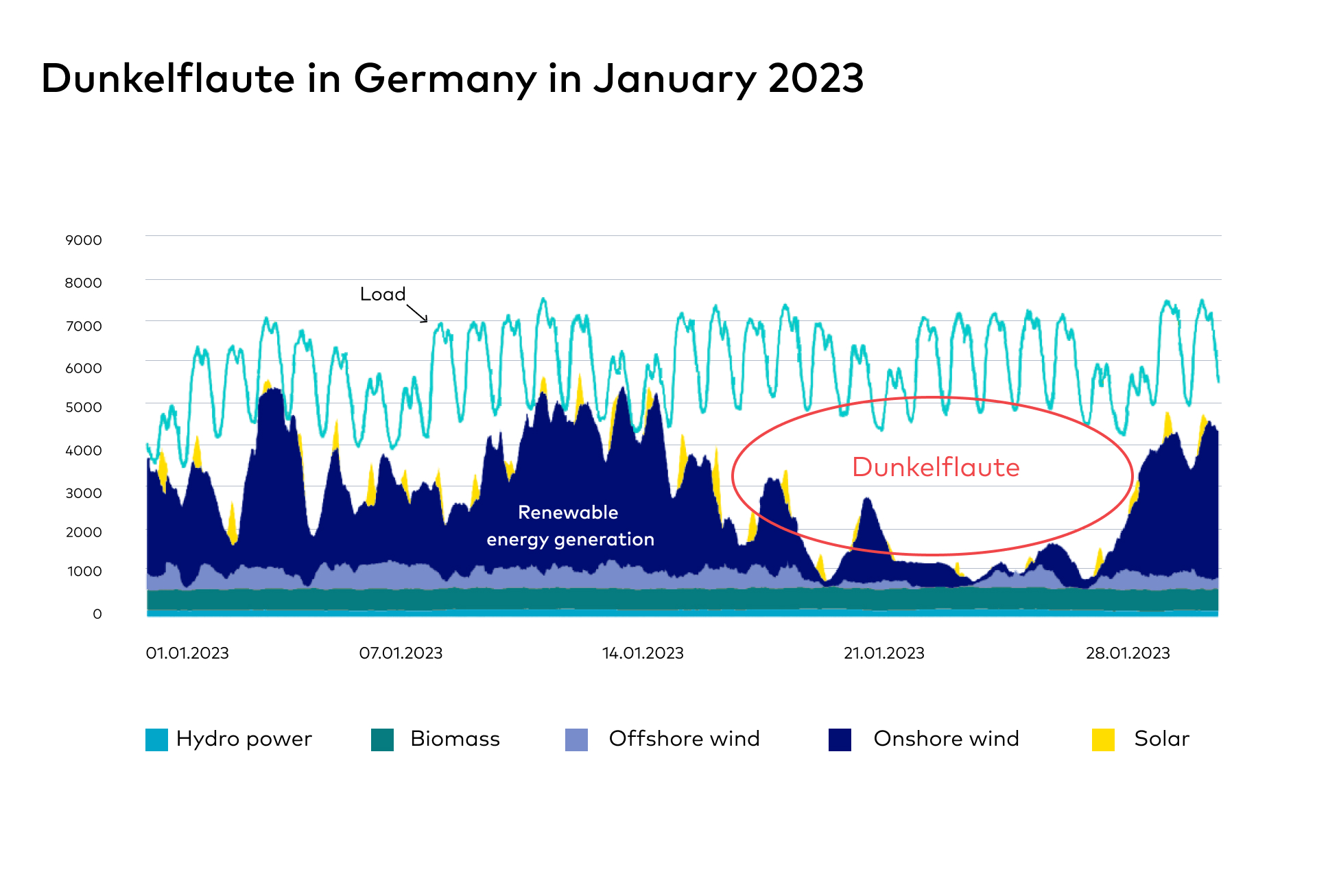
Add Dunkelflaute to the list of interesting and expressive compound German words. Die Dunkelflaute is a dark lull, a period of time in which minimal energy can be generated by the sun or wind. More specifically in German:
Die Dunkelflaute als sogenanntes Kofferwort beschreibt das gleichzeitige Auftreten von Dunkelheit und Windflaute. Diese Wetterlage entsteht typischerweise im Winter und sorgt für geringe Erträge aus Solar- und Windenergie bei gleichzeitig saisonal hohem Strombedarf. Eine Dunkelflaute kann mehrere Tage andauern. Kommen zu Dunkelheit und Windflaute noch niedrige Temperaturen hinzu, die für gewöhnlich den Strombedarf weiter ansteigen lassen, spricht man auch von “kalter Dunkelflaute.”
Note the prolonged Dunkelflaute (below) during which renewables provided minimal power in the middle of winter.
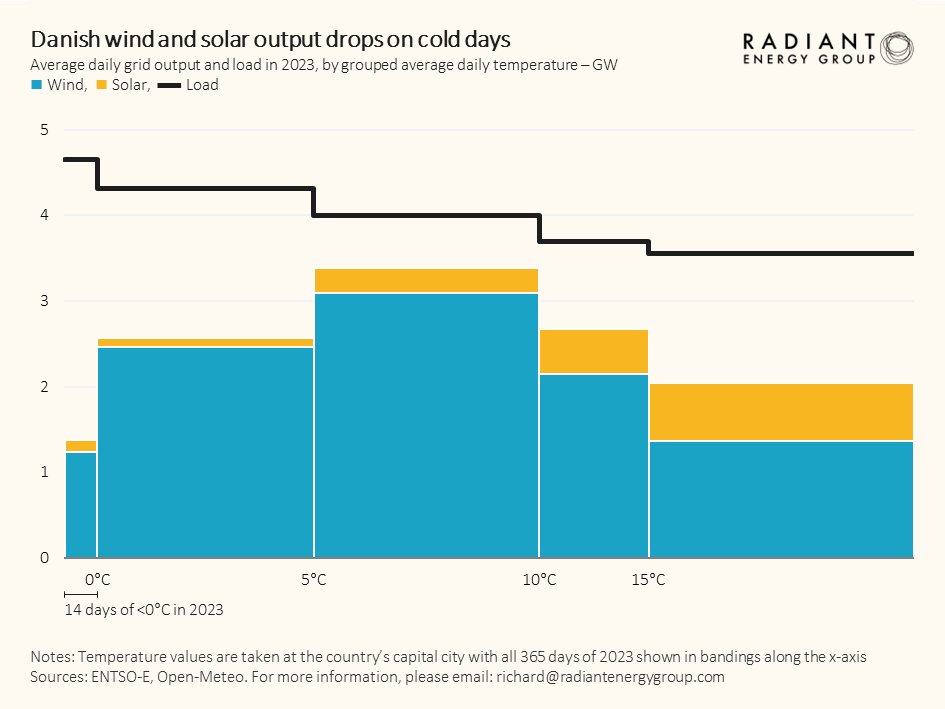
Unsurprisingly, wind and solar output are the lowest when the temperatures are the coldest. See the Danish summary for 2023 below. Note that wind output was also low when temperatures were above 15 deg. C.
Regional wind energy grids are not always an effective solution as Danish physicist Jens Christiansen, a nuclear energy advocate, has illustrated:
‘The wind always blows somewhere.’ Is that really true though? Here I’ve looked at the capacity factors of wind from five northern European countries in August The winds seem highly correlated, and there is almost a week-long period without significant wind anywhere.

Christiansen illustrates Denmark’s reliance on imported electricity:
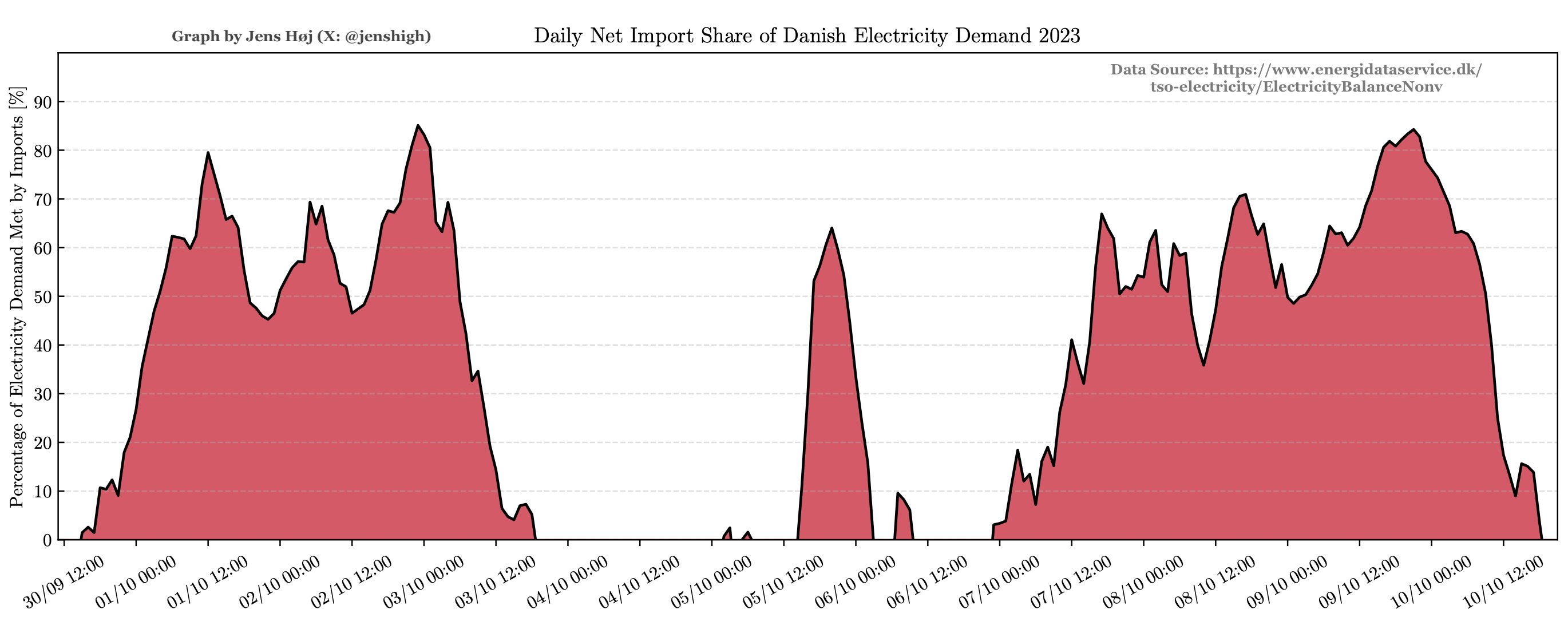
Paraphrasing Margaret Thatcher: “The problem with electricity imports is that you eventually run out of other people’s electricity.” In the U.S., California imports more electricity than any other state and typically receives between one-fifth and one-third of its electricity supply from outside of the state.
Given that massive battery storage is well beyond current capabilities and restrictions on electricity consumption and economic growth are undesirable, redundant or complementary power sources are essential for a reliable grid. Natural gas power generation is most responsive to variable demand, and is thus a good complement to variable sources like wind turbines and solar panels.
Posted in climate, energy policy, Uncategorized, Wind Energy, tagged COP 28, Denmark, fossil fuel, Jens Christiansen, renewable energy on December 4, 2023| Leave a Comment »
The quote and graphic are from Jens Christiansen, a Danish physicist and nuclear power advocate.
Energy reality on display (vs. COP theater):

 Bud's Offshore Energy (BOE)