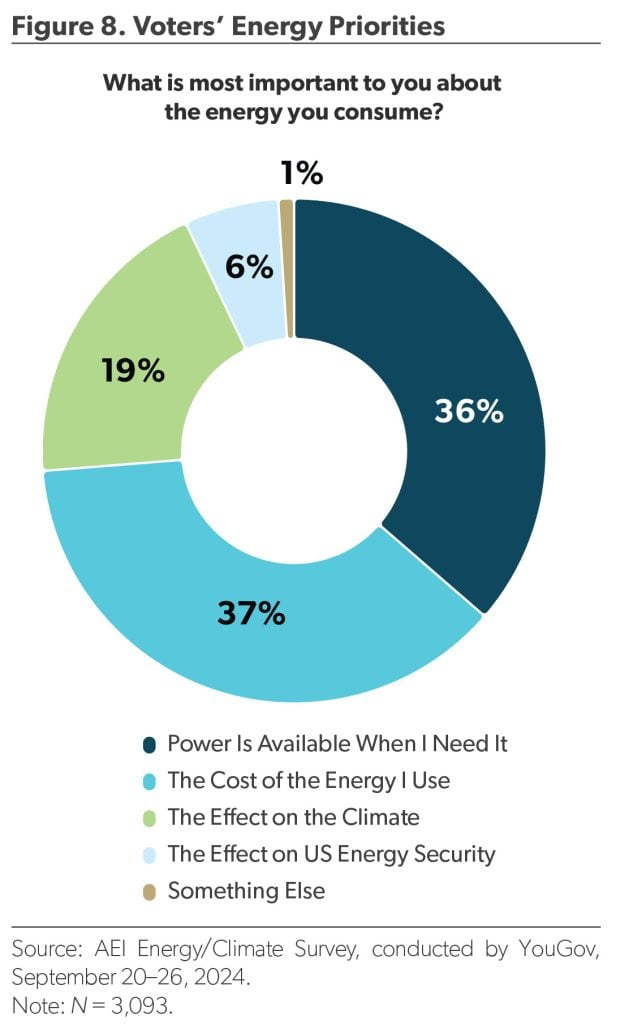
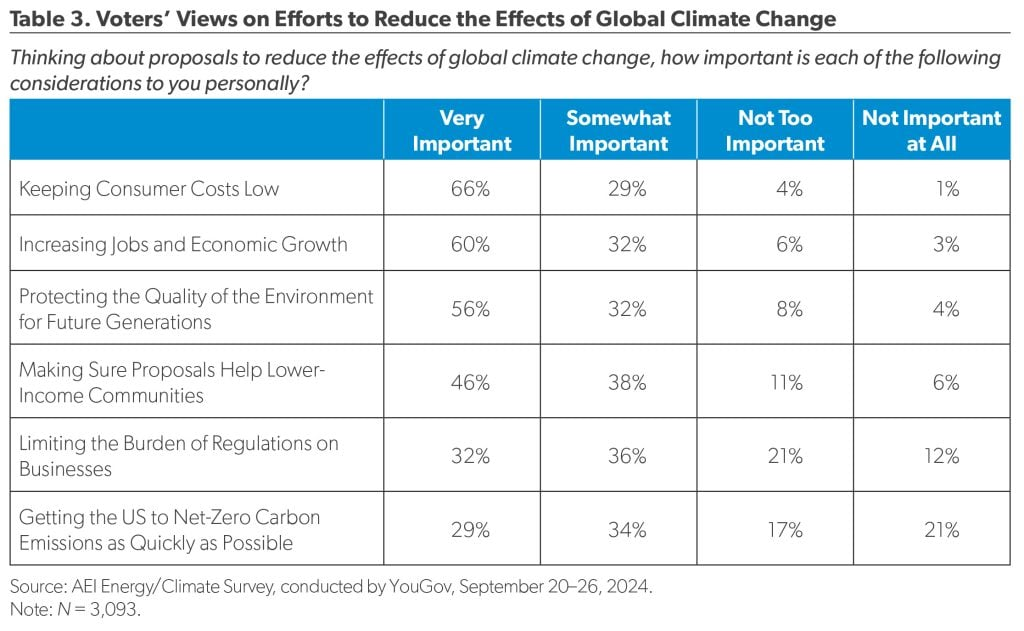
The public is most interested in the cost and reliability of the energy they use and the convenience and comfort of their energy-using products. They are unwilling to sacrifice much at all financially to address climate change or significantly change their consumer behavior.
Minimizing flaring and venting is important from both environmental and resource conservation standpoints.Flaring and venting volumes are also good indicators of how well production systems are designed, managed, and maintained.
The best performance indicators are the percentages of produced gas that are flared and vented both for oil-well gas (OWG, also known as associated or casinghead gas) and gas-well gas (GWG or non-associated gas).
Updated flaring and venting volumes for the Gulf of America have been compiled using monthly data submitted to the Office of Natural Resources Revenue (ONRR). This is the best data source because reporting is mandatory and strictly enforced, and flaring and venting are accounted for separately.
In assessing performance trends, it’s important to segment venting and flaring volumes for both OWG and GWG production. Venting produced gas (mostly methane) is a more significant environmental concern from both air quality and greenhouse gas (GHG) perspectives.
Flaring and venting data for 2019-2024 are summarized in the table below. All volumes are in millions of cubic feet (MMCF).
Notes and comments:
The more disappointing 2024 numbers are entered in red. The blue numbers, all related to OWG venting, are encouraging.
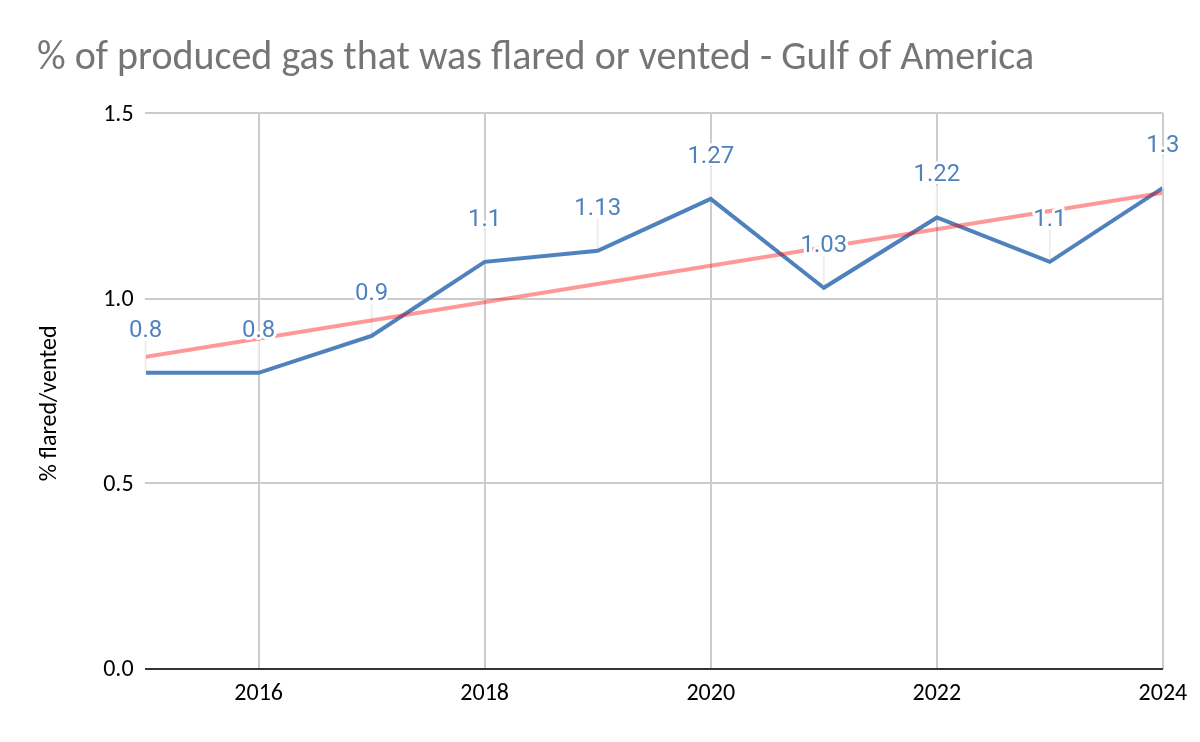
The % of all produced gas that was flared or vented in 2024 (1.3%) was the highest in the past 10 years (see the chart below the table). Until 2018, annual flaring/venting rates of <1% of production were commonly achieved. This should be the target going forward.
OWG flared increased significantly from 2023 levels, both in terms of the volume (7.26 billion cu ft) and the % of OWG produced (1.22%).
Production curtailments and restarts related to Tropical Storms Francine and Helene may have contributed significantly to the 2024 flaring increase. ONRR’s monthly reports show a near doubling of the average monthly flaring volume in Sept., when Francine and Helene shut-in 42% and 29% of oil production respectively. However, even if the Sept. flaring surge is normalized to the monthly average for the other 11 months, the total 2024 flaring still exceeds the 2023 volume by 361 MMCF.
The % of GWG vented in 2024 was the highest in the 6 year period and double the 2019, 2020, 2021 rates. Inefficiencies associated with the dramatic decline in GWG production, down 41.5% from 2023, may be a contributing factor.
The continued decline in OWG venting to only 0.16% in 2024 is encouraging. The decline should be sustainable given that most OWG is now produced at modern deepwater platforms equipped with efficient flare stacks.
Given the significance of these data, from safety, conservation, and environmental perspectives, a more comprehensive analysis by the offshore industry and regulators should be a priority.
Thanks to the Colorado Oil & Gas Association’s tongue-in-cheek “Customer Appreciation Award,” which rivals the Not My Job Award as a means of recognizing extraordinary individual and organizational chutzpah, Chris Wright was on our radar long before he became Secretary of Energy.
He continues to impress:
BREAKING: America’s new Secretary of Energy just exposed the entire climate scam
“Media & politicians NEVER bothered to actually learn about climate change.”
§ 328-a provides that no fossil fuel industry member, as that term is defined in the bill, shall knowingly or recklessly create or contribute to a condition that endangers the safety or health of the public by
extracting, storing, transporting, refining, importing, reporting, producing, manufacturing, distributing. compounding, marketing, or sale of a "qualified product".

328-b declares that a violation of the new article that results in any harm shall be deemed climate negligence regardless of when the underlying conduct occurred.

328-c prohibits governmental enforcement. (i.e. prohibits govt intervention on behalf of the accused company)

328-d provides that any person, firm, corporation, or association that has been damaged as a result of a fossil fuel industry member's acts or omissions in violation of this article shall be entitled to bring an
action for recovery of damages.
This non-attorney suspects that the legislation might conflict with the Commerce Clause of the US Constitution (Article 1, Section 8, Clause 3), which gives Congress the power “to regulate commerce with foreign nations, and among the several states, and with the Indian tribes.” New York produces little oil, gas, or coal, so the legislation would largely affect operations that are conducted in other states, on Federal lands, or in foreign countries.
Rep. Rashiba Tlaib: “Does your bank have a policy against funding new oil and gas products?” (I assume her script said “projects,” and that she misread it. She also butchered “Celsius,” a word that should be very familiar to such a climate expert.)
Jamie Dimon: “Absolutely not and that would be the road to Hell for America.”
🚨 Rep. @RashidaTlaib asked all major bank CEOs to submit to her ESG agenda and stop funding fossil fuels.
Their response?
JPMorgan Chase CEO Jamie Dimon: "Absolutely not and that would be the road to Hell for America." pic.twitter.com/rGX7EjrVZj
When Congress seems slow to solve problems, it may be only natural that those in the Executive Branch might seek to take matters into their own hands. But the Constitution does not authorize agencies to use pen-and-phone regulations as substitutes for laws passed by the people’s representatives.
Capping carbon dioxide emissions at a level that will force a nationwide transition away from the use of coal to generate electricity may be a sensible “solution to the crisis of the day.” New York v. United States, 505 U. S. 144, 187 (1992). But it is not plausible that Congress gave EPA the authority to adopt on its own such a regulatory scheme in Section 111(d). A decision of such magnitude and consequence rests with Congress itself, or an agency acting pursuant to a clear delegation from that representative body.
At first glance, the SCOTUS decision would seem to affect the regulation of GHG emissions on the OCS and possibly the Lease Sale 257 decision (now being appeal), which was based on BOEM’s failure to estimate the effect of reduced OCS production on GHG emissions outside the US.
His speech began with a slide declaring that “unsubstantiated, shrill, partisan, self-serving, apocalyptic warnings are ALWAYS wrong.” Stuart Kirk, HSBC
Sadly, any oil industry exec who dared to publicly question climate orthodoxy would face a similar or worse fate.
I do like this very sensible quote:
A former Blackrock executive focused on sustainable investment said Kirk’s remarks had “done us a service” in discussions on climate change risk by “infusing a dose of honesty into a debate that is otherwise leading us nowhere,”
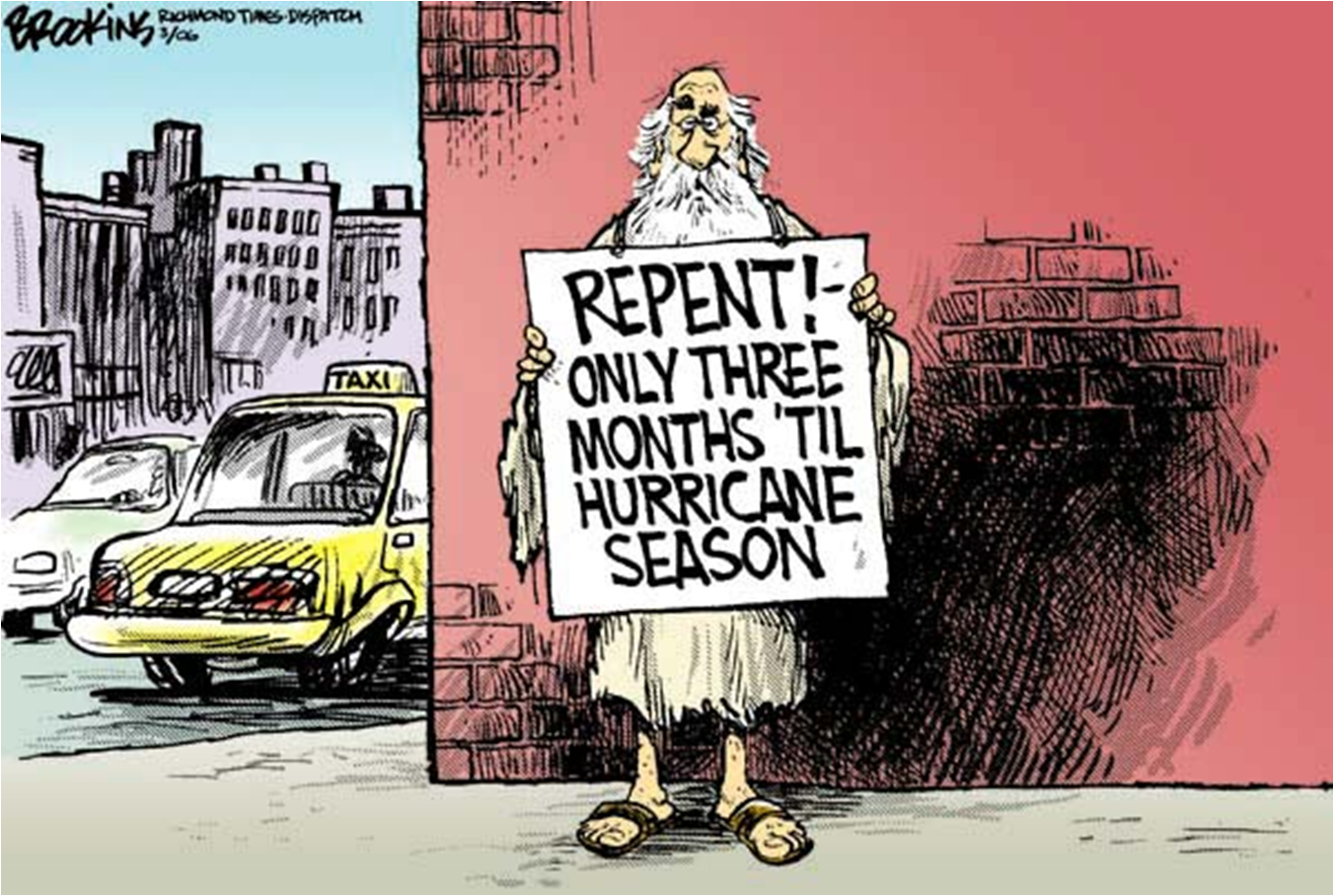
This is a great Gary Brookins cartoon from March 2006 that has been featured in some of my presentations. We now have only one month until the official start of the 2022 Atlantic hurricane season so my post is a bit late! However, the season peaks in mid-September, so you could also argue that I’m posting this too early!
In 2019, the United States emitted 970 million metric tons less than in 2005, with 525 million metric tons of that emissions reduction resulting from replacing coal with natural gas in power generation. Said another way: since 2005, in the United States, all emissions reduction efforts combined have had less impact than coal to gas switching alone.
The emissions associated with the production of natural gas are dwarfed by the emissions reduction of switching from the consumption of coal to gas.
Meanwhile, China, which produced only 3% of the world’s natural gas but the majority of the world’s coal, saw its methane emissions increase by an amount roughly equivalent to adding a second Europe to the world.


 Bud's Offshore Energy (BOE)