Remembering the 123 offshore workers who lost their lives on this dayin 1980 in one of the offshore industry’s great tragedies 🙏
See the excellent interview with Magne Ognedal that describes the evolution of Norway’s highly regarded offshore regulatory regime following the Alexander Kielland tragedy.
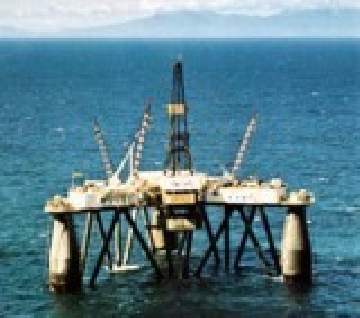
Pioneering subsea engineer, JL Daeschler, brought to my attention the little known sinking of the Sedco 135 B semisubmersible drilling rig (pictured above) while in transit from Hiroshima to Borneo in 1965. 13 workers died in this tragedy. Miraculously, a single survivor, dehydrated and floating on a wooden pallet, was found days later by a passing Japanese trawler.
The bottle shape of the columns with the tapered top section was intended to reduce the influence of sea conditions when the rig was on the bottom. These early semisubmersibles sometimes operated in shallow water and sat on the seafloor. However, when buoyant, this type of column reduced the rig’s dynamic stability.
The 135 B tragedy resulted in stricter stability requirements by the American Bureau of Shipping (1968 ABS Rules for Building and Classing Offshore Mobile Drilling Units.)
JL informs me that the Alexander Kielland was a symmetrical pentagon design. Unfortunately, with this design, the failure of a major diagonal brace results in the complete loss of structural integrity.
Tiå går og di seie tiå lege adle sår Men ein mista bror e sår som aldri gror Kanskje vil dårr gå vinter og vår Sei oss klart kor dokker står Håpte på at han sko komma At han sko komma hjem igjen
Time is gone, they said; time would heal all wounds But to lose a brother is a wound that will never heal It could take as long as the never-ending winter and spring [i.e., never] I hope that he should come That he should come home again

 Bud's Offshore Energy (BOE)