Feeds:
Posts
Comments

Posts Tagged ‘Aberdeen’

The sad state of UK North Sea production

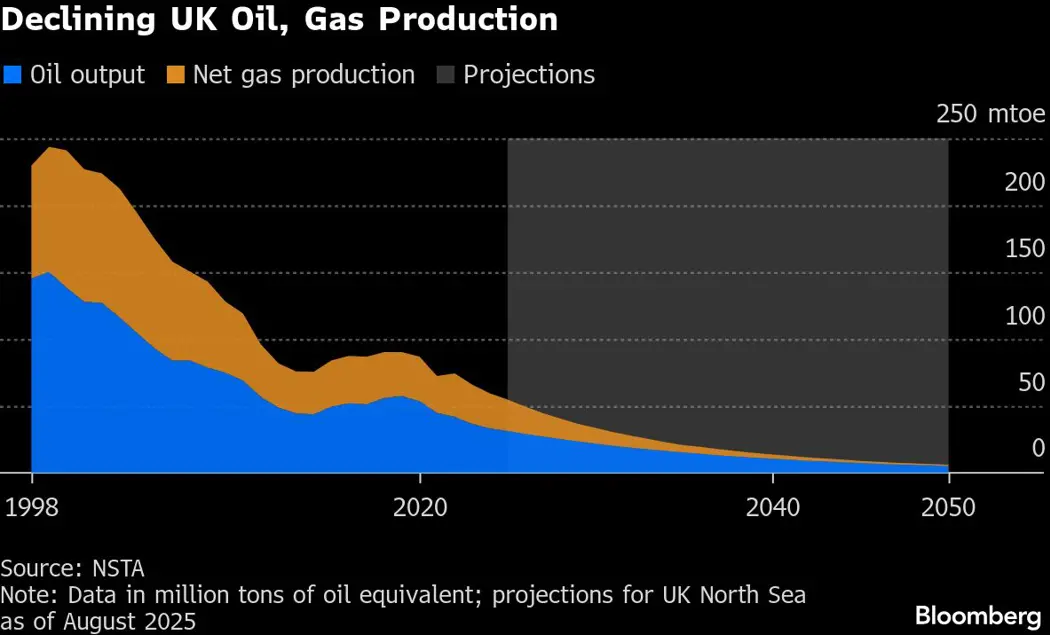
JL Daeschler, other North Sea veterans, and those of us who once admired the UK offshore program, lament the sad plight of their oil and gas industry and the destruction of the economy in northeast Scotland.

Incomprehensibly, the UK has retained the Energy Profits Levy, which requires North Sea operators to hand over 78% of their diminished profits to the Treasury. Most have regrettably chosen to do business elsewhere. Investment in the UK North Sea is at a record low and a study from Robert Gordon University says jobs are being “quietly” lost at a rate of 1,000 a month.

The UK government is grudgingly allowing some tieback production to existing facilities, but this will do little to stem the industry’s decline. JL notes that this limited infield development is not the type of new field investment needed to grow production and sustain the service industry (rigs, boats, helicopters, equipment, etc.).

The UK Oil and Gas Authority rather smugly changed its name to the North Sea Transition Authority in 2022. Besides lower production and higher energy prices, what has the Transition Authority accomplished? As Dan Yergin correctly informs us:

“The term energy transition somehow sounds like it is a well-lubricated slide from one reality to another. In fact, it will be far more complex: Throughout history, energy transitions have been difficult, and this one is even more challenging than any previous shift.”

Related article in the WSJ: “Europe’s Green Energy Rush Slashed Emissions—and Crippled the Economy”

European politicians pitched the continent’s green transition to voters as a win-win: Citizens would benefit from green jobs and cheap, abundant solar and wind energy alongside a sharp reduction in carbon emissions. Nearly two decades on, the promise has largely proved costly for consumers and damaging for the economy.

Europe largely took an “or” strategy: It raced to replace fossil fuels with solar, wind and biomass by taxing carbon heavily, subsidizing renewables and closing scores of fossil-fuel power plants. Britain, which pioneered the use of coal for energy, last year became the first large industrialized country to shut all of its coal-fired power plants. It has also banned new offshore oil-and-gas drilling. Denmark plans to eliminate gas for home heating by 2035. Around one-fifth of Germany’s municipal utilities plan to shut down their gas networks in coming years, according to an October survey by the utilities’ trade association.”


Read Full Post »

In 1991 Wood Group Production Technology (WGPT) received the Queen’s award for engineering innovation.

JL Daeschler, a pioneering subsea engineer who lives in Scotland, is saddened by the sale of the famous Wood Group engineering firm. After difficult financial losses, the Wood Group, headquartered in Aberdeen, has been sold at a cut-price to a Dubai based group.

Per JL: I knew Ian in the early North Sea development stage. He became Sir Ian Wood. We used to chat at various conferences in Houston, Stavanger, and Aberdeen. Ian was an energetic man, who had a friendly approach to our North Sea challenges. He was a true Aberdonian entrepreneur who employed 1000’s in offshore related disciplines worldwide.
The crystal glass above was a gift by a University student I sponsored who later worked for the Wood group. In 1991 Wood Group Production Technology (WGPT) received the Queen’s award for engineering innovation. We worked closely on the development of down hole pressure censors and temperature gauges in the 1980’s.

JL reports that oil & gas is a hot subject in Scotland, but political commentary dwarfs technical discussion. To fix the economy, the govt should look at where people are struggling, and energy costs are their no. 1 concern.

While some politicians are belatedly vowing to maximize North Sea production, that will be difficult given the loss of operators, rigs, ships, installation and pipeline vessels, shipyards, and experienced workers. The infrastructure in Aberdeen is back to 1970 levels, and it’s difficult to build back what has been destroyed.

Read Full Post »

Aberdeen: once the proud Oil Capital of Europe

JL Daeschler comments that after crucifying the North Sea oil workers who saved the country in the 1970’s, the perpetrators are calling for £1.9 billion in emergency funding to help their victims transition to green energy jobs. How noble of them! How much of the funding will be provided by those responsible for the industry’s premature death? 😡

Times columnist Gillian Blowditch got it right:

It is difficult to imagine a world in which it makes sense to import oil and gas but not produce it, while forcing our skilled workforce to work offshore in far flung corners of the globe, especially when we are importing from Norway, which is extracting oil and gas from the same seabed for which we are refusing to grant licences.”

How many jobs are being created by government-driven energy transitions that seem to be moving in reverse? Where are those jobs?

Read Full Post »

Juergen Maier, chairman of GB Energy, “a planned British government-owned renewable energy investment body,” is promising to revive Aberdeen with “green energy” jobs, and to create “something special for the years ahead.”

Maier: “Floating offshore wind, green hydrogen, and carbon capture should be as synonymous with Aberdeen’s future as oil and gas have been with its past.” This is an interesting comment given that the success of the industries he is promoting is far from assured; nor is the continuation of government edicts and subsidies on which they are dependent.

How many times have we been told that the government driven energy transition would create thousands of jobs? How many workers in economically important industries have been told to transition to politically favored professions? How many Keystone Pipeline workers found the promised “green energy jobs?” Why were coal miners condescendingly told to “learn to code?”

Perhaps Mr. Maier should broaden his message by showing support for development of the Rosebank and Jackdaw fields, and for sustaining production of oil and gas, on which the UK will be dependent for many years. As Louise Gilmour wisely opined in her column in the Scotsman:

We need more of it because even the most ardent supporters of renewable energy, the most vocal proponents of net zero, quietly admit oil and, especially, gas will be needed for a couple of decades at least. That obvious truth, that inarguable necessity, is not, apparently, enough for ministers to encourage UK production, however, or temper their rhetoric around renewables.

Allowing our rigs and refineries to power down and relying on other countries to keep the lights on still seems a little, well, counter-intuitive. We will import oil and gas but not produce it while happily exporting contracts, skills and jobs overseas? The practical impact of Labour’s refusal to grant new exploration licences in the North Sea might remain unclear but the message it sent was absolutely crystal.

Read Full Post »