Sweden’s prosecutor’s office said Friday that an investigation into gas leaks from two underwater pipelines connecting Russia to Germany found traces of explosives, confirming that it is a case of “serious sabotage.”
CNBC
Archive for the ‘Russia’ Category
Nord Stream explosives confirmed
Posted in energy, Offshore Energy - General, pipelines, Russia, tagged explosives, Nord Stream, Sweden on November 18, 2022| Leave a Comment »
Nord Stream and the buzz about “dark ships”
Posted in pipelines, Russia, UK, tagged AIS, dark ships, Nord Stream, pipeline rupture on November 14, 2022| Leave a Comment »

Using satellite data, SpaceKnow detected 2 “dark ships” near the pipelines prior to the explosions. The ships were operating with their automatic identification system (AIS) transponders turned off or malfunctioning. While this is cause for suspicion, no data were provided on the frequency of such issues in the Baltic. Also, what were the specific routes and timelines for these vessels? Absent this information. the “dark ship” reports aren’t terribly meaningful.
Although the assumption that the explosions occurred outside the pipeline seems most likely, some observers have suggested that the explosions were internal. It’s unknown whether the investigators have ruled out this possibility.
Meanwhile, the folks in Germany and elsewhere in Europe are understandably impatient. They want answers from their governments!
Nord Stream: Russia blames UK navy
Posted in accidents, pipelines, Russia, tagged investigations, Nord Stream, Russia, UK on October 30, 2022| Leave a Comment »
LONDON, Oct 29 (Reuters) – Russia’s defence ministry said on Saturday that British navy personnel blew up the Nord Stream gas pipelines last month, a claim that London said was false and designed to distract from Russian military failures in Ukraine.
No evidence was presented to support the Russian claim; nor was any information provided on the results of their blitz investigation.
Will the Russian Nord Stream investigation be the first to be released?
Posted in accidents, Offshore Energy - General, pipelines, Russia, tagged investigation, Nord Stream, pipelines, Russia on October 27, 2022| Leave a Comment »
It looks like it might be.
Nord Stream AG, or the operator of Nord Stream 1 pipeline, sent a specially equipped vessel on Thursday to investigate damage to the pipelines under the Baltic Sea.
Nord Stream AG, whose majority shareholder is Russia’s state energy giant Gazprom, said the chartered vessel arrived at the location of damage in Sweden’s exclusive economic zone.
The vessel, bearing the Russian flag, would have specialists aboard to assess the damage within a day and investigation would take three to five days, the company said.
Nord Stream AG said it didn’t have relevant permits to conduct an investigation until now.
DW
That’s a fast investigation!
Worse than embarrassing
Posted in accidents, pipelines, Russia, tagged Angela Merkel, germany, NordStream on September 28, 2022| Leave a Comment »

Alleged missile attack on Black Sea platforms
Posted in Offshore Energy - General, Russia, tagged Black Sea platforms, Crimea, missile attack, Russia, Ukraine on June 23, 2022| Leave a Comment »
Following an alleged missile strike on three platforms operated by the Crimea-based oil and gas company Chernomorneftegaz, satellite images indicate the fire is still visible at the site in the Black Sea. Russian official claims that the strike left behind several injured and missing persons.
offshore-energy.biz
Energy at the End of the World Seminar – Peter Zeihan
Posted in energy policy, Russia, tagged international energy, Peter Zeihan, Ukraine on May 26, 2022| Leave a Comment »
Dr. Malcolm Sharples, a leading offshore engineer for many years, forwarded this interesting presentation by Peter Zeihan. It’s long (2.5 hours) but you can watch in chunks or jump around based on your particular interests.
I was surprised by Peter’s firm prediction that a US oil export ban was coming soon, but now I see that such a ban is actually being considered. This excellent assessment by the Federal Reserve Bank of Dallas explains why a ban on crude exports would not lower gasoline prices, but would reduce domestic exploration and production, increase the trade deficit, and increase US dependency on crude oil imports. Offshore projects, which require massive capital investment, could be particularly hard hit. Unfortunately, an oil export ban would be such a bad decision that it might actually happen.
Stupid use or stupid comment?
Posted in climate, energy policy, natural gas, Russia, tagged CCS, Enel, natural gas on May 24, 2022| Leave a Comment »
I vote for stupid comment.
The CEO of Italian power firm Enel has cast doubt on the continued benefit of using gas to produce electricity, telling CNBC it is “stupid” and that cheaper and better alternatives are now available.
“You can produce electricity better, cheaper, without using gas … Gas is a precious molecule and you should leave it for … applications where that is needed,” he added.
Francesco Starace to CNBC
Gas is scarce and expensive in Europe because of bad foreign and energy policy decisions, most notably dependence on Russia and unrealistic expectations regarding renewables. Mr. Starace seems intent on doubling down on the latter. Of course, Enel is a large renewable energy generator and a natural gas purchaser and consumer (not a producer). His comments are thus rather self-serving.
I do agree with Enel on CCS:
Although the company could rely on carbon offsets or carbon capture to hit that target, Bernabei said the technology has failed to take off, despite receiving funding from the EU and national governments. He said there is no reason to expect that situation to change, especially since carbon capture and storage, or CCS, technology is not guaranteed to eliminate 100% of emissions.
“These are very big and complex projects. And at the end, they will not solve the problem,” Bernabei said. “We already tried CCS in the past and it didn’t lead to success. So why do it again?”
SPGlobal
500 days
Posted in energy policy, Gulf of Mexico, Offshore Energy - General, Regulation, Russia, tagged 500 days since the last offshore lease sale, Lease Sale 257, offshore oil and gas, Senator Kelly, Senator Manchin on April 4, 2022| Leave a Comment »
500 days (and counting) since the last US offshore oil and gas lease sale. Abbreviated chronology:
- 11/18/2020 – BOEM holds Gulf of Mexico oil and gas lease sale 256 (listing of all offshore oil and gas leases sales); WTI = $41.64/bbl
- 1/27/2021 – President Biden issues EO 14008 which pauses all oil and gas leasing on Federal lands, onshore and offshore; WTI = $52.81/bbl
- 6/15/2021 – Federal court in the Western District of Louisiana issues a preliminary injunction blocking the administration’s leasing moratorium
- 7/1/2021: WTI price reaches 75.23/bbl
- 8/11/2021 – White House urges OPEC to increase oil production.
- 8/16/2021 – The administration appeals the Louisiana Federal court injunction that blocked the leasing pause
- 8/31/2021 – BOEM issues Record of Decision (ROD) to proceed with Sale 257 Concurrently, a suit is filed in DC Federal Court to block the sale. WTI= $68.43/bbl
- 9/30/2021 – BOEM announces Lease Sale 257 as necessary to comply with the order of the Louisiana Federal Court. DOI will “continue its comprehensive review of the deficiencies associated with its offshore and onshore oil and gas leasing programs.”
- Oct/Nov 2021 – Media coverage sensationalizes Sale 257, a typical GoM lease sale, by focusing on the sale area, of which the area receiving bids is just a small fraction.
- 11/15/2021 – Press Secretary Psaki: “We believe the (Louisiana court) decision is wrong, and the Justice Department is appealing it. So it’s in the courts; it’s in a legal process. We’re required to comply with the injunction. It’s a legal case and legal process, but it’s important for advocates and other people out there who are following this to understand that it’s not aligned with our view, the President’s policies, or the executive order that he signed.” WTI = $80.85/bbl
- 11/17/2021: Sale 257 bids opened and announced despite pending litigation. In a surprising twist, Exxon was the sole bidder on 94 carbon sequestration tracts offshore Texas. Neither the Notice of Sale nor the environmental review announced or assessed carbon sequestration operations in Federal offshore waters. BOEM/DOI have not commented publicly on the CCS bidding.
- 11/26/2021: DOI issues report on the Federal Oil and Gas Leasing Program. With regard to the offshore program, the report is rather moderate in tone and no new deficiencies are identified.
- 1/27/2022: Judge Contreras, DC Federal Court, vacates Sale 257. The Judge agreed with the plaintiffs’ assertion that BOEM failed to consider the effect that reduced production (and thus higher prices) would have on foreign consumption and the associated GHG emissions. The judge not only decided in favor of the plaintiffs, but ruled that BOEM’s omission was so serious that the lease sale had to be vacated. The judge reached this decision even though (1) the five year leasing plan expires in June leaving the timing of any future sale very much in doubt and (2) all of the sale 257 bids, which are based on proprietary assessments, are now public information, thus compromising the integrity of the leasing process at the next sale (if and when that occurs). WTI= $87.61/bbl
- 2/8/2022: API and the State of Louisiana appeal the Sale 257 decision.
- 2/24/2022: Russia invades Ukraine
- 2/28/2022: The Administration announces that it will not appeal the Sale 257 decision. WTI = $96.13
- 3/8/2022: WTI peaks at $123.70/bbl
- 3/30/2022: EIAP Report for API and NOIA estimates economic impacts from leasing program delays noting: In most cases, additional leases are required to produce an existing field fully or to underpin the economics of processing and transportation infrastructure. It is thus important for the industry to have continued opportunities to secure leases through a predictable leasing program. (US lease blocks are too small for optimal development in deepwater and frontier areas, increasing the importance of regular lease sales.)
- 3/31/2022: President Biden directs the release of 1 million bbls/day from the Strategic Petroleum Reserve for 6 months, lowering oil prices.
- 3/31/2022: Senators Manchin (D-WV) and Kelly (D-AZ) urge President BIden to develop and implement the new 5 year leasing plan without delay.
- 4/2/2022: 500 days since the last lease sale. WTI = $99.27
Let’s not forget the Black Sea resources seized by Russia following the Crimea annexation and their importance to Ukraine!
Posted in energy policy, Offshore Energy - General, Russia, tagged Black Sea, Crimea, Russia, Ukraine oil and gas on March 17, 2022| Leave a Comment »
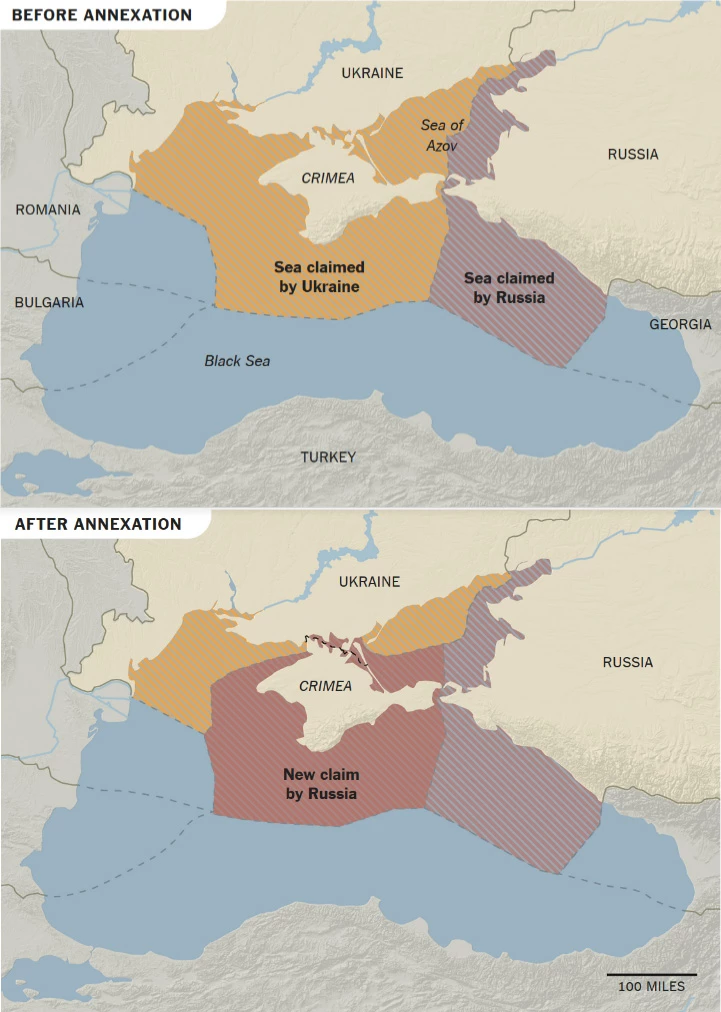
Per our previous post on this topic, the Ukranian shelf may contain more than 70 Tcf of natural gas, most of which was seized by Russia along with Crimea. This illegal seizure of resources in 2014 should be considered as part of any long-term settlement and before easing sanctions on Russia.
For those who want to learn more, this 2018 article by Ukranian journalist Kostiantyn Yanchenko has proven to be particularly insightful. A few key points:
…when in 2014, two-thirds of the former Ukrainian water area passed to Russia with the occupation of Crimea, only a few experts assumed that the struggle for control over energy resources might have been among the main reasons for annexation. Against the background of Moscow’s famous explanation “Why Crimea? Be[cause]Kosovo!”, this version looked unconvincing, but there are many reasons to give it a second glance.
The naysayers often argue that Russia doesn’t have the technology to extract gas on the deep-water shelf. This is true, at least now. However, as researchers note, Russia’s short-term objective was not to benefit from the Black Sea gas but to block its production by the Western companies and hence secure its own positions in the European market.
Furthermore, Russia largely relies on an energy leverage in international relations. Thus, “The Energy Strategy of Russian Federation Until 2020” starts with the statement: “Russia has significant reserves of energy resources and a powerful fuel and energy complex, which is the basis for economic development, an instrument for domestic and foreign policy.”
 Bud's Offshore Energy (BOE)