Feeds:
Posts
Comments

Posts Tagged ‘NTSB report’

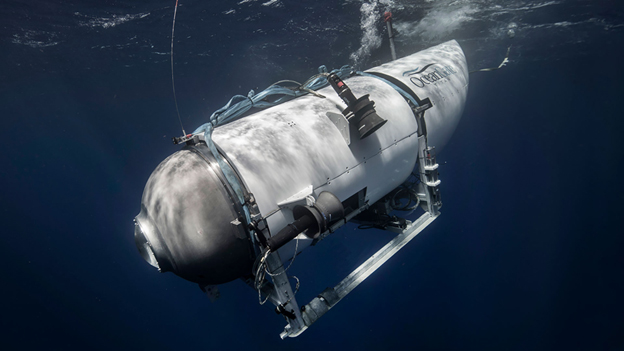
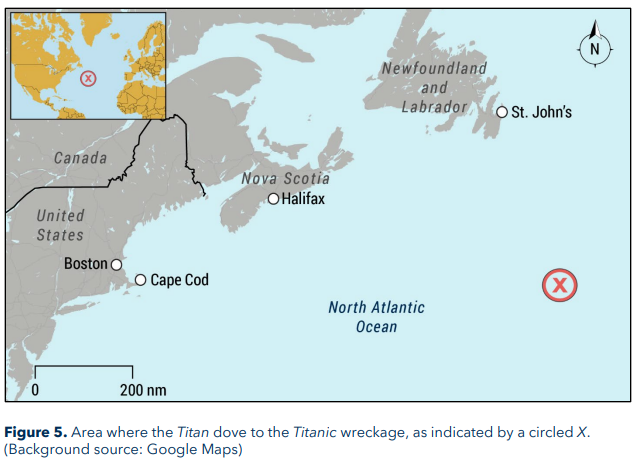
JL Daeschler brought the report on the Titan submersible tragedy to my attention. In June 2023, five died when the Titan dove to the Titanic wreckage in the North Atlantic (map below).

The full NTSB report has now been issued and is attached.
The NTSB found that OceanGate’s engineering process for the Titan was inadequate and resulted in the construction of a carbon fiber composite pressure vessel that contained multiple anomalies and failed to meet necessary strength and durability requirements. Because OceanGate did not adequately test the Titan, the company was unaware of the pressure vessel’s actual strength and durability, which was likely much lower than their target, as well as the implications of how certain operational changes, including storage condition and towing, could impact the integrity of the pressure vessel and overall safety of the vessel. Additionally, OceanGate’s analysis of Titan pressure vessel real-time monitoring data was flawed, so the company was unaware that the Titan was damaged and needed to be immediately removed from service after dive 80.

As is the case with most NTSB reports, the technical analysis and findings are very sound. However, it would be helpful if the NTSB also considered the organizational factors that contributed to the engineering process failures, testing inadequacies, and data analysis flaws. Was there pressure to accelerate the mission? Budget crunch? Training deficiencies? Oversight issues? This type of information can help improve management systems and prevent accidents throughout the marine industry and beyond.
Read Full Post »

Attached is the full NTSB report. Here’s what happened:

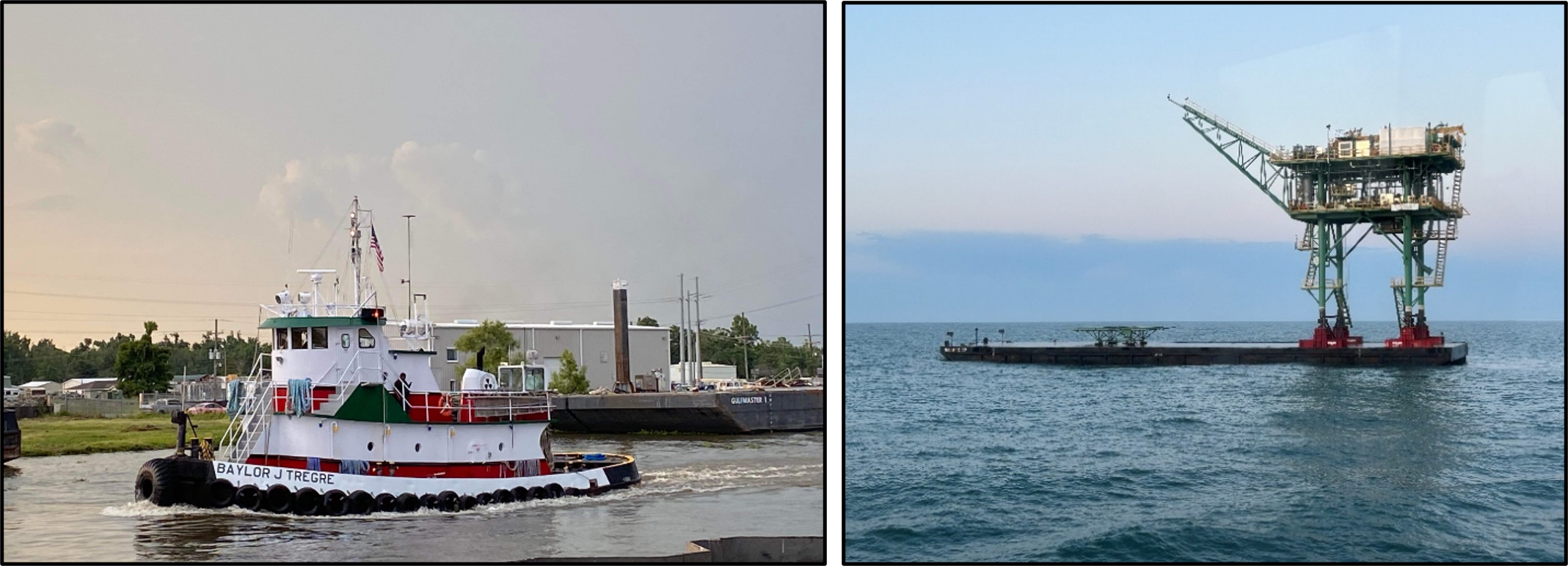
  • In May 2024, the Baylor J. Tregre tugboat was towing a platform on the barge MARMAC 27 to Brazos Block 538 in the Gulf of America.
  • The tug capsized in stormy conditions.
  • The 4 crew members were rescued by the Coast Guard.
  • The NTSB determined that the probable cause of the capsizing was “the mate’s inability to maneuver the tow into the wind due to the overwhelming towline force generated by the towed barge during the sudden onset of severe weather, resulting in unrecoverable heeling.”

Comments:

  • Who knew? When a tugboat capsizes while towing a platform on a barge, endangering the crew, that’s a very serious incident. Yet there was no public announcement by the companies involved or the Coast Guard, and there was no media coverage following the incident (May 2024). The NTSB docket includes only the final investigation report.
  • The NTSB report says a production platform was being towed, but it was actually a gas transmission platform owned by Transco Gas Pipe Line Co. There is no production in Brazos Area Block 538, an unleased block.
  • Here and here are bits of information on the Transco’s Brazos Area 538 Platform modification project.
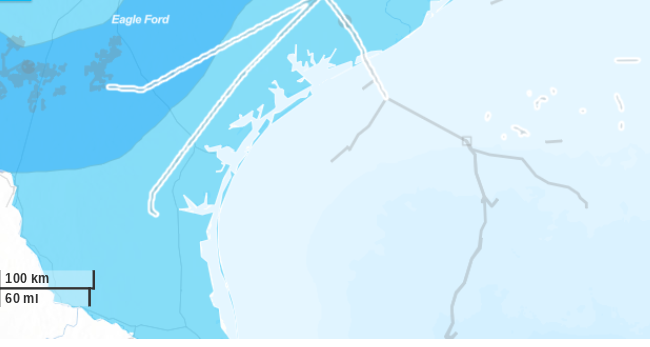
  • Per a 2007 article, Williams’ Seahawk gathering system, which collects deepwater gas production, connects at Brazos Block 538 with a pipeline that transports gas to the Transco processing plant in Markham, TX (see map below).
  • The NTSB report lacks context needed to understand the planning process, organizational factors, and timing/urgency of the project.
  • The NTSB report attributes the failure to the mate’s inability to respond to the weather conditions, but provides no information on the safety management system, risk assessment, job safety job planning process, crew training, and other project management factors.
  • Two of the crew members are suing Trinity Tugs alleging that they suffered personal injuries resulting from the negligence of Trinity and the unseaworthiness of the M/V BAYLOR J. TREGRE.
Deepwater gas gathering system connects with Brazos 538 transmission platform at the “Y” in the center of the screen.

Read Full Post »

On Sept. 16, 2024, a routine helicopter approach at an offshore facility nearly resulted in a serious accident due to a failure to follow proper helideck procedures. Before landing, the helicopter pilot visually confirmed that a nearby crane was securely stowed and stationary (Figure 1). However, as the helicopter neared the helideck, the crane operator unexpectedly raised the crane boom, bringing it alarmingly close to the landing area as the helicopter was 10 feet from touchdown. The pilots swiftly executed a go-around maneuver, successfully avoiding a collision and ensuring the safety of the crew and passengers onboard.”

Good work by BSEE in continuing to identify and address helideck safety issues. This is the 4th helideck safety alert issued in 2024.

Meanwhile, why are we still waiting for the final NTSB report on the tragic helideck crash that occurred 2 years ago?

Read Full Post »