Feeds:
Posts
Comments

Posts Tagged ‘nonassociated gas’

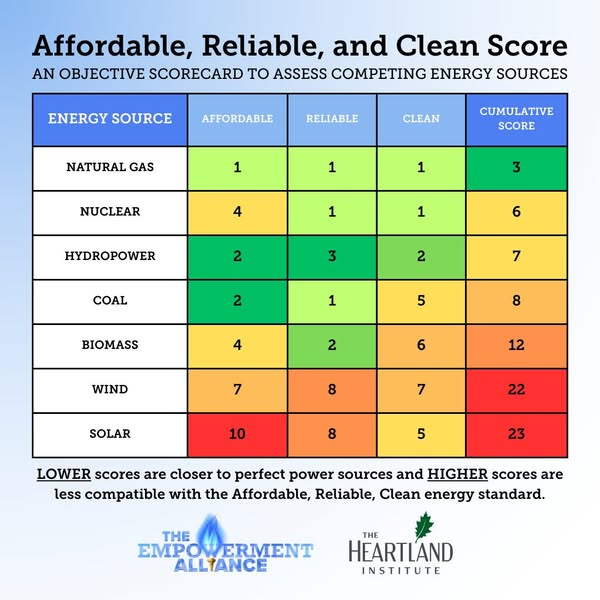
All rankings are suspect, especially those I agree with šŸ˜‰. The full scoreboard report is attached, so you can judge for yourself.

I was an early advocate for the use of natural gas in improving urban air quality. (I still have the ancient graduate school paper! šŸ˜€). This blog has repeatedly saluted natural gas and its compelling economic and environmental benefits.

Although combustion of natural gas emits 30% and 45% less CO2 than oil and coal respectively, the CO2 emissions are still significant. As a result, those who focus solely on greenhouse gases and ignore all other impacts (e.g. other air pollutants like NOx, SO2, and particulates, land use and space preemption, visual effects, and wildlife risks), want to limit the production and use of gas. However, whether or not fossil fuel consumption is significantly affecting the climate, the use for natural gas will be economically and environmentally imperative for the foreseeable future.

Not all natural gas production is equal from an environmental standpoint. Because this is an offshore energy blog, I draw your attention to the unique advantages of offshore gas production: minimal visual impact, bird friendly (rigs-to-roosts!), no risks to freshwater aquifers, and few land use issues.

Currently, most offshore gas production is in the form of oil-well gas (AKA associated or casing head gas). Offshore gas production is thus being primarily driven by oil demand, and is an added benefit from deepwater oil development.

Offshore gas-well or non-associated gas is largely the domain of independent operators producing in the shallower waters of the continental shelf. Non-associated gas has an added benefit in that there is little or no spill risk (depending on how dry the gas is). Shelf gas platforms also provide ecosystem benefits through their reef effect (rigs-to-reefs). Sustaining this non-associated gas production is therefore desirable from both energy and environmental standpoints.

Read Full Post »

While it’s highly unlikely that wind turbine siting activities are responsible for the alarming number of whale deaths, some of the vociferous wind industry defenders would have been among the first to point the finger at oil and gas operations if there were any in the US Atlantic.

Some quotes from a recent USA Today article followed by BOE comments:

ā€œIt’s just a cynical disinformation campaign,ā€ said Greenpeace’s oceans director John Hocevar. ā€œIt doesn’t seem to worry them that it’s not based in any kind of evidence.ā€ (Comment: World class chutzpah on the part of Greenpeace, the master of disinformation.)

Gib Brogan, a campaign director with Oceana, an international ocean advocacy group, said those opposed to wind power areĀ using a spate of whale deaths in the area asĀ an opportunity. (Comment: Does Oceana suddenly find this type of opportunism to be shocking?)

Groups opposed to clean energy projects spread baseless misinformation that has been debunked by scientists and experts,” saidĀ JC Sandberg, chief advocacy officer with the American Clean Power Association, a renewable energy trade group.Ā (Comments: Use of the term “clean energy” is clever advocacy that serves to discredit other forms of energy. All energy sources have pros and cons, environmentally and otherwise. Wind and solar have significant visual, space preemption, navigation, wildlife risk, and intermittency issues, and are heavily dependent on subsidies and mandates. When all issues are considered, one could argue, as we have, that offshore gas, particularly nonassociated gas, is perhaps the environmentally preferred energy alternative.)

Read Full Post »

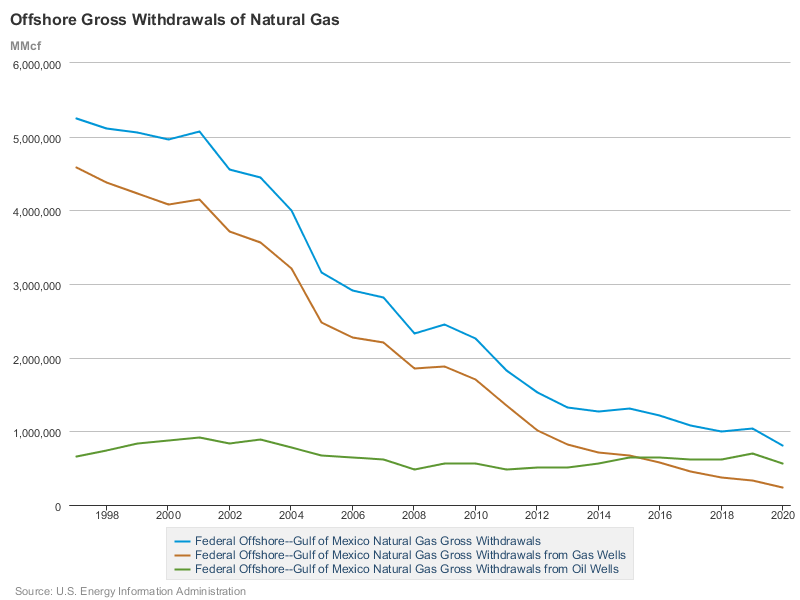
Offshore gas production (see chart below) has declined for the past 20 years and now accounts for only 4% of total US gas production, down from 20% in 2005 and 25% in the 1990s. Associated gas production (oil-well gas) has remained relatively constant owing to the strength in deepwater GoM oil production. 73% of 2020 gas production was from deepwater wells, and was mostly oil-well gas. Associated gas production surpassed nonassociated gas production (gas-well gas) in 2016 and the latter has continued to decline.

The case for natural gas has been well documented (see the EQT letter linked below). Recent natural gas advocacy has emphasized the carbon/GHG advantages given that methane (CH4) is essentially a hydrogen transporter that emits far less CO2 than other fossil fuels when burned. However, natural gas’s other important air quality advantages – low NOx. SO2, and particulate emissions – have greater local significance from a human health standpoint. Those who have ridden a bike behind a natural gas powered bus have no doubt experienced the natural gas advantage firsthand. These buses are literally a breath of fresh air!

Other environmental advantages of offshore natural gas, particularly nonassociated gas, receive less attention but are nonetheless significant. Advantages of nonassociated offshore gas include the following:

  • Fewer wells required than for shale gas
  • No risk of fresh water contamination
  • Platforms provide beneficial reef effects
  • Minimal space preemption and land disturbance relative to onshore gas production and wind/solar operations
  • Low facility density and navigation risks relative to wind operations;
  • Lower elevation and fewer view-shed, aesthetic, and aviation issues than for wind
  • Minimal avian risks relative to on- and offshore wind operations
  • Minimal spill risk relative to oil and associated gas production
  • Significantly less flaring than for oil well gas. While the overall % of US offshore gas production that is flared is low (approx. 1.0 -1.5% from 2016-2020 per EIA data), the % of gas-well gas that is flared has historically been less than 0.5%.

Low natural gas prices and competition from nimble and efficient shale operations have constrained offshore gas exploration. Ultradeep (subsurface) drilling has shown promise from a gas resource perspective but has proven to be expensive and operationally challenging. Some independent producers are still acquiring gas prone shelf tracts and that needs to be encouraged. Consideration should be given to incentives such as making nonassociated gas production royalty free. That would certainly seem preferable to subsidizing complex, expensive, and uncertain carbon disposal operations on offshore leases.

Read Full Post »