Feeds:
Posts
Comments

Posts Tagged ‘Mayank Tyagi’

The government’s decision to require that a capping stack be located in Guyana is prudent. Although the need for a capping stack is dependent on multiple barrier failures and is thus extremely low, the environmental and economic consequences of a prolonged well blowout warrant timely access to this tertiary well control option.

A capping stack must be properly maintained and deployable without delay. In that regard, BSEE has a good program for testing Gulf of Mexico capping stack readiness. Capping stack drills are an important post-Macondo addition to the unannounced oil spill response program that dates back to 1981.

The capping stack designed during the Macondo blowout shut-in the well on 15 July 2010. The decision process that allowed the well to remain shut-in was a bit perplexing, and we had a bizarre situation where the Federal Incident Commander threatened to require the resumption of the blowout. The same well integrity concerns had prematurely ended the “top kill” operation on 28 May, allowing the well to flow unnecessarily into the Gulf for an additional 48 days (5/28-7/15). (See this important paper by LSU Petroleum Engineering professor Dr. Mayank Tyagi et al: Analysis of Well Containment and Control Attempts in the Aftermath of the Deepwater Blowout in MC252)

“Troy Naquin, BSEE New Orleans District, observes as a capping stack is carefully lowered onto the deck of ship to be transported more than 100 miles offshore for a drill designed to test industry’s ability to successfully deploy it in case of an emergency, May 8, 2023.” BSEE photo/Bobby Nash

Read Full Post »

While the official BOEMRE-USCG and National Commission/Chief Counsel investigation reports were quite good and there are countless court documents and ad hoc reviews of the blowout, some important Macondo issues have not been fully addressed. BOE will touch on these issues periodically starting with the decision to terminate the top kill operation on 5/28/2010.

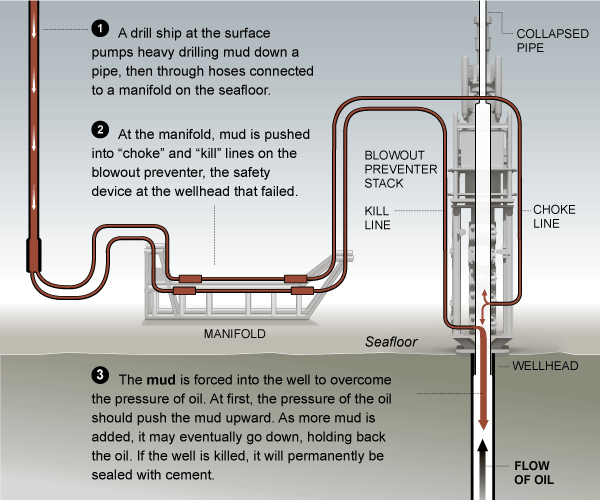
The top kill operation (see diagram above) was intended to overcome and halt the flow of oil by pumping heavy mud into the well bore.  The operation was not successful because the pumping rate and mud weight did not generate sufficient pressure.  Per an excellent paper by Dr. Mayank Tyagi and colleagues at LSU  (Analysis of Well Containment and Control Attempts in the Aftermath of the Deepwater Blowout in MC252):

It is very likely that if the top kill had been designed to deliver more than 109 bpm of 16.4 ppg drilling fluid below the BOP stack for a sustained period, the Macondo blowout could have been stopped between May 26-28, 2010. Given that the well was successfully shut-in with the capping stack in July, and that the subsequent bullhead (static) kill was successful, certainly a higher rate top kill would have been successful at that time.

The American Thinker, citing the New York Times, reports that Energy Secretary Chu stopped the top kill operation over the objections of some BP engineers. While it was reasonable to be concerned about possible casing leaks and the fracturing of subsurface formations, the subsequent (7/15/2010) closure of the capping stack demonstrated that the well had sufficient integrity to support the top kill operation. Questions regarding why a higher rate top kill effort was not attempted and how that decision was made are therefore important and merit discussion. Did the Macondo well flow unnecessarily into the Gulf for an additional 48 days (5/28-7/15)? Did the National Incident Command facilitate or delay source control?

Keep in mind that the NIC almost made a similar mistake in July. Even after the capping stack successfully shut-in the well on 7/15, Incident Commander Thad Allen (USCG) continued to call the closure of the capping stack a temporary test and threatened to require BP to resume flow from the well. Fortunately, informed input from experienced engineers prevailed. The well remained shut-in and the static well-kill operation was successful.

Read Full Post »