Feeds:
Posts
Comments

Posts Tagged ‘Judge Cain’

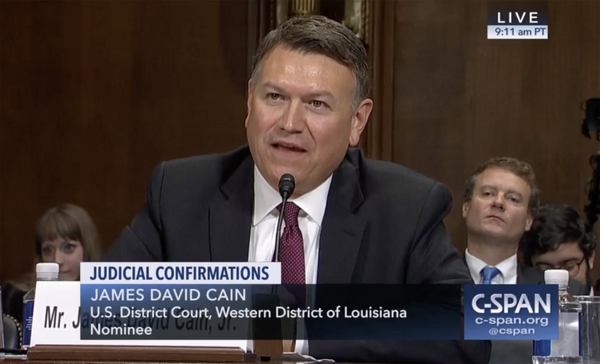
On Friday (10/3/2025), Judge Cain found that President Biden exceeded his authority under Section 12(a) of the Outer Continental Shelf Lands Act (OCSLA) by attempting to permanently withdraw large areas of the OCS from future oil and gas leasing. The Biden withdrawals, executed in his final days in office (by autopen?), resulted in the largest ever permanent ban on offshore oil and gas leasing in the US, and to the best of my knowledge, anywhere in the world (see link for details on the ban).

Although President Trump rescinded Biden’s action via executive order on January 21, 2025, the court proceeded with the case, acknowledging the high likelihood of similar actions in the future.

Judge Cain concluded that Biden departed from historical executive practice and exceeded statutory limits under OCSLA Section 12(a), which allows the president to “withdraw from disposition any of the unleased lands of the outer Continental Shelf,” but does not explicitly authorize permanent or irrevocable bans.

The judge emphasized that prior withdrawals were typically temporary or modifiable, and attempts to make them permanent encroached on congressional powers.

Judge Cain extended the ruling to Obama’s extensive end-of-term withdrawals in 2016, finding them similarly unlawful for intending permanence.

The ruling reinforces that OCSLA withdrawals must be revocable by future presidents, limiting executive power to bind successors on public lands disposition. The ruling should prevent future reliance on leasing bans.

Judge Cain’s decision is important because leasing bans should be carefully considered and should not be executed casually at the end of a term for purely political purposes. 

Read Full Post »

On July 1, U.S. Federal Judge James Cain Jr. (Western District of Louisiana) issued a preliminary injunction suspending DOE’s LNG exports “pause.” The judge’s full ruling is attached.

Judge Cain: It appears that the DOE’s decision to halt the permit approval process for entities to export LNG to non-FTA countries is completely without reason or logic and is perhaps the epiphany of ideocracy.”

Nothing subtle about that comment 😉

Despite the court order, the Administration seems intent on keeping the “pause” in place. Per White House spokesperson Angelo Fernández Hernández, “We remain committed to informing our decisions with the best available economic and environmental analysis, underpinned by sound science.” ????

Nearly 80% of current OCS gas production is from deepwater leases. This production is primarily associated (oil-well) gas that operators are rightfully required to market for resource conservation and environmental reasons. Expanding LNG marketing opportunities could thus improve the economics of deepwater development.

The other 20% of OCS gas production is largely from gas-well (non-associated) gas produced by independent companies that continue to operate in the shallower waters on the shelf. LNG sales could improve the challenging economics for these producers and increase the ultimate recovery of shelf resources.

Read Full Post »

Quotes from the judge’s order (emphasis added):

The challenged lease term for the expanded Rice’s whale area only arose in a July 2023 district court filing and then appeared in the FNOS for Lease Sale 261 on August 25, 2023—one month before the statutory deadline for the sale. BOEM failed to follow its own procedures by making significant changes to the FNOS, thereby depriving both affected states and the public the opportunity for meaningful review and comment. The procedural error is particularly grave here, because of both the compressed timeline and BOEM’s inexplicable about-face on the scientific record it had previously developed. (p.19)

The challenged provisions inserted into these leases at the eleventh hour, and the acreage withdrawal, are based only on an unexplained change in position by BOEM on a single study a few months after that supplemental EIS. The process followed here looks more like a weaponization of the Endangered Species Act than the collaborative, reasoned approach prescribed by the applicable laws and regulations. (p.22).

According to an affidavit from Shell’s commercial manager, the new restrictions on vessel traffic apply to an area of the northern Gulf that separates Shell’s existing offshore leases from the onshore infrastructure that supports them. Shell Offshore Inc., No. 2:23-cv-1167, at doc. 4, att. 2, ¶¶ 23–27. (p. 23).

Given the shaky justification offered by BOEM, the court cannot find that the challenged provisions are so necessary that withholding them even on a preliminary basis will outweigh the risk of irreparable economic harm shown by plaintiffs. Additionally, “there is generally no public interest in the perpetuation of unlawful agency action.” (p. 26)

Read Full Post »