Feeds:
Posts
Comments

Posts Tagged ‘energy policy’

By the end of 2022, Germany will have switched off its last 8.1 GW of nuclear power. Another 6.4 GW of coal capacity are scheduled for shuttering by 2023. Recent events and publications have given ammunition to those who fear a collapse of the system.

In 2018, Germany’s influential energy industry association BDEW said that Germany would run into a “shortfall in secured capacity by 2023 at the latest”, and that the country shouldn’t rely on its neighbors to make up the difference. Three years later and a lot closer to the nuclear phase-outBDEW head Kerstin Andreae says: “For a secure energy supply, we also need new gas-fired power plants, as this is the only way to obtain the required controllable power.”

Clean Energy Wire

Germany will need back-up and supplemental power from gas plants, but the EU has excluded gas-fired energy generation from the list of sustainable investments and the associated incentives. Per Kerstin Andreae of the BDEW:

“We need to build these new power plant capacities now. Although they will initially run on natural gas, they are already capable of using hydrogen as an energy source in the future and will thus ultimately become climate neutral,” she said. But without a clear decision from the Commission „ important energy transition investments are at risk”

Clean Energy Wire

Meanwhile, oilprice.com reports that “UK peak-hour power prices for Monday evening through 6 p.m. surged to the highest level in a month due to low wind power generation during the weekend.” In what is becoming a familiar story:

Coal closures and no immediate replacements for nuclear power have exposed the UK’s vulnerabilities to the whims of the weather, with cold winters stoking natural gas demand and still weather lowering wind power generation.

oilprice.com

Daniel Yergin reminded us that energy transitions take time. Countries that ignore those realities are likely to suffer the consequences, both economically and environmentally. Per Aissatou Sophie Gladima, the energy minister of Senegal:

Restricting lending for oil and gas development, she said, “is like removing the ladder and asking us to jump or fly.”
Read Full Post »

Leading up to #COP26 convening in Glasgow next month, the OPEC SG advised legislators and policymakers to consider the fact that billions of people lack reliable and affordable modern energy, a basic need for all.

OPEC

Reminder that “no energy is dirtier than no energy.

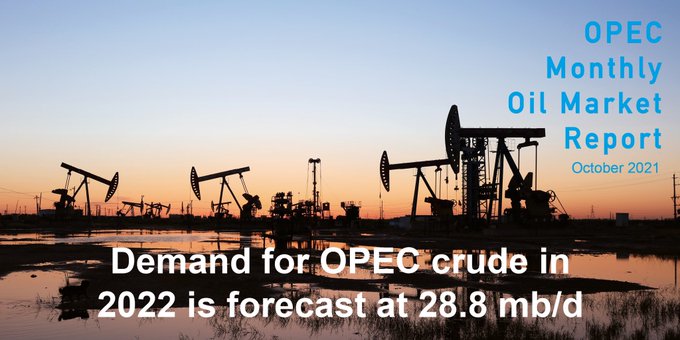
For those interested in regional and international oil market data, OPEC’s monthly reports are quite good. You can download the October report here.

Image

Demand for OPEC crude in 2022 was revised up by 0.1 mb/d from the previous month’s assessment to stand at 28.8 mb/d, around 1.0 mb/d higher than in 2021.

Read Full Post »

Look at the US Dept. of Energy homepage and I think you’ll get a better sense of the imbalanced energy policies, in the US and elsewhere, that are contributing to the emerging energy crisis.

There isn’t a single mention of oil or natural gas on the Dept. of Energy homepage. DOE’s priorities are “Combating the Climate Crisis” (embellished with a satellite image of Hurricane Andrew), “Creating Clean Energy Union Jobs” (other energy jobs aren’t important?), and “Promoting Energy Justice.” With regard to the latter, how is driving up energy prices “energy justice?” How is importing more of the oil that we consume “energy justice.” Affordable energy has increased economic opportunities for all and enabled us to better protect our environment. In that regard, this Petr Beckmann slide holds true:

Read Full Post »

Very good Washington Post article.

As the global economy recovers and global leaders prepare to gather for a landmark conference on climate change, the sudden energy crunch hitting the world is threatening already stressed supply chains, stirring geopolitical tensions and raising questions about whether the world is ready for the green energy revolution when it’s having trouble powering itself right now.

In the United States, which as an energy producer has been spared the worst consequences of the crisis even as gasoline prices have hit their highest mark since 2014, Energy Secretary Jennifer Granholm suggested Wednesday that the Biden administration might sell off part of the country’s Strategic Oil Reserve or ban exports of crude oil.

Energy analysts warned that such moves could be self-defeating, and on Thursday the department backpedaled.

Energy analysts argue that Europe moved too quickly away from fossil-fueled power, before ensuring that sufficient renewable sources could take up the slack in an emergency. Caught halfway in a transition that should take decades, they say, Europe is now scrambling to find coal and gas to burn in its remaining traditional plants.

In Guangdong, China’s most populous province, authorities have banned the use of elevators in office buildings for the third floor and below, encouraged residents to use natural light as much as possible, and asked for air conditioners to be adjusted to higher temperatures. Beijing and Shanghai canceled annual light shows during the Golden Week holiday that spanned the first week of October.

Read Full Post »

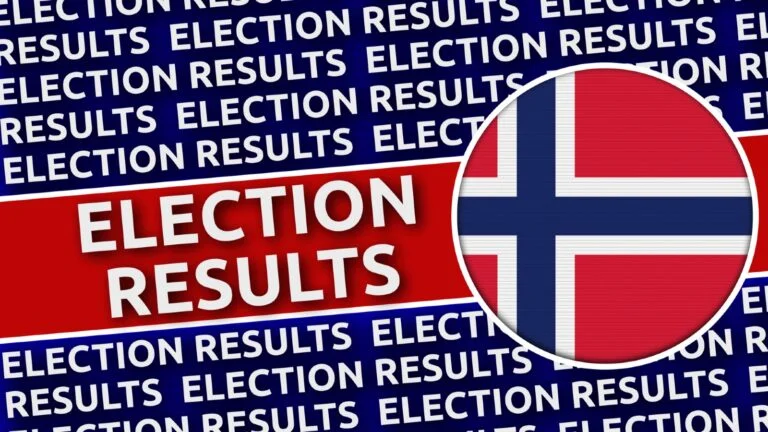
Election Results 2021: Norway Set for New Prime Minister - Life in Norway

While Conservative Party leader Erna Solberg will no longer be Prime Minister, her likely replacement, Labor leader Jonas Gahr Støre, seems to be a moderate on energy issues:

“I believe that calling time on our oil and gas industry is the wrong industrial policy and the wrong climate policy,” Stoere told reporters.

KFGO

Monday’s result means Labour neither needs the Marxist Red Party nor the anti-oil Green Party to rule, thus lessening the pressure for big shifts.

“Labour will not make any dramatic changes to the oil industry,” said Teodor Sveen-Nilsen, an energy analyst at Sparebank 1 Markets.

EuroNews

Read Full Post »

A wise old Indian said:

Only the government would believe that you could cut a foot off the top of a blanket, sew it to the bottom, and have a longer blanket.

The fact that Daylight Savings Time is one of our more noteworthy energy policy achievements speaks volumes about our current economic predicament.


Read Full Post »

Neither the rhetoric (produce more, consume less) nor our actions (produce less, consume more) ever change. When will we see the light? When will we break the cycle?

Read Full Post »

« Newer Posts