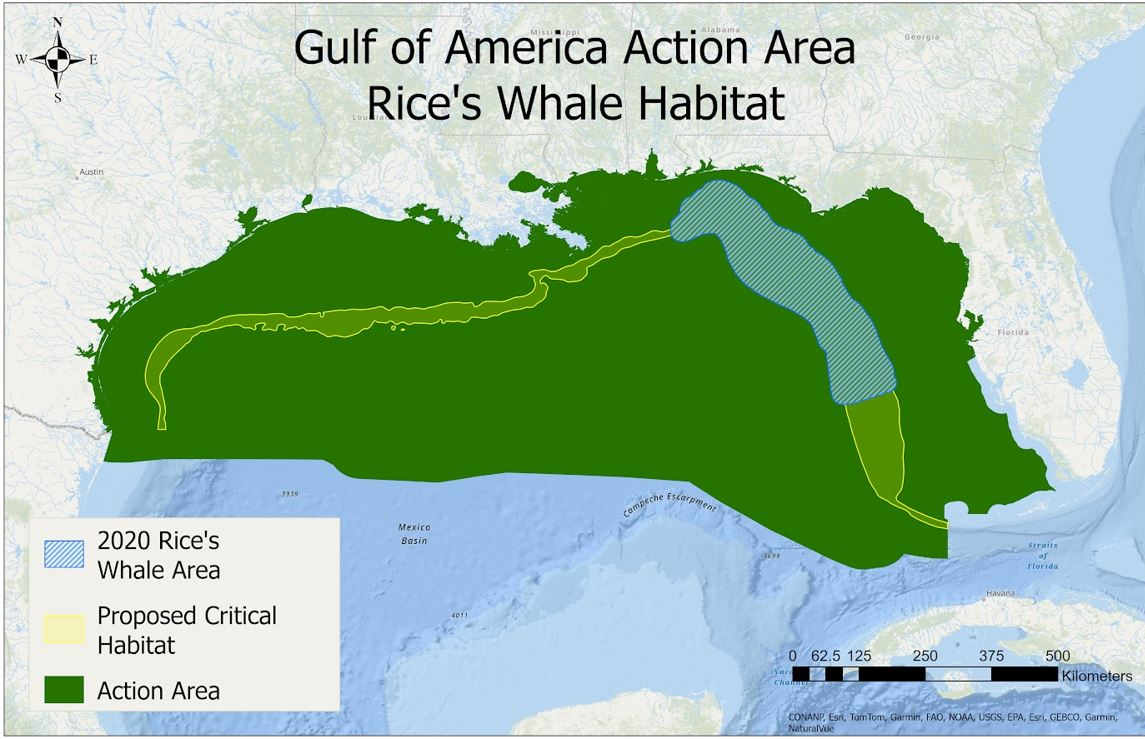
National Marine Fisheries Service (NMFS) biological opinion dated 5/20/2025
Background:
- Section 7(a)(4) of the Endangered Species Act (ESA) requires federal agencies to confer with NMFS on any action that is likely to jeopardize the continued existence of proposed species or result in the destruction or adverse modification of proposed critical habitat.
- Section 7(b)(3) of the ESA requires that at the conclusion of consultation, NMFS provides an opinion stating whether the Federal agency’s action is likely to jeopardize ESA-listed species or destroy or adversely modify designated critical habitat.
- Last year, the U.S. District Court for the District of Maryland vacated the NMFS 2020 Biological Opinion for Gulf of Mexico Oil and Gas activities effective May 21, 2025, so failure to complete the opinion by that date would have jeopardized oil and gas operations in the Gulf.
Key points in the biological opinion:
- p. 598: The proposed action is not likely to jeopardize the continued existence of sperm whale, Northwest Atlantic loggerhead sea turtle, Kemp’s ridley sea turtle, North Atlantic DPS green sea turtle, leatherback sea turtle, hawksbill sea turtle, or Gulf sturgeon.
- The proposed action is not likely to destroy or adversely modify loggerhead or Gulf sturgeon designated critical habitat, or proposed critical habitat for green sea turtle North Atlantic DPS or Rice’s whale.
- p. 599: The operation of oil and gas vessels in the Gulf of America, in an area where the endangered Rice’s whale occurs, is likely to jeopardize the continued existence of the whale due to the risk of vessel strike.
According to NMFS, the reasonable and prudent alternative (see below) reduces or avoids the primary threat to Rice’s whales, the risk of injurious and lethal vessel strike interaction. The impacts of other stressors are more limited in space and time, diffuse, or not likely to result in adverse effects to Rice’s whale.
The reasonable and prudent alternative (RPA) requires the following as it relates to vessel activity in the action area. More detail on p. 601:
- Immediately begin to use technology to enable Rice’s whale vessel strike avoidance and monitoring of presence of Rice’s whale.
- Establish an expert working group to support development and implementation of a Rice’s whale vessel strike avoidance technology plan (RW Tech Plan)
- Improve understanding of Rice’s whale vessel strike risk associated with the proposed action
- Develop a Rice’s whale vessel strike avoidance technology plan (RW Tech Plan)
- Undertake independent peer review
- Implement Rice’s whale vessel strike technology plan
- Monitor Rice’s whales to ensure no likelihood of jeopardy during RPA implementation
Comment: Because the risk to the Rice’s whale in the central and northwestern GoA is highly speculative (see analysis by Darren Ireland), the RPA is arguably excessive. However, I like the RPA’s technological and management system focus.
Unsurprisingly, Earth Justice et al found the NMFS opinion inadequate and filed a suit (attached) in Maryland calling on the court to vacate the opinion and grant injunctive relief.
How can they sue in a Federal court in Maryland, far away from the Gulf? The venue was ostensibly chosen because NMFS headquarters are located in a Maryland suburb of DC. The Maryland court is also likely to favor the plaintiffs, which may have been a factor in the choice of venue. It’s a great country! 😉
 Bud's Offshore Energy (BOE)
Leave a comment