BSEE’s decision to revise downhole commingling policy by increasing the allowable pressure differential between reservoirs is sound and supported by an impressive University of Texas (UT) Petroleum Engineering study. Although the announcement hype is a bit much, this is the way regulation is supposed to work.
The main benefit of commingling (vs. sequential production) is the accelerated return on investment, which is fine as long as other risks are not introduced and ultimate oil recovery is not sacrificed. The UT study of Paleogene (Wilcox) reservoirs found that downhole commingling actually maximizes per-well oil production compared to sequential schemes. Over 30 and 50 years, commingling yields 61% and 21% more oil respectively.
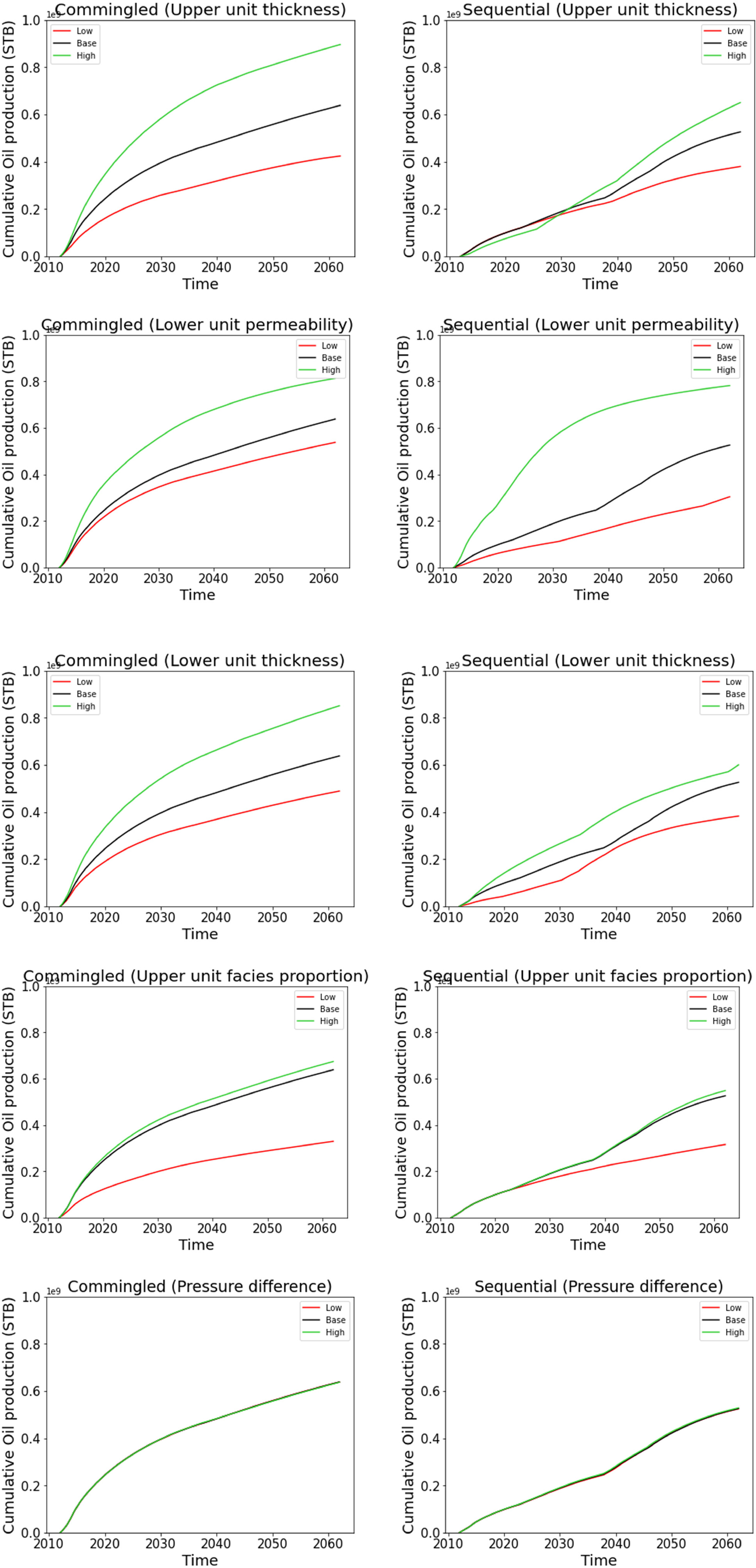
The UT study analyzed 3 cases with 19 variables (Table 2 in their report). The reservoir pressure differentials were 500, 1000, and 1500 psi. Interestingly, pressure differential had essentially no impact on cumulative production in either the commingled or sequential scenarios.
Figure 13. Cumulative production over 50 years for commingled (left) and sequential (right) production scheme. The most significant variables are shown in the first four pairs of plots. The last pair of plots shows the least important parameter which is pressure difference between reservoir units.
Also note that (fig. 13):
- As the upper reservoir thickness increases to 1000 ft (high case), total production increases by 41% for the commingled production scheme and 26% for the sequential production scheme.
- The second most important field feature is upper reservoir facies proportion for both production schemes. A higher sand proportion in the reservoir results in higher production.
 Bud's Offshore Energy (BOE)
Leave a comment