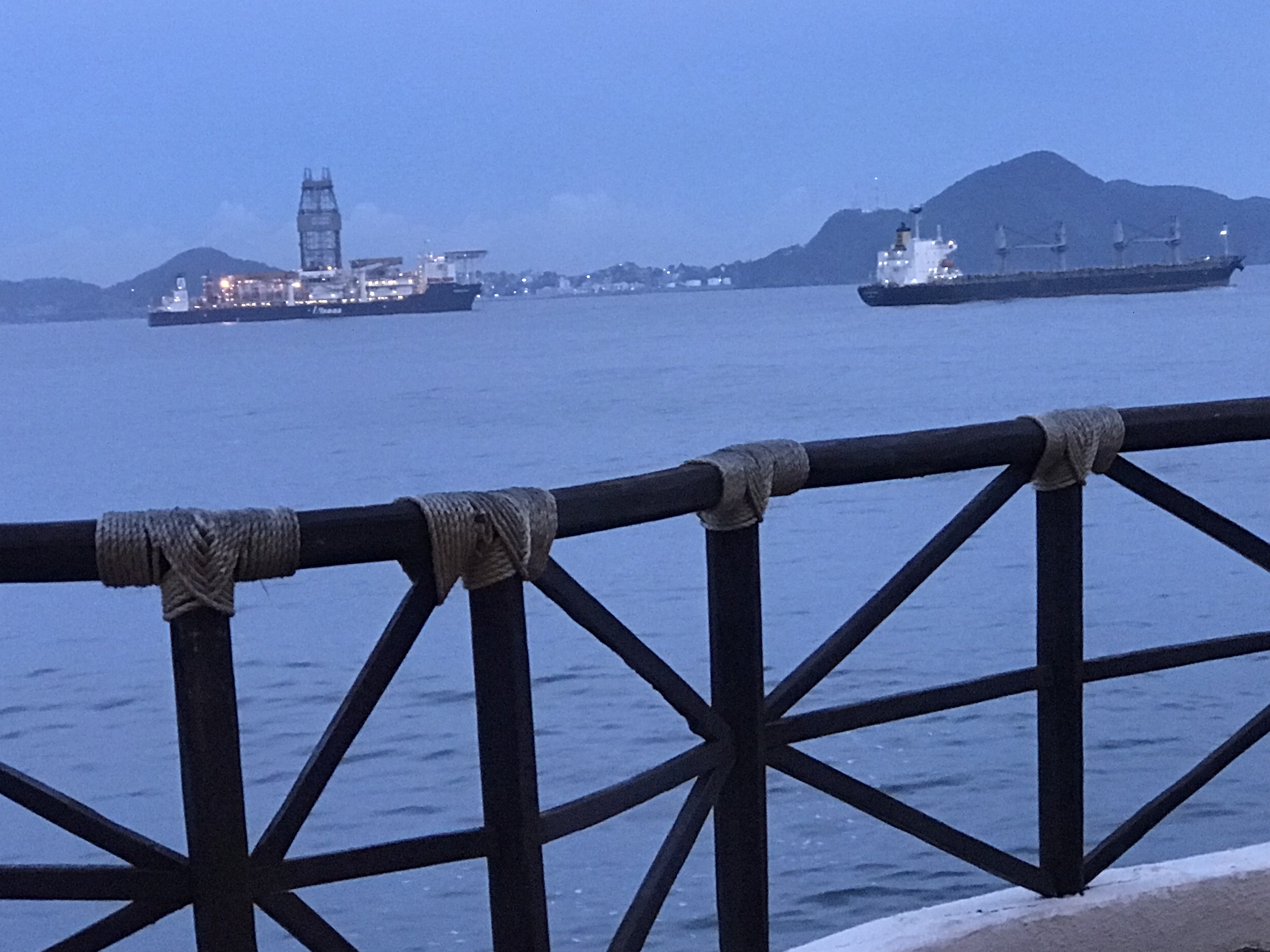
Andrew Konczvald’s reports from Manzanillo, Mexico about the presence of the Hidden Gem (pictured above), a converted deepwater drillship, have renewed BOE interest in deep sea mining, a topic that is full of political, environmental, legal, and operational intrigue:
- Ocean mining has served as cover for a CIA mission! The Glomar Explorer was built by Howard Hughes to recover a Russian submarine beneath 16,500′ of water in the Pacific. Interestingly, some manganese, the material the Glomar Explorer was supposedly researching, was also recovered. (As a young engineer, I read fascinating trade journal articles about the Glomar Explorer and its mining capabilities. Little did I know that it was all a ruse!)
- The US is not a party to the UN Law of the Seas (UNCLOS) Convention under which the International Seabed Authority (ISA) was established in 1994 to oversee deep sea mining. Purportedly, the US is reluctant to cede any high seas authority to the UN. Doing so might preclude escapades like the recovery of the Russian submarine 😉
- China, which already controls 95 percent of the world’s supply of rare-earth metals and produces three-quarters of all lithium-ion batteries, is an active participant in ISA and hopes to extend its control over emerging energy industries.
- The Clarion-Clipperton Zone, which spans 3,100 miles (map below), contains up to six times the cobalt and three times the nickel in all land-based reserves. Chinese contractors have licenses to explore two of the 17 areas of the zone.
- The Metals Company (TMC), the Canadian company that owns the Hidden Gem, is the leader in the deep sea technology race.
- In 2021, the Pacific island of Nauru activated a provision embedded in UNCLOS to encourage ISA to adopt mining regulations by July 9, 2023, absent which mining could begin with whatever rules were in place at the time.
- TMC subsidiary Nauru Ocean Resources Inc. (NORI) intends to submit an application to ISA for an exploitation contract for NORI Area D (second map below) following the July 2024 ISA meeting. Assuming a one-year review process, NORI expects to be in production in the fourth quarter of 2025.
- Despite the need for metals to support their electrification goals, some environmental groups are staunchly opposed to deep sea mining. Their concerns range from disturbing the ocean’s natural carbon sink to impacts associated with noise and pollution from mineral recovery and transportation.
- TMC contends that the environmental impacts and social costs associated with deep sea mining are far less than for onshore mining.
- Meanwhile the Hidden Gem remains parked near Manzanillo. Stay tuned.


 Bud's Offshore Energy (BOE)