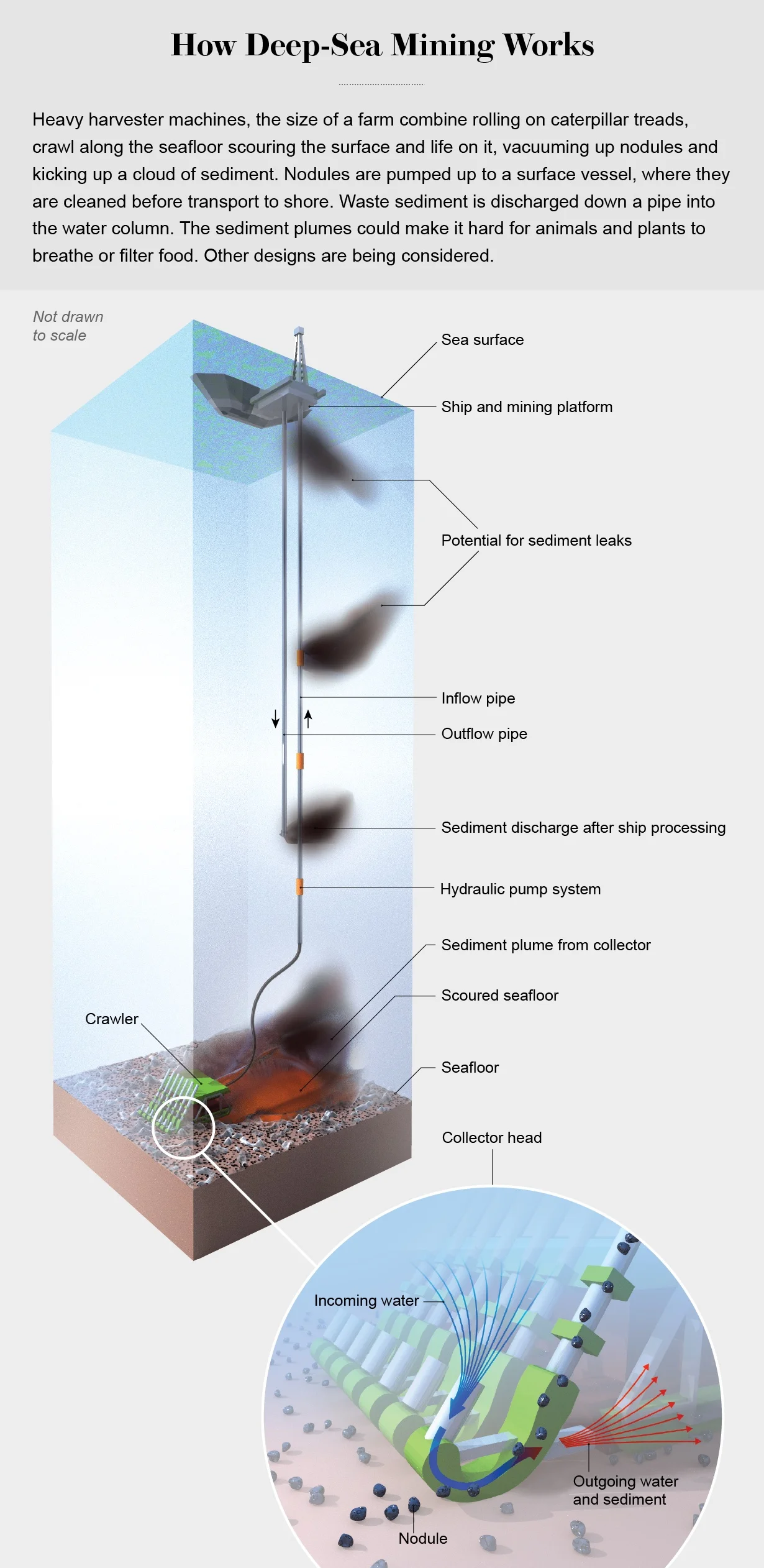
This interesting Scientific American article ends with a short paragraph that our regulatory scholars may want to ponder:
Mining’s larger future will rest largely on how ISA (the International Seabed Authority) finalizes its rule book amid the rush to scour the seafloor. ISA has a rare chance to regulate an industry before the industry has begun.
Thoughts:
- Deep sea mining is not an entirely new industry. The technology and procedures evolved from other industries, most notably deepwater drilling, and from decades of ocean exploration. Keep in mind that the Hidden Gem mining vessel is a converted deepwater drillship.
- The offshore oil and gas industry’s risk assessment and safety management practices can be adapted to deep-sea mining.
- Effective regulations are not static. The deep-sea mining regulations should not be considered “final” when they are blessed by ISA and the governing body.
- Before permits are issued, ISA can establish general safety and environmental management requirements, and should specify planning, monitoring, reporting, and liability requirements. (ISA appears to have made an extensive effort on these elements of the regulatory program.)
- The more prescriptive elements of regulations are dependent on operational experience, observations, and performance data. These must evolve over time.
- Timely revisions to equipment and procedural requirements through updates to operator management systems and industry standards are critical. In most cases, formally revising regulations takes much too long and is an ineffective means of mitigating emerging risks.
- Long, detailed regulations are indicative of a weak regulatory regime, not a strong one. Optimal regulations specify goals, not methods, and are implemented by focused regulators who inquire, challenge, analyze, and where necessary penalize.
- The respective roles of the operating companies and the regulating authority must be clearly articulated.
- With continuous improvement as the primary objective, the regulator should develop a strategy for measuring safety and environmental performance.
 Bud's Offshore Energy (BOE)